Negative learning has never been more important than it is today, particularly in large language model (LLM) fine-tuning, where it underpins machine unlearning, preference- and reward-based optimization, and exploratory data generation. Yet its functional role remains a subject of ongoing debate, with existing work var...
Yue Wang, Qizhou Wang, Zizhuo Zhang et al.· 0 citations
Reward models (RMs) are critical to reinforcement learning from human feedback (RLHF). However, policy models can exploit biases or spurious correlations in dense RMs, causing reward hacking: RM scores rise while alignment with human preferences deteriorates, especially under distribution shift. We propose UMM-RM (Upcy...
Upperological Signatures is presented for characterizing the structure of embedding spaces and finds that it outperforms individual metrics in downstream performance prediction and reveals novel insights into representational similarity that challenge the global claims of the Platonic Representation Hypothesis.
Florian Rottach, William Rudman, Bastian Rieck et al.· arXiv.org· 5 citations· ⚡1
Text offers intuitive access to information. This can, in particular, complement the density of numerical time series, thereby enabling improved interactions with time series models to enhance accessibility and decision-making. While the creation of question-answering datasets and models has recently seen remarkable gr...
Felix Divo, Maurice Kraus, Anh Q. Nguyen et al.· 0 citations
Reach audiences
Advertise in front of researchers, engineers, and readers.
Toeplitz covariance estimation is a classical signal processing problem, yet the geometry of the Gaussian maximum-likelihood objective remains only partially understood. Recent Newton-type, majorization-minimization, and gradient-based methods often solve the nonconvex problem globally with enough samples, but also rev...
Federated learning (FL) enables collaborative model training across distributed clients without sharing raw data, yet its scalability is limited by synchronization overhead. Asynchronous federated learning (AFL) alleviates this issue by allowing clients to communicate independently, thereby improving wall-clock efficie...
Baris Askin, Holger R. Roth, Zhenyu Sun et al.· 0 citations
We introduce Deep Jump Gaussian Processes (DJGP), a novel method for surrogate modeling of a piecewise continuous function on a high-dimensional domain. DJGP addresses the limitations of conventional Jump Gaussian Processes (JGP) in high-dimensional input spaces by integrating region-specific, locally linear projection...
We study the online stochastic difference-of-convex (DC) program $\min_{x \in R^n} F(x) = G(x) - H(x) + r_1(x) - r_2(x)$, which covers sparse learning with nonconvex penalties, robust regression with smooth robust losses, and non-negative positive--unlabeled learning. We propose \emph{momentum-based DCA} (MDCA), which...
Real-world deployment often exposes vision models to distribution shifts, making test-time adaptation (TTA) important for reliable prediction. Existing TTA methods can be difficult to deploy on edge devices because they require backpropagation, activation storage, or test-time batches, which increase computation, memor...
Xinyu Luo, Jie Liu, Kecheng Chen et al.· 0 citations
Hyperparameter tuning is a challenging problem especially when the system itself involves uncertainty. Due to noisy function evaluations, optimization under uncertainty can be computationally expensive. In this paper, we present a novel Bayesian optimization framework tailored for hyperparameter tuning under uncertaint...
Global Navigation Satellite Systems (GNSS) underpin location-dependent mobile computing, such as railway signaling, public transport and fleet tracking, yet face growing disruption from low-cost jammers. Under moderate jamming, low-cost receivers keep reporting a valid fix, shifted by up to several meters and often wit...
Ivana Kesi\'c, Alja\v{z} Blatnik, Carolina Fortuna et al.· 0 citations
Markov chain Monte Carlo is one of the most useful tools for obtaining samples from complex distributions, such as posterior distributions in Bayesian inference. Bouncy particle sampler (BPS) is a method that performs sampling using uniform linear motion and elastic collisions. Since BPS does not require time discretiz...
By studying the computational foundations of language learning, Associate Professor Jacob Andreas builds intelligent systems that can communicate effectively with humans.
MIT News · Artificial Intelligence· news.mit.eduNov 17, 2026
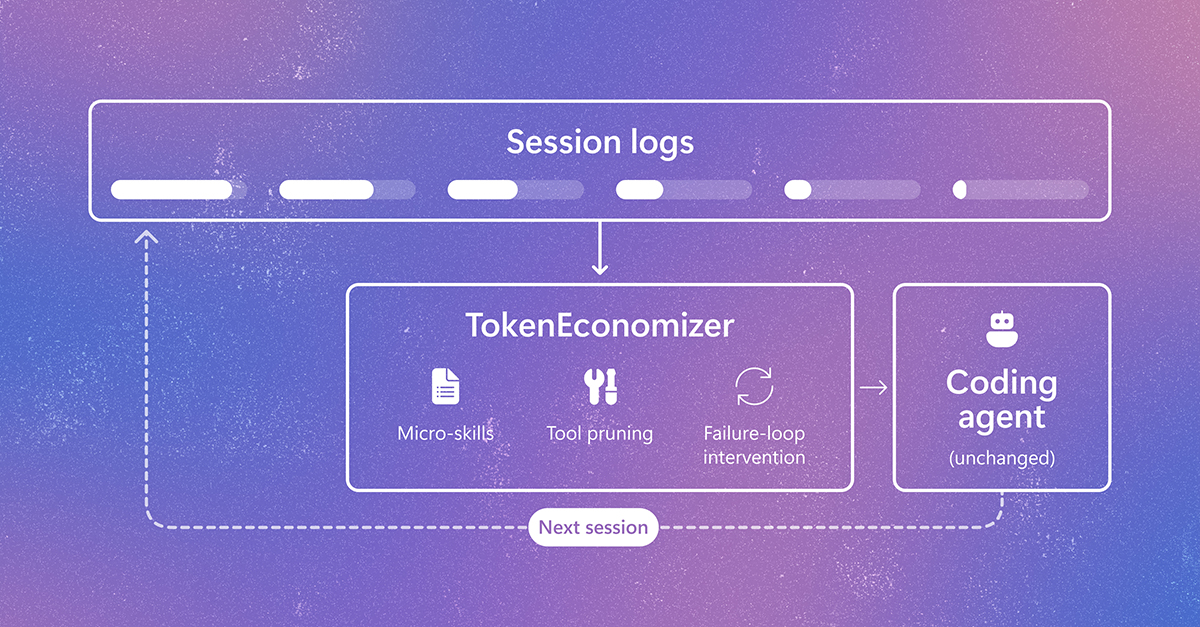
AI coding agents are increasingly help developers fix bugs and build features largely on their own, but every interaction with their models consumes tokens. In each session, an agent sends instructions, tool descriptions, and session history to its model. Most efforts to reduce this cost focus on individual tasks. Yet developers return to the same […] The post TokenEconomizer: Learning from Experience to Make AI Coding Agents More Efficient appeared first on Microsoft Research.
MIT News · Artificial Intelligence· news.mit.eduNov 13, 2026