A weighted Hilbert-space framework is developed and sufficient conditions under which the row-stochastic design converges faster even with a smaller spectral gap are derived, by using a Rayleigh-quotient and Loewner-order eigenvalue comparison.
Bing Liu, Boao Kong, Limin Lu et al.· arXiv.org· 0 citations
This work empirically verify that the weak formulation, with a proper choice of test function and integration domain, effectively filters noisy data and explains why a weak form loss function is analogous to fitting a model to filtered data and provides a practical way to parameterize the weak form.
Xuyang Li, J. Harlim, R. Maulik· arXiv.org· 1 citation· ⚡1
A single pre-training pipeline that builds transformer-based imputation specialists through three components: an entry-wise featurization that recasts imputation as supervised prediction over row--column context, a synthetic data generator with pluggable missingness modules, and prior-data fitting on millions of synthetic tables.
Jacob Feitelberg, Dwaipayan Saha, Kyuseong Choi et al.· 2 citations· ⚡1
This work proposes an efficient, model-agnostic framework that asynchronously updates node features across layers, unlike standard synchronous message passing, and shows theoretically that the framework's sensitivity bound decays more slowly with depth than synchronous message passing.
Kushal Bose, Swagatam Das· arXiv.org· 0 citations
Reach audiences
Advertise in front of researchers, engineers, and readers.
Across various physical and biomedical problems, where direct parameter measurements are prohibitively expensive or unattainable, Neptune significantly outperforms existing methods, achieving robust parameter estimation from as few as 45 measurements and reducing parameter estimation errors by up to two orders of magnitude.
Xuyang Li, Mahdi Masmoudi, R. Gharbi et al.· arXiv.org· 1 citation
Federated learning systems typically allocate gradient compression by link speed. This is sensible when bandwidth and data informativeness align. However, under non-IID data, these signals often decorrelate or invert. A bandwidth-driven allocator then risks compressing the most informative gradients hardest. We propose HeteRo-Select, a framework that replaces bandwidth with a per-client informativeness score as the primary driver of compression. The score jointly governs three decisions per round: client selection, compression ratio, and server aggregation weight, with bandwidth retained only as a hard ceiling. Score-proportional selection provably reduces the effective heterogeneity of the chosen subset; score-proportional compression provably lowers aggregate top-$k$ error at fixed traffic. Under the exact FedCG simulation protocol, HeteRo-Select delivers a $1.78\times$ speedup and an $18.2\%$ reduction in traffic on CIFAR-10. The same configuration, unchanged, scales from a $7{,}850$-parameter logistic regression to an $11.27$M-parameter ResNet-18, hitting the accuracy target on three of four benchmarks. When bandwidth and informativeness are deliberately anti-correlated, the method still achieves the target accuracy with less traffic than the normal-bandwidth run.
Md. Akmol Masud, Md Abrar Jahin, Mahmud Hasan· 0 citations
This work proposes neural network nudging, a data-driven method for learning nudging terms in nonlinear state space models and establishes a theoretical existence result based on the Kazantzis--Kravaris--Luenberger observer theory.
This paper introduces, for the first time, exact constrained reformulations for direct metric optimization (DMO) problems, which can be effectively solved by exact penalty methods and is expected to be applicable to a wide range of DMO problems for binary IC and beyond.
Le Peng, Y. Travadi, Chuan He et al.· arXiv.org· 2 citations
PEM-UDE, a method that combines prediction-error methodology with universal differential equations to discover governing equations from limited, noise-corrupted observations, yields a multi-scale neural mass model that ties single-neuron parameters to macroscopic network dynamics and predicts a relationship between connection density, dominant oscillation frequency, and synchrony.
Anthony G. Chesebro, David Hofmann, V. Dixit et al.· 1 citation
The Continuous Evolution Pool (CEP), a replay-free framework that maintains a dynamic pool of specialized forecasters, is proposed, which employs a retrieval mechanism to identify the nearest concept based on gene similarity, an evolution strategy to spawn new forecasters upon detecting distribution shifts, and an elimination policy to prune obsolete models under memory constraints.
Tianxiang Zhan, Ming Jin, Yuanpeng He et al.· arXiv.org· 3 citations
This article presents the first study on the lowest cost required to find a monotone classifier whose error is at most $(1 + \epsilon) \cdot k^*$ where $\epsilon \ge 0$ and $k^*$ is the minimum error achieved by an optimal monotone classifier.
Yufei Tao· Journal of computer and syst...· 0 citations
This is the first global convergence and recovery result for EM or Gradient EM beyond the special case of m=2, and it is proved that with only mild over-parameterization, randomly initialized gradient EM converges to the ground truth with polynomial time and samples.
Mo Zhou, Weihang Xu, Maryam Fazel et al.· arXiv.org· 2 citations· ⚡1
A weeklong summer workshop brought higher education faculty to campus to explore how AI and machine learning materials can be adapted for their classrooms.
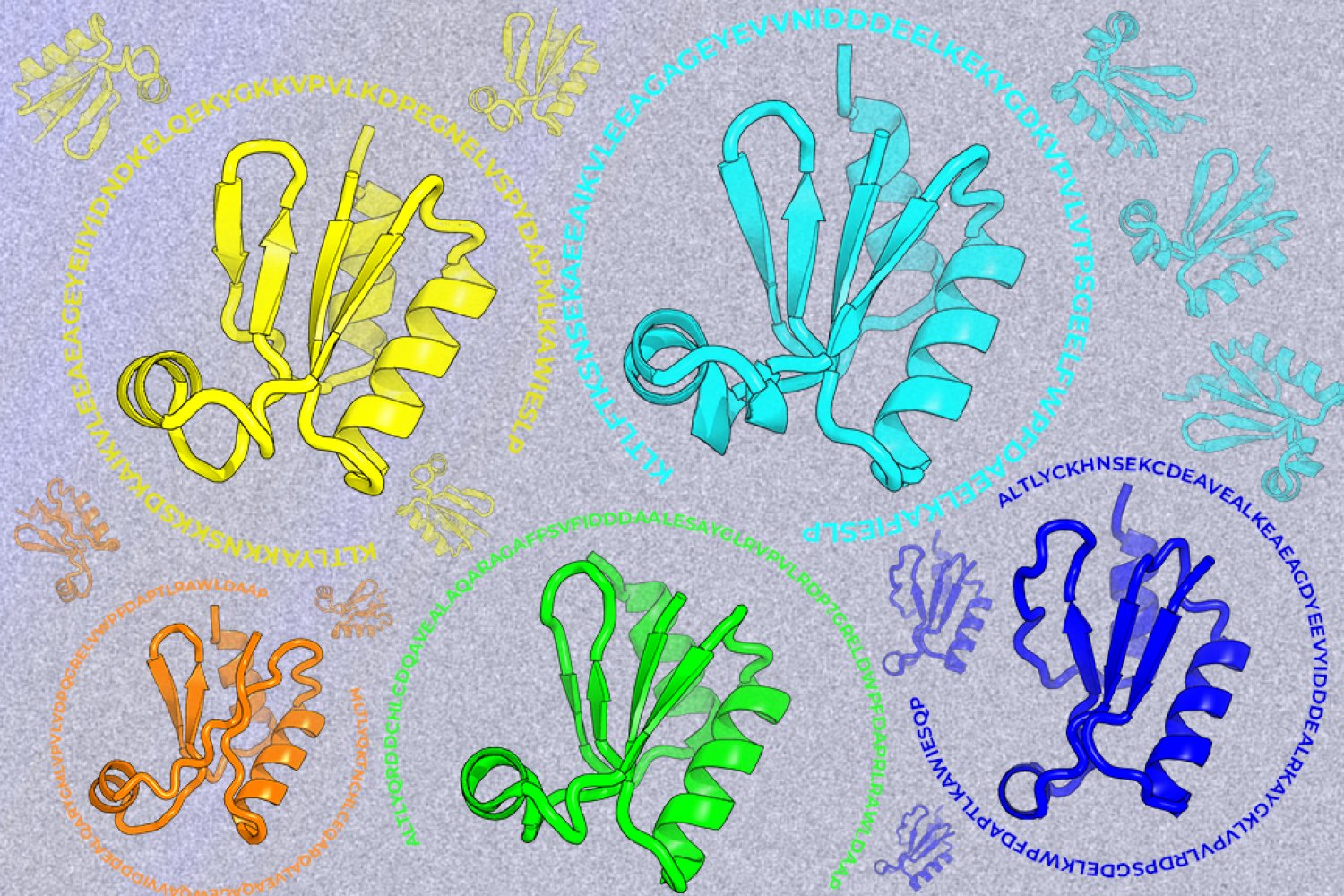
A new machine-learning framework aims to improve the success rate of computational protein design while moving away from results that reproduce sequences found in nature.
MIT News · Artificial Intelligence· news.mit.eduAug 24, 2026