A novel quantum generative model for synthesizing tabular data by proposing a quantum generative adversarial network architecture with flexible data encoding and a novel quantum circuit ansatz for effectively modeling tabular data is introduced.
P. Bhardwaj, Caitlin Jones, Lasse Dierich et al.· Scientific Reports· 2 citations
The LZ penalty is introduced, a penalty specialized for reducing degenerate repetitions in autoregressive language models without loss of capability and without instances of degenerate repetition, and enables state-of-the-art open-source reasoning models to operate with greedy decoding without loss of capability and without instances of degenerate repetition.
Antonio A. Ginart, Naveen Kodali, Jason Lee et al.· 0 citations
This study provides a theoretical analysis showing that gradient heterogeneity, together with Hessian heterogeneity, degrades the convergence of gradient-based methods such as SGD, while sign-based methods are substantially less sensitive to this effect.
Simulation results confirm the effectiveness and benefits of DMs in generating neighbor velocity estimates in a four-UAV swarm coordination task using Deep Reinforcement Learning (DRL), and explore the integration of DMs with RL and DT.
Comprehensive experiments on four molecular benchmarks, including the four large-scale Open Graph Benchmark datasets, substantiate the effectiveness of hyperbolic positional encodings in enhancing the performance of Graph Transformers and provide extensive theoretical underpinnings to offer insights into the working mechanism of the HyPE framework.
A comprehensive re-evaluation of two memory-based methods for self-improving agents is conducted, broadening the scope of evaluation along two axes and hypothesizing that task and environment underspecification contribute to this fragility.
Qinyuan Ye, Yu Li, Yada Pruksachatkun et al.· 1 citation
Language model tokenizers are typically selected with minimal evaluation, despite the fact that their design choices directly impact model capabilities. This can be partly attributed to a limited understanding of which tokenizer properties affect which aspects of downstream performance. We introduce TokEval, a framework of tokenizer evaluation metrics that goes beyond standard measures like fertility and compression rate to capture linguistically and structurally meaningful properties, e.g., UTF-8 character boundary integrity and digit place-value boundary alignment for mathematics. To validate whether these metrics are predictive of downstream model performance, we conduct controlled language model pretraining experiments, varying solely the tokenizers'training data mixture, pretokenization strategy, and training algorithm. We evaluate the resulting models on bits-per-byte (a tokenizer-agnostic version of perplexity) and several benchmarks, spanning linguistic understanding, mathematical reasoning, and code generation. Our experiments suggest that different intrinsic properties have different impacts on model abilities: information-theoretic metrics predict language modeling abilities (Spearman rho up to 0.80), while structure-sensitive metrics, such as those measuring digit and line-break handling, correlate with task accuracy. We hope TokEval enables more principled tokenizer evaluation, replacing pretraining sweeps with intrinsic measurement wherever the two agree.
This work proposes a multi-dimensional, primitive based framework for dynamic contrast-enhanced MRI reconstruction that disentangles the underlying anatomy, the dynamic contrast enhancement, and residual motion into separate temporal basis functions, thereby enabling a geometrical interpretation of the representation.
Veronika Spieker, Wenqi Huang, Cemre Ariyurek et al.· 0 citations
This work investigates the use of auxiliary k-space magnitude information for accelerated steady-state dynamic MRI reconstruction, and demonstrates strong consistency of k-space magnitudes across time-frames.
Mahdi Saberi, Y. Alçalar, Merve Gülle et al.· 0 citations
Analysis of the pre-trained embedding geometry of a small sentence transformer (SBERT) and classic SLM reveals that pre-trained embedding geometry is associated with classification performance and reveals a counterintuitive finding that a structured input that would help a human reader does not improve the SLM performance.
Emma Ceccherini, Daniel Lawson, Anjulika Salhan· 0 citations
TSN4PI, a unified framework for tracking the evolution of political ideologies on social media, includes two core modules: the PIDN and the PIPN, which employs temporal graph neural networks to predict future ideological shifts, enabling comprehensive analysis of ideology presence, intensity, and evolution.
This work presents a novel world model formulation where the reward prediction only depends on a subset of structured, symbolic components of the whole latent state, and demonstrates the strong generalisation properties of this approach over purely neural methods.
Isidoro Tamassia, Lennert De Smet, Giuseppe Marra· 0 citations
A weeklong summer workshop brought higher education faculty to campus to explore how AI and machine learning materials can be adapted for their classrooms.
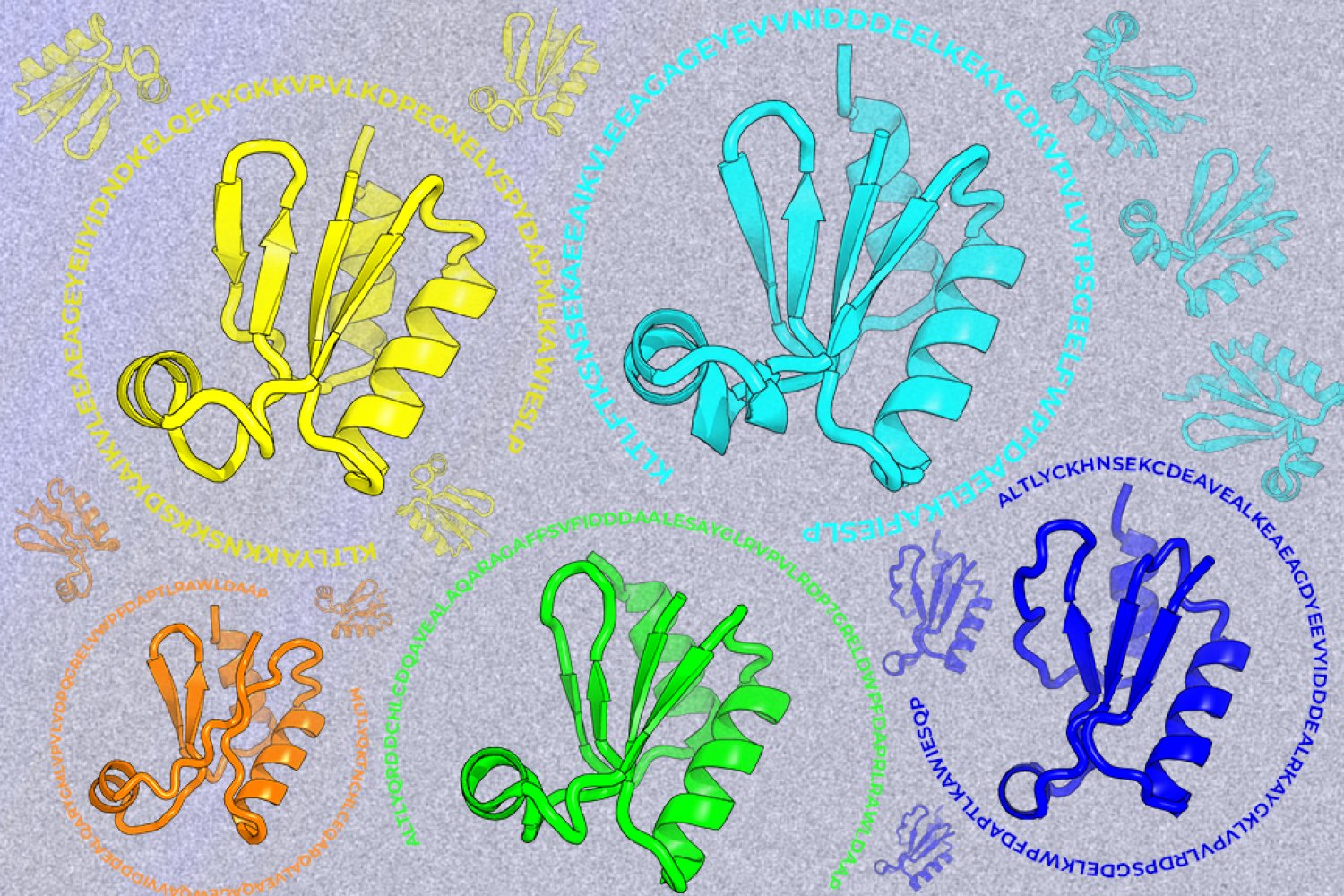
A new machine-learning framework aims to improve the success rate of computational protein design while moving away from results that reproduce sequences found in nature.
MIT News · Artificial Intelligence· news.mit.eduAug 24, 2026