This work compares four reward designs that span lexical suppression, anti-refusal shaping, rubric-based broad answering, and an explicit refusal contrast, and shows that optimization success is not equivalent to behavioral unlearning: RWKU forget scores, held-out completion audits, terminal training-rollout audits, and training dynamics can point to different conclusions.
Let $\varepsilon_1,\ldots,\varepsilon_n$ be independent Rademacher signs and let $a=(a_1,\ldots,a_n)\in\R^n$ satisfy the normalization below. For the normalized Rademacher sum, we determine how its higher moments depend on the fourth-order mass. Combining a sharp fixed-q moment envelope with a separate argument below the convexity threshold gives the Gaussian stability inequality for the full range $p\geq4$ of this linear-in-q bound. The same fourth-order framework determines the sharp finite dimensional $L_p/L_4$ Khintchine constant for $p\geq5$, with the flat coefficient vector as the extremizer. These results settle the conjectures of Jakimiuk and of Bara\'nski, Murawski, Nayar, and Oleszkiewicz stated below. We also prove Jakimiuk's conjectured quadratic stability estimate at $p=3$. The resulting bounds retain information about sparsity and effective dimension, with applications to Rademacher random projections and randomly signed errors; those applications are not developed further here. Their Laplace-transform form also gives coefficient-sensitive tail bounds. The proofs are discovered with substantial assistance from ChatGPT 5.6 Sol.
We demonstrate that RL finetuning an LLM using debate, a two-player adversarial game between a generator and a critic adjudicated by a weaker LLM judge, reduces reward hacking compared to a reinforcement learning from AI feedback (RLAIF) baseline. Reward hacking is a central obstacle in RLAIF: as training progresses, the policy learns to exploit systematic errors in its AI judge, degrading task performance, a problem that worsens precisely when the judge is weaker than the policy, the setting most relevant to overseeing increasingly capable AI systems. We study mathematics tasks, where final-answer correctness is verifiable, allowing us to measure reward hacking dynamics. We train a Gemini~2.5 Flash-class policy with a frozen, weaker Gemini~2.5 Flash Lite judge, comparing a single-player RLAIF baseline against debate. While the baseline quickly hacks the judge, debate maintains judge performance throughout training, leading to a higher peak validation accuracy (45\% performance gap recovered) that persists through many RL steps. Additional experiments show that: 1) further weakening the judge leads to faster hacking, but this can be compensated by adding an additional debate round; 2) debate incentives override prompted misalignment; 3) RL using an LLM judge has a smaller train/validation reward gap than RL from verifiable rewards; 4) learning to critique to convince the judge using ground truth labels is possible but slow. Taken together, our results are a positive update on the feasibility of debate, while highlighting that balancing multi-agent training is critical: without player constraints, adversarial training risks defaulting to critic judge-hacking. We show that critique word limits (effective up to 150 words) successfully balance the game and avoid judge hacking, though this introduces a trade-off by restricting critic expressive clarity.
Zachary Kenton, Lili Janzer, Rory Greig et al.· 0 citations
Anomaly detectors are hardest to deploy exactly where training data is scarcest: a newly commissioned production line has a handful of verified"golden"samples and no machine-learning engineer on the factory floor. We present a training-free human-in-the-loop framework in which a domain expert corrects a PatchCore detector by direct memory bank editing: no retraining, no gradients, no original training data. A false-positive correction inserts the reviewed image's normal patches through a self-calibrating novelty gate admitting only those beyond the median pool-normal nearest-neighbour distance. From a bank built on only ten golden samples, operator corrections close a median 66% of the gap to an uncorrected fully trained bank (mean 80%, raised by three categories that overshoot parity), significantly improving 12 of 15 MVTec AD categories and harming none: ten samples plus corrections outperform hundreds of samples without them. On already-trained banks the headroom is smaller and concentrated where the bank undersamples normal appearance (gated: toothbrush +0.10, metal nut +0.09, zipper +0.05, screw +0.05), and no category except grid is significantly harmed. Evaluation uses a held-out protocol (20 splits per category, Holm-corrected Wilcoxon), because corrected images entering the bank inflate naive evaluation toward AUROC 1.0 by memorisation. Passive and active querying are statistically indistinguishable; a matched-label-budget control attributes gains to deployment-time label production at 43% of exhaustive-review cost; a defect-memory extension fails decisively. Feedback is simulated from ground truth; live expert trials, where mislabelling is costliest on small banks, remain future work.
Ayusha Abbas, Saram Abbas, K. Adhikari· 0 citations
Reach audiences
Advertise in front of researchers, engineers, and readers.
Short-duration heavy-rainfall warning determines whether 1 h rainfall will exceed a threshold within a target-station neighborhood over the next few hours. Multitemporal infrared and water-vapor observations from the Fengyun-4A Advanced Geostationary Radiation Imager (FY-4A AGRI) capture cloud-top cooling, moisture evolution, and cloud expansion before substantial surface rainfall develops. However, most deep-learning nowcasting methods convert these signals into local warnings by post-processing gridded precipitation predictions, preventing station-neighborhood event targets from directly supervising the satellite-to-station learning pathway. We propose MAGPIE-Net, which embeds a geographically adaptive, differentiable grid-to-station mapping in a pathway combining convection-initiation features, multiscale encoding, and auxiliary gridded precipitation diagnosis. Station-neighborhood event losses thereby constrain the satellite representation and its mapping to irregular station locations for 0-3 h event prediction. In independent 2023 warm-season tests over central and eastern China, critical success index (CSI) values under the primary 40 km/20 mm h-1 definition were 0.371, 0.304, and 0.238 at 0-1, 1-2, and 2-3 h. Across episodes, MAGPIE-Net achieved a detection rate of 65.1% and a mean lead time of 64.6 min, compared with 23.6% and 18.3 min for the best gridded-output baseline, and remained superior for smaller neighborhoods and the 50 mm h-1 threshold. During the critical early-warning stage, when antecedent 1 h rainfall within 40 km remained below 1 mm, MAGPIE-Net detected 51.9% of episodes with a mean lead time of 38.5 min. These results show that event-oriented satellite-to-station modeling converts multitemporal geostationary cloud and moisture observations into local heavy-rainfall warnings more effectively than gridded-precipitation modeling.
Xiang Lin, Yunying Li, Chengzhi Ye et al.· 0 citations
A validity theory and audit with three components: two-sided validation of nuisance removal and response preservation, all-optima identification of downstream conclusions, and uncertainty propagation after validity is established is developed.
This work addresses one of the most pervasive obstacles to applying AI in real-world drug development by addressing conformal prediction framework tailored to label shift by weighting conformal scores using marginal label probability ratios and enhancing the trustworthiness of AI-driven predictions.
Hyeonsu Lee, Juyeong Kim, Erkhembayar Jadamba et al.· 0 citations
Bayesian imaging inverse problems often require sampling from high-dimensional posterior distributions. While recent score-based and diffusion models provide expressive Bayesian priors, their sampling procedures remain inherently sequential and computationally expensive for large-scale imaging applications. We propose PiX-MC, a time-parallel posterior sampling framework based on proximal Langevin dynamics and Picard iteration. The proximal-likelihood formulation exploits the fact that many imaging likelihoods admit efficient, problem-specific proximal operators, while Picard refinement exposes parallelism across discretization nodes and naturally supports multi-GPU implementation. To further improve practical scalability and sampling performance, we develop multi-block and annealed variants of the proposed framework. We establish convergence guarantees under transparent assumptions, accommodating non-log-concave posteriors, imperfect learned score models, multi-block implementations, and annealing schedules. Experiments on a diverse collection of imaging inverse problems demonstrate that PiX-MC substantially reduces wall-clock time while preserving reconstruction quality. On a $512\times512\times80$ sparse-view computed tomography (CT) problem, annealed multi-block PiX-MC achieves up to a $50\times$ runtime speedup over the standard Langevin sampler using eight GPUs.
Deliang Wei, Evan Bell, Wenhan Guo et al.· 0 citations
Elimination geometry is developed, a typed, native-loss, audit-oriented framework for studying when locally optimal objects can be realized by a shared deployment rule and derives native defects from the original objective.
We present rl-triton, an open-source library of high-performance GPU kernels for reinforcement learning credit assignment, implemented in Triton. The core contribution is a unified associative scan framework that recasts seven distinct RL estimation algorithms - Generalized Advantage Estimation (GAE), V-Trace, Retrace($\lambda$), TD($\lambda$) returns, discounted returns, eligibility traces, and episodic prefix sums - as instances of a single first-order linear recurrence solved in $O(\log T)$ parallel steps. All algorithms share the same associative scan operator, with algorithm-specific fused Triton kernels constructing their recurrence coefficients on-chip. We verify the associative operator algebraically and define the treatment of terminated and truncated episodes explicitly. Benchmarks show a 1.6-5.70$\times$ full-call speedup over a vectorized torch-compile baseline in the massively parallel simulation regime (thousands of environments, short rollouts). The reported range covers all seven algorithms on both GPUs, both with and without per-step truncation handling. For most algorithms, speedups increase at longer sequence lengths, as the baseline requires more scan stages as $\log T$ grows, each adding an intermediate HBM round-trip. The library is available at https://github.com/simonsays1980/rl-triton.
A benchmark for EEG OOD detection is introduced, a broad range of methods are evaluated, and complementary methods for both aspects can be combined to form a robust safety net for the deployment of EEG-based machine learning models in real-world applications are demonstrated.
Pretrained molecular language models are increasingly used as molecular encoders for learning structure-property relationships. However, their practical suitability for molecular discovery within and beyond their pretraining domain remains unclear. Herein, we systematically benchmark four molecular language models across six virtual molecular libraries spanning drug discovery, organic materials, and catalysis. Native molecular language model embeddings show substantial variation in discovery performance across libraries, whereas molecular fingerprints provide a consistently strong and robust baseline. Consistent with a potential domain-representation mismatch, we show that explicit domain adaptation substantially improves representation performance. Fine-tuning molecular language model encoders on structures from the target virtual library consistently improves sample efficiency, with several adapted encoders emerging as the top-performing representations across the benchmark tasks. These results show that molecular representation quality depends strongly on the target domain and that explicit adaptation can improve the practical utility of molecular foundation models. More broadly, our findings establish domain-adapted molecular representations as a promising strategy for sample-efficient adaptive decision making in virtual screening and self-driving laboratories.
Henrik Wille, Luis-Finley Schütz, Felix Strieth-Kalthoff· 0 citations
A weeklong summer workshop brought higher education faculty to campus to explore how AI and machine learning materials can be adapted for their classrooms.
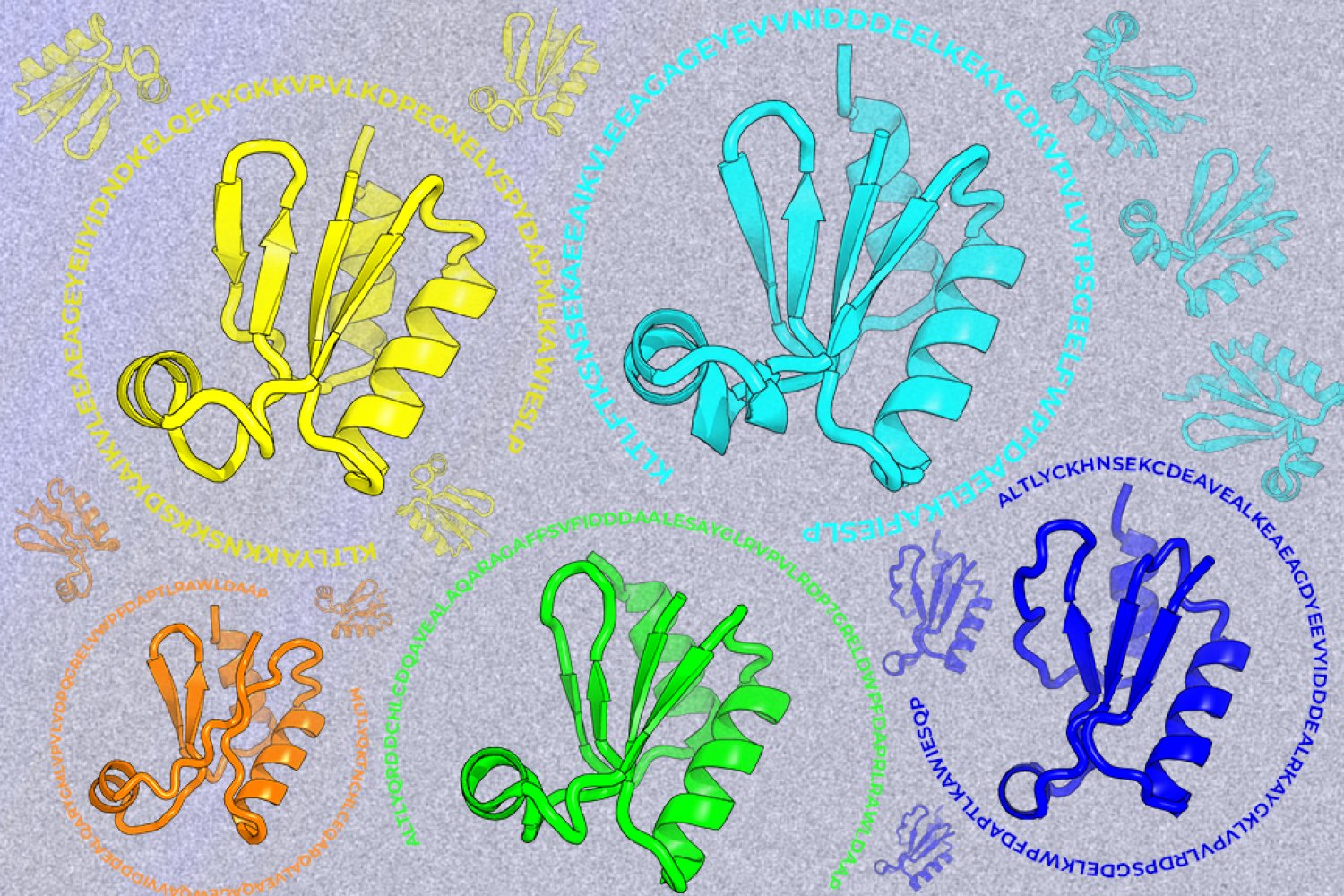
A new machine-learning framework aims to improve the success rate of computational protein design while moving away from results that reproduce sequences found in nature.
MIT News · Artificial Intelligence· news.mit.eduAug 24, 2026