Interactions are introduced as a fine-grained tool to analyze prompt sensitivity of LLMs and it is discovered that subtle changes to prompts can trigger severe instability in interactions, even when the outputs of the LLM remain the same.
Ruiyang Qin, Qingzhuo Wang, Tianhao Wang et al.· 2 citations· ⚡1
This work proposes DART-SD (Diamond-topology Aware Retrieval and Tuning for Self-Distillation), a novel framework that shifts the paradigm from global forcing to topology-guided localized correction, and significantly outperforms traditional full-trajectory baselines.
Hangrui Xu, Jiarui Wang, Yang Yang et al.· 0 citations
The Gramian Chebyshev Neural Operator is introduced, a physics-based, variable-rate compressor that identifies a sample-dependent set of path directions that achieves better reconstruction accuracy at the same payload - or lower payload at the same accuracy - than neural feedback baselines, and transfers to unseen antenna counts without retraining.
This work proposes Physics-Unrolled Hybrid Neural Operator (PU-HNO), a three-stage cascade that predicts high-fidelity indoor radio maps from low-fidelity ray-tracing outputs and scene priors by progressively capturing reflection, diffraction, and scattering effects, rather than treating radio maps as generic images.
Rafid Umayer Murshed, Saif Ur Rahman, Mingyue Tang et al.· 0 citations
Reach audiences
Advertise in front of researchers, engineers, and readers.
This work introduces SparsePR, which combines Response-Coupled Partitioning with Probe-Fitted Residual Reconstruction and consistently reduces attention-reconstruction error across four heterogeneous video generation and world models.
P. Taghavi, Reza Langari, Gaurav Pandey· 1 citation
The detachment mechanism of Forward-Forward (FF) is reinterpreted as a scheduling primitive: given a local objective, detaching a block's output removes downstream gradient dependencies, making its backward pass ready when its forward pass finishes.
The system reduces supervisory triage latency from 72 hours to real time (~10 seconds per session), enabling proactive intervention in high-risk cases and addresses the cold-start problem through Bayesian priors and implements timestamp-based modality synchronization for robust multi-modal fusion.
Shreeya Sharma, Ravish Gupta, Saket Kumar et al.· 0 citations
Recent work has shown that large language models (LLMs) exhibit strong numerical sequence modeling capabilities and show promise in time-series prediction. While LLMs display in-context learning capabilities, the mechanisms with which they accomplish time-series prediction remain unclear. Specifically, whether they truly understand the underlying structure, which at a minimum requires reasoning over first differences in the sequence of numbers. To study this, we investigate Llama 3.1-8B from a mechanistic interpretability point of view. Mechanistic interpretability is an emerging field concerned with the reverse engineering of the algorithms learned by neural networks such as LLMs. To assess Llamas'numerical sequence modeling capabilities and to facilitate our mechanistic interpretability analysis, we create a sequence modeling task that cannot be solved without picking up structural cues. Specifically, we sample n random numbers and repeat them with an offset. We find that Llama displays strong performance on our tasks suggesting that it can pick up on the underlying structure. To understand the mechanisms that allow it to do so, we perform probing experiments and activation patching based counterfactual analysis. Probing reveals that the model computes and stores first differences in its internal representations without explicit supervision, indicating that it tracks structural information about the sequence. Activation patching reveals that Llama retrieves the relevant first-difference with a mechanism similar to an induction circuit and subsequently adds it to the current value. Notably, our work represents one of the first studies to identify this form of concept induction in LLMs.
Rahul Chowdhury, Timothy Rupprecht, Senhao Cao et al.· 0 citations
Vector-Symbolic Policy Gradient (VSPG), a discrete-action actor that represents each action by a unit-norm hypervector and scores it by similarity to the encoded state, connects VSA action memories, log-linear policy gradients, and kernel policy search while providing a quantitative robustness guarantee.
Ryozo Masukawa, Sanggeon Yun, Sungheon Jeong et al.· 0 citations
This work introduces the missing candidate-free control under the same maximum output-token allowance and stratify by the number of correct candidates, finding that conditioning on an all-wrong candidate pool lowers accuracy relative to a fresh solve.
Learned restraint through least-privilege aware post-training is useful as an additional control layer for tool-using agents in executable terminal and MCP environments, but it does not replace permission gates and sandboxing.
Coupled-cluster theory defines the accuracy standard for molecular electronic-structure properties but scales too steeply for routine application, whereas density-functional theory is affordable yet systematically biased. We resolve this trade-off with a single equivariant network, MEHnet-MG, that predicts an effective one-electron Hamiltonian from one inexpensive B3LYP/def2-SVP calculation and derives a broad suite of properties from it (energy, optical gap, dipole, quadrupole, polarizability, Mulliken atomic charges, and Mayer bond orders) at coupled-cluster accuracy across nine main-group elements, including the under-served phosphorus, sulfur, and chlorine chemistries. The model is trained on a new in-house dataset of multi-property labels computed at the CCSD(T) level for all nine elements. On a held-out test set, it reduces the error of every property by a factor of 3.8 to 230 relative to semi-local, hybrid, and double-hybrid DFT (referenced to composite CCSD(T)/cc-pVTZ; Methods), while adding only ~25 ms wall time per molecule, delivering coupled-cluster-quality predictions at the cost of a single DFT calculation. Critically, deriving every property from a predicted Hamiltonian rather than pooling per-atom features builds the correct size-scaling into the model architecture: on pi-conjugated oligothiophenes it matches finite-field CCSD polarizability and the EOM-CCSD optical gap to ~2% at the largest sizes where those references remain affordable (44 and 37 atoms, where a single CCSD field point already costs ~500x the model's entire inference) and extrapolates the corrected trends to 58-atom chains, a regime where pooling-based architectures fail by construction. Accurate extrapolation is therefore set by the model's inductive bias rather than by the training data.
A weeklong summer workshop brought higher education faculty to campus to explore how AI and machine learning materials can be adapted for their classrooms.
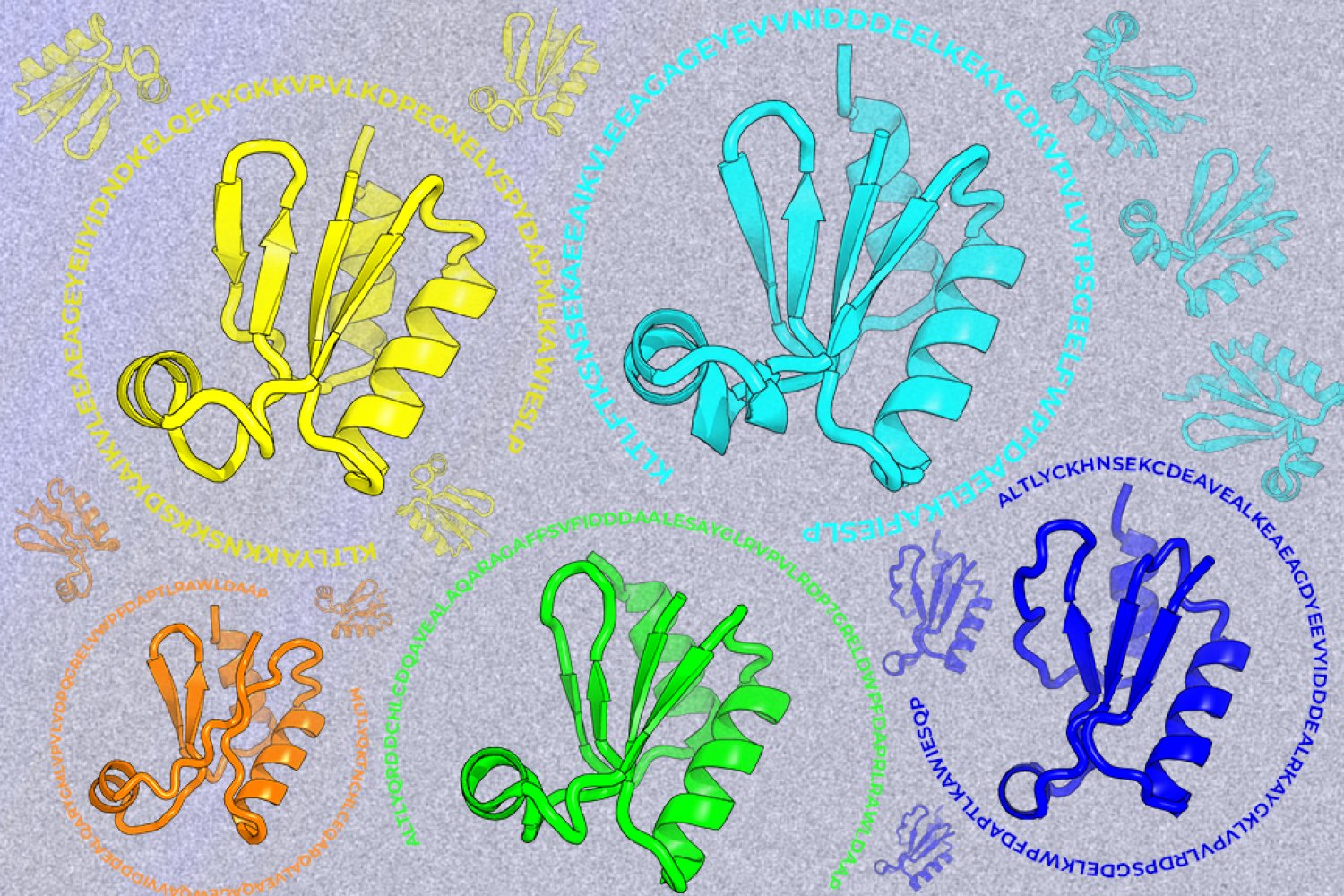
A new machine-learning framework aims to improve the success rate of computational protein design while moving away from results that reproduce sequences found in nature.
MIT News · Artificial Intelligence· news.mit.eduAug 24, 2026