Large language models (LLMs) have demonstrated strong capabilities in handling long-context tasks, but processing such long contexts remains challenging due to the substantial memory requirements and inference latency. In this work, we discover that certain attention heads exhibit sequential consistency in their attention patterns, which can be persistently identified using a coefficient-of-variation-based algorithm. Inspired by this observation, we propose CateKV, a hybrid KV cache method that retains only critical token information for consistent heads, thereby reducing KV cache size and computational overhead, while preserving the majority of KV pairs in adaptive heads to ensure high accuracy. We show the unique characteristics of our algorithm and its extension with existing acceleration methods. Comprehensive evaluations on long-context benchmarks show that, while maintaining accuracy comparable to full attention, CateKV reduces memory usage by up to $2.72\times$ and accelerates decoding by $2.18\times$ in single-sample inputs, and boosts throughput by $3.96\times$ in batch scenarios.
Haoyun Jiang, Haolin Li, Jianwei Zhang et al.· 0 citations
Expected-cost constraints can still permit rare, high-cost events. Monte Carlo conditional value at risk (CVaR) gradients can be noisy at high confidence, whereas critics that model an outcome distribution add complexity. We propose BCPPO (Bachelier-Inspired Constrained Proximal Policy Optimization), a proximal policy optimization (PPO) method. Separately initialized cost-prediction networks (critics), trained with random sample masks, produce disagreement that marks predictions sensitive to which state-action regions occur in the training data and to critic training. A Bachelier formula for the expected amount above a reference level converts this disagreement into a smooth policy-update penalty. Gradients from this penalty do not alter the critics, so temporal-difference (TD) critic learning is unchanged. A saturation-aware controller adjusts the mean-cost penalty and stops accumulated error from growing while that penalty is clipped. Deployment retains only the policy network. The disagreement penalty is neither a tail-event probability nor a guaranteed error bound, and it provides no safety guarantee. Across 175 runs with shared tasks, costs, budgets, training steps, and evaluation seeds, no comparator attains both higher mean return and lower mean CVaR than BCPPO in any task. On Push1, BCPPO has no lower return and no higher CVaR than every comparator, with at least one strict gain. These results support a practical balance among reward, caution around cost predictions that vary across trained critics, and policy-only deployment.
Scientific simulations generate collections of physical fields with heterogeneous statistics and dependencies, yet learned compressors often encode those fields independently or rely on a shared encoder without explicitly modeling the structure that remains in latent space. We present CAESAR-LDAR, an error-controlled multivariate learned compressor that augments a shared CAESAR-V backbone with two complementary mechanisms: a trainable orthogonal transform that reorganizes dependence across aligned latent channels, and a causal autoregressive hierarchical prior that captures local spatial structure left after transformation. Orthogonality is maintained through a matrix-exponential parameterization, making the transform exactly invertible without an additional penalty. A common residual-correction stage is applied uniformly to all variants to enforce the requested reconstruction tolerance.
Experiments across combustion, climate, and turbulence data show that the two mechanisms are useful in different regimes. Latent decorrelation helps most when substantial linear cross-channel dependence survives the nonlinear encoder, whereas autoregressive modeling remains effective when the remaining structure is primarily local or spatial. Their combination provides the strongest or near-strongest rate-distortion performance across the evaluated datasets. The global transform adds little computational overhead, while autoregressive coding introduces a larger throughput tradeoff. More broadly, the results suggest a practical design principle for multivariate scientific compression: exploit global cross-channel dependence when it is measurably present in latent space, and use local probabilistic context as a complementary mechanism across a wider range of data regimes.
We resolve the threshold part of Question 4 of the COLT 2025 open problem "Data Selection for Regression Tasks" of Hanneke, Moran, Shlimovich and Yehudayoff. In vector-valued linear regression with square loss $\ell_{(x,y)}(W)=|Wx-y|_2^2$, where $x\in\mathbb{R}^d$, $y\in\mathbb{R}^m$ and the learner is the empirical risk minimizer of minimal Frobenius norm, we prove that the minimal budget of weighted examples that recovers the full-data loss on every finite dataset is exactly $n^*(d,m)=(m+1)d$. We further determine two more values of the weighted selection profile $F_w(d,m,n)$: at the near-threshold budget, $F_w(d,m,(m+1)d-1)=1+\frac{1}{dm^2}$, and at the spanning budget, $F_w(d,m,d)=d+1$ for every $m$, while $F_w(d,m,n)=\infty$ for $n<d$. For the smallest open intermediate cell $(d,m)=(2,2)$ we prove $F_w(2,2,3)\in[13/8,15/8]$ and $F_w(2,2,4)\in[5/4,3/2]$, reduce the conjectured exact values $13/8$ and $5/4$ to a finite moment problem on the circle with at most seven atoms, and establish strong structural evidence for the conjecture. The upper-bound techniques (a fixed-basis conic compression lemma, a determinant-facet rigidity theorem for maximal certificates, and sharp sparsification lemmas for zero-mean weighted point systems) are of independent interest. As a byproduct we correct an erroneous claim circulating in a recent unrefereed preprint, exhibiting an explicit dataset with $m=2$ on which no weighted selection of $2d$ points recovers the optimal loss. All results are new only for $m\ge 2$; the scalar case $m=1$ is due to Hanneke et al.
Guangjian Zhang· 0 citations
Reach audiences
Advertise in front of researchers, engineers, and readers.
Long-context LLM applications such as document summarization and multi-turn agents require generation from prefixes spanning tens of thousands of tokens, making decoding latency a major bottleneck. Speculative decoding (SD) reduces latency without changing model outputs, but its speedup depends on both accepted draft tokens and draft-step latency: Lightweight drafts are fast but lack the capacity to capture long-range dependencies, whereas strong independent drafts recover acceptance but incur growing KV-access cost at long prefixes. We introduce memory-augmented drafting for long-context SD, equipping a strong independent draft with compressed draft-side KV memory: A lightweight adaptor constructs and incrementally updates this memory to retain distant information and exact recent context. The target verifier retains its full KV cache and applies the standard accept/reject rule, preserving SD's lossless guarantee. Experiments on Llama~3.1-8B and 70B targets at prefix lengths up to 32K show that our method reduces draft-side memory by over 70%. It achieves speedups of up to 2.08x and 3.33x , respectively, over autoregressive decoding.
Localized extreme precipitation is a major trigger of urban flash floods and landslides, yet producing nowcasts that combine fine spatial detail with probabilistic uncertainty remains challenging. Here we introduce exPreCast-ENS, a conditional residual diffusion framework that transforms the deterministic 4 km radar nowcaster exPreCast into a 1 km probabilistic ensemble while correcting systematic forecast errors. Conditioning on both the forecast and preceding radar observations lets the ensemble-mean correct the baseline rather than perturb it, while members represent unresolved fine-scale variability. Over the Korean Peninsula, skill improves with ensemble size. In two high-impact events in 2023, a 30-member ensemble recovers 38-47% of heavy-rain pixels missed by exPreCast while retaining approximately 95% of its correct detections and alarming on under 1% of the pixels it correctly left clear. The method generates a 1-h forecast in 3.4 s on a single GPU and yields consistent improvements on the French regional MeteoNet radar dataset.
Dohyun Park, Changhoon Song, Tengyuan Chang et al.· 0 citations
Directly robustifying small-signal stability in AC optimal power flow is challenging since the stability boundary in the original uncertainty space is implicit, highly nonconvex, and changes with the operating decision. This paper exploits an alternative geometry. For a fixed model-specific stability certificate admitting suitable physical lifts, the small-signal stability requirement becomes an affine positive semidefinite constraint in the lifted variables, thereby defining a convex certified safe region. Instead of approximating the nonlinear instability boundary itself, we optimize a sample-wise safe radius in the original uncertainty space and certify, in the lifted space, that the entire power-flow image of the corresponding uncertainty ball is contained in the convex stability region. To this end, a componentwise Perron certificate guarantees existence, uniqueness, and Jacobian regularity of the target AC power-flow branch throughout each ball. An adjoint elimination then provides an exact affine-quadratic representation of the stability-relevant quantities, while rigorous matrix remainder bounds convert their nonlinear variation into finite robust PSD constraints. The resulting radii are certified lower bounds on the distances from empirical samples to failure and can therefore be coupled directly to the distance-based reformulation of a Wasserstein distributionally robust chance constraint, without directly approximating the instability boundary. Numerical studies demonstrate the effectiveness of the proposed framework.
Peptide-protein affinity models are often evaluated with a single data split, obscuring whether they interpolate among measurements for observed targets or generalize across peptide or target shifts. We integrated three sources of quantitative peptide-protein binding data to obtain 11,349 deduplicated pairs and benchmarked ten peptide representations, ESM-2 protein embeddings, and six regressors under peptide-similarity, within-target, and leave-target-out partitions. Across 60 matched representation-regressor configurations, mean test Spearman correlations were 0.462, 0.669, and 0.530, respectively. The top configuration shifted from ECFP-16 count fingerprints with random forest in the first two settings to HELM-BERT with Extra Trees when exact target sequences were excluded. Representation-rank correlations ranged from -0.042 to 0.624 across partitions, whereas regressor-rank correlations ranged from 0.771 to 0.943. Learning curves showed that representation differences were largest with limited supervision and narrowed as training data increased. PeptideCLM-2 adaptation and simple element-wise interaction features provided no consistent gain over a frozen encoder and direct concatenation under the tested protocols. These conclusions are specific to a dataset that pools transformed Kd, Ki, and IC50 measurements and to target exclusion at the exact-sequence level. Peptide-protein affinity benchmarks should therefore align data partitions with the intended use and jointly assess the effects of data scale, molecular representation, and downstream learner.
We present a reinforcement-learning agent that solves symbolic equations step by step, covering both nonlinear closed equations (radicals, exponentials, trigonometric) and a controlled class of restricted-open families requiring a change of variables (CoV) such as completing the square. We cast algebra as an MDP with a dynamic action space and a tree-structured policy (TreeMLP). The main policy learns from reward alone with no supervised solution traces; the CoV substitution comes from a supervised generator interchangeable with a CAS call. On closed equations the agent matches the prior best on CommonCore (0.93 greedy vs. ConPoLe's 0.925) under a single policy. On four hand-designed restricted-open families (quadratic, cubic, quartic, exponential) it reaches 0.79 beam / 0.67 greedy, exceeding the strongest non-learned search (A-star, 0.64). Learned CoV timing has content only on the exponential family, the one requiring a nested CoV, where a natural rule solves none of the held-out equations while the policy solves 75% from reward alone. At 10x scale a sharp seed-level bimodality emerges; a UCB learning-progress curriculum shows a non-significant positive trend toward mitigating it. We do not claim general open-equation solving: every open-equation result is confined to these four controlled families.
Graph positional encodings are widely used in graph neural networks and graph Transformers, yet it remains unclear when the code itself can identify nodes. We study a hybrid distance-spectral encoding that combines anchor-distance profiles with quantized low-frequency Laplacian-energy coordinates. Treating the encoding as an observation map yields a simplex-refined converse, an exact collision factorization \(\kappa_H=\kappa_D\kappa_{S|D}\), and the collision information \(I_H=-\log\kappa_D-\log\kappa_{S|D}\). On random regular graphs, the criterion is made explicit through a bounded-correlation Gaussian-wave surrogate; for actual Laplacian-energy coordinates, we give the distance-conditioned spectral collision condition sufficient for conditional actual-coordinate achievability. Experiments show that \(I_H/\log n\) calibrates localization success, and PE-only structural task probes on Universal Dependencies trees show that hybrid encodings better recover syntactic-tree geometry than distance-only or spectral-only baselines.
Systematic generalization remains a significant challenge in deep learning. In particular, combinatorial generalization - generalizing to new configurations of known factors of variation - is effortless for humans but difficult for standard neural architectures that rely on statistical correlations rather than explicit structural representations. We introduce a new architectural component that embeds structured inductive bias into deep learning: an attention mechanism operating over tensor-product representations (TPRs). Through controlled experiments on compositional tasks, we show that this TPR-attention mechanism outperforms existing architectural components in combinatorial generalization. These results highlight the value of integrating explicit compositional structure into neural attention and point toward a promising path for models capable of systematic generalization.
A supraglacial lake on the Greenland Ice Sheet ends its melt season in one of four ways: it drains rapidly through a hydrofracture, drains slowly across the surface, refreezes in place, or is buried by late-season snowfall. Which one occurs decides whether the meltwater reaches the ice bed. Satellite classifiers recover the outcome accurately but only after the season closes, and how much of a season each outcome actually requires has never been measured. We measure it directly: holding the representation and the classifier fixed, we truncate the input at $14$ cutoffs from 1 May to 31 December, retrain at each, and record the earliest cutoff at which each outcome's per-class $F_1$ reaches a fixed target. The outcomes resolve in a consistent order, two of them months early: rapid drainage by 15 July and slow drainage by 1 August, $92$ and $75$ days ahead of the earliest date a full-season pipeline can be computed at all, with buried and refreeze following at $44$ and $30$ days. Five further learners, from a majority-class floor and $54$ summary statistics to a trigger-based early classifier, leave the ordering intact: every learner that produces a per-class trajectory reproduces it despite end-of-season accuracies differing by up to $18$ percentage points, and it survives leave-one-basin-out evaluation, though not the substitution of machine labels for expert ones in an unseen season. Every feature we compute at day $t$ reads only days up to $t$, at a cost of at most $1.3$ percentage points. A monitoring system should therefore not have one release date: rapid drainage can be flagged on 15 July, three months before a full-season pipeline can be computed at all.
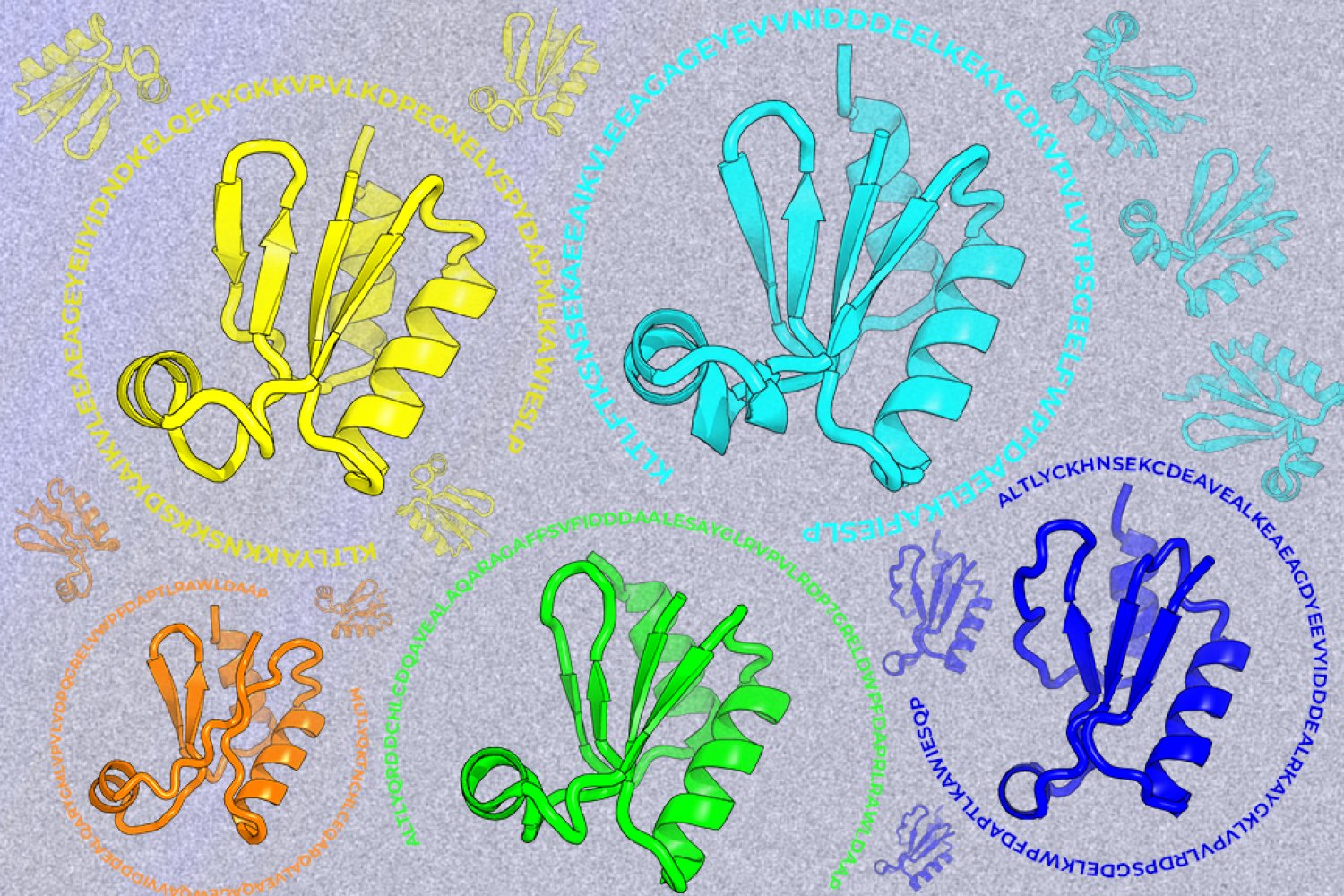
A new machine-learning framework aims to improve the success rate of computational protein design while moving away from results that reproduce sequences found in nature.
MIT News · Artificial Intelligence· news.mit.eduAug 24, 2026
A new method for surgically removing training examples from a model reveals that as datasets grow, the link between what a model learns and what it produces dissolves.