System-one decision models — fast, non-generative networks that emit typed, calibrated probabilistic decisions for machine-to-machine pipelines, of which TypeSafe AI's Jev, trained by Reinforcement Learning for Calibrated Decisions (RLCD), is the announced instance — are audited by hop-level calibration on stationary h...
Anh Khoa Doan Ngoc· Zenodo (CERN European Organi...· 0 citations
본 논문은 재난 환경에서 4족 보행 로봇의 보행, 전도복귀 및 낙하착지를 단일 정책으로 통합하기 위한 제어 프레임워크를 제안한다. 기존의 단일 정책 공동 학습 방식은 상이한 목표를 동시에 다루는 과정에서 학습 시간과 난이도가 증가할 수 있으며, finite state machine(FSM) 기반 다중 정책 전환 방식은 모드 선택 및 전환 규칙에 의존한...
Sung Jae Han, Jung-Yup Kim· Transactions of the Korean S...· 0 citations
A novel federated graph reinforcement learning-based digital twin predictive intelligence, blockchain trust management, and adaptive self-healing control integrated framework called Energy Efficient Federated Digital Twin Framework (EEFDTF) for Blockchain-Enabled Self-Healing Smart Grids to overcome challenges.
Anuj Mangal, Gunaselvi Manohar, D. Seenivasan et al.· International Journal of Com...· 0 citations
This work formalizes the Free Inference dimension dFI(S,N), a combinatorial measure of the environmental complexity a VM agent can handle while preserving trajectory coherence, and proves dFI is strictly smaller than the VC-dimension and relates to the Natarajan dimension up to a path-length factor, capturing the cost...
L. Guedes, E. Haeusler· Lecture notes in computer sc...· 0 citations
Reach audiences
Advertise in front of researchers, engineers, and readers.
We report a twenty-campaign experimental arc on the safety of a goal-directed, model-based causal agent. The first nine campaigns (v1–v9) built the agent and established that its explicit causal module solves the epistemic job it was designed for, while its reward conversion is a property of the world rather than of th...
Oxunjon Ubaydullayev, (autonomous research agent) Aiodam· Zenodo (CERN European Organi...· 0 citations
Pan–tilt–zoom (PTZ) cameras are central to visual counter-UAV surveillance: they steer the optical axis to keep a small, agile target centered and adequately resolved, which tightly couples perception with camera control in a closed loop. Learned PTZ controllers face three obstacles: temporal models that treat the obse...
Coordinated control of multiple soft robotic manipulators is challenging because continuous deformation, distributed actuation, and nonlinear dynamics increase both modeling and policy-learning complexity. This paper proposes a simulation-based reinforcement learning framework for coordinated shared-target tracking usi...
Hong-Fei Yu, Sheng-Kai Liu, Li-Si Liu et al.· Electronics· 0 citations
Continuous advancements in medical device technologies require developing comprehensive frameworks for real-time monitoring, predictive maintenance, and adaptive control of medical devices to ensure patient safety and reliability of devices. Conventional ways of testing and simulation usually require static models, pro...
Anto Lourdu Xavier Raj Arockia Selvarathinam, V. Subha, S. Prathi· Handbook of Smart Healthcare· 0 citations
Code and data: deep reinforcement learning for weekly mosquito-control allocation under an operational capacity ceiling This package reproduces every number, table and figure in the manuscript. Version 2.0.0 extends the original submission with a weekly operational-capacity ceiling, additional algorithms, cross-year va...
Gustave·Kateb· Zenodo (CERN European Organi...· 0 citations
Antibiotics with new mechanisms are highly pursued to address the threat of infections caused by drug-resistant Gram-negative bacteria. Targeting MsbA, a key protein of the lipopolysaccharide biosynthesis pathway, represents a promising strategy to discover new classes of antibiotics. However, currently available MsbA-...
Lei Wang, Bai-Xin Jing, Qing-Xin Liu et al.· bioRxiv· 0 citations
Reconfigurable manufacturing requires robotic workcells that can adapt to changing products, processes, and equipment without extensive redesign or manual reprogramming. This paper presents the R3M framework, a ROS 2 driven integration architecture that connects model based manufacturing knowledge with execution level...
S. A. Syed Asif, Mikel Bueno, Paul Anandan et al.· Robotics and Computer-Integr...· 0 citations
This paper designs a comprehensive fourlayer architecture featuring semantic-aware intent parsing, distributed decision-making, and dynamic resource orchestration and achieves a high constraint satisfaction rate under dynamic disturbance scenarios, thereby guaranteeing fault tolerance, stability, and system robustness...
Si-Yu Yan, Ying Ouyang, Zi-Yi Tang et al.· International Conference on...· 0 citations
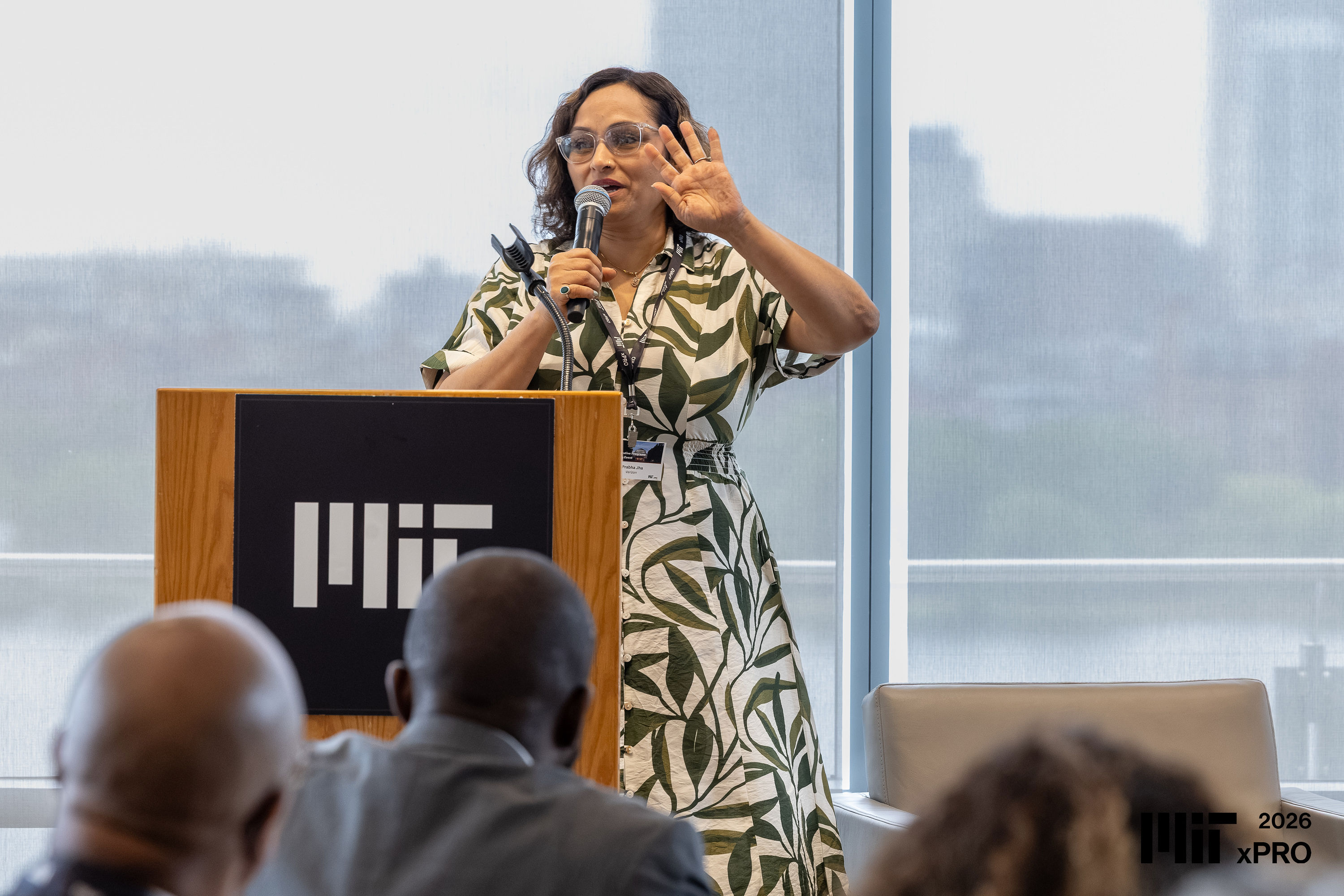
Prabha Jha used her experience with MIT Open Learning’s program for senior executives to develop AI solutions for her employer, Verizon, and to write a book.
Assistant Professor Benjamin Lindquist studies how engineers deliberately injected randomness into early AI, giving rise to deep-learning models that sometimes hallucinate.