Background. RewardBench 2 aggregates pairwise preference accuracy across heterogeneous task families (factuality, instruction following, safety, and others). A single leaderboard score can mask systematic subset specialization, yet standard benchmark reporting rarely tests whether accuracy is independent of task catego...
Alvaro Chaveste-Fernandez· Zenodo (CERN European Organi...· 0 citations
Both TMAD methods are effective alternatives to extraction-based treatment, and intra-jaw and inter-jaw TMAD better preserved anterior torque and occlusal plane stability.
Amer M. Owayda, R. Al-Sabbagh, M. Y. Hajeer et al.· International Orthodontics· 0 citations
Vul4Py is presented, a Python AVR benchmark in which every entry carries a paired oracle: an exploit oracle that must fail on the vulnerable revision and pass on the fixed one, together with a project-native pytest functional oracle that must pass on both.
Bui Tan, Ting Zhang, Ferdian Thung et al.· Lecture notes in computer sc...· 2 citations
Reach audiences
Advertise in front of researchers, engineers, and readers.
Findings indicate that the implementation of Mission Planner can improve navigation precision, travel-time efficiency, and the reliability of payload delivery using reconnaissance drones compared with manual flight operations.
Nur Rachman Supadmana Muda, Dimas Cahyo Nugroho· Cendekia· 0 citations
This paper presents VocalCap, an institution-controlled, browser-based system for self-guided capture of voice and related acoustic signals by participants without technical training, and verify VocalCap's software behavior under the tested browser-engine conditions.
Findings show that functional-only evaluation overestimates agents'ability to satisfy the full requirements of repository-level repair tasks, and introduces SWE-Gate, a repository-level benchmark for software engineering agents that explicitly evaluates review constraint compliance alongside functional correctness.
Xin He, Yan-Lin Wang, Ming-Wei Liu et al.· 1 citation
A case study in a large software development services company found that software professionals experience accountability anxiety, craft identity disruption, meaning and satisfaction erosion, cognitive and workload intensification, and uncertainty distress during organizational AI adoption.
Adam Alami, Elda Paja, Abhishek Tiwari· 0 citations
This repository contains the software and reproducibility materials associated with the study “Factorized Coordinated Double Deep Q-Learning for Multi-User Computation Offloading and Resource Allocation in Mobile Edge Computing.” The proposed Factorized Coordinated Double Deep Q-Network (FC-DDQN) separates the binary l...
Youssef Oukissou, Moulay Amzil, Mohamed Amine Meddaoui et al.· Zenodo (CERN European Organi...· 0 citations
The primary objective of this study was to quantitatively evaluate the clinical rationale and prescription patterns for Cone-Beam Computed Tomography (CBCT) across various dental specialties, specifically investigating how diagnostic indications correlate with field of view (FOV) preferences, patient demographic variab...
Tolga Han EDEBAL, Sedef Kotanlı, Berat Yücedağ et al.· BMC Oral Health· 0 citations
This repository contains the data, software, and reproducibility materials supporting the manuscript “An End-to-End Hydro-AI Framework for Participatory Water Resources Planning: Coupling Agentic Language Models with Physics-Informed Surrogates.” The archived materials include the MODFLOW-2005 benchmark configuration,...
Replication package for the paper submitted to DINAME 2027 (XXI International Symposium on Dynamic Problems of Mechanics, ABCM): "Comparative Analysis of Numerical Methods for Solving the Discrete Algebraic Riccati Equation in Resource-Constrained Embedded Systems". Stabilising a small quadrotor demands feedback above...
Guilherme Ali Abdallah Bassani, Reginaldo Cardoso, Diego Paolo Ferruzzo Correa· Zenodo (CERN European Organi...· 0 citations
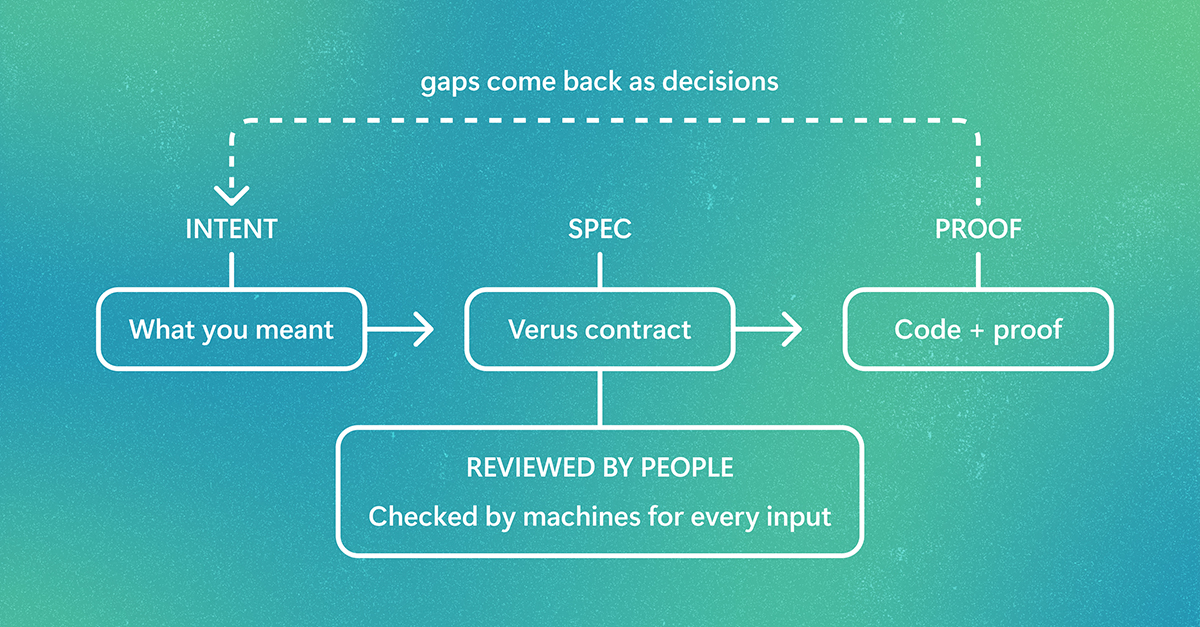
AI agents can generate code at a scale that’s hard for humans to review line-by-line. PDD Kit helps ensure the code is doing what the developer intended by creating formal specifications and testing against them. It converts developer intent into a Verus specification, proves AI-generated code meets it for every input, and uses tests where proofs aren't practical. Developers review intent, not every line. The post Formally verifying agent-written full-stack web apps with PDD Kit appeared first o…
Is your company’s AI sovereign? A practical guide for CIOs on AI vendor lock-in, EU Data Act switching, cloud sovereignty, and testing your exit plan before you need it. The post Sovereignty Is the Option to Leave appeared first on GPT-Lab.
Microsoft Research Blog· microsoft.comOct 30, 2026
Evaluating Microsoft Copilot at enterprise scale requires test data that captures the full complexity of real organizations, yet real enterprise data contains sensitive information that cannot be used for evaluation under any circumstances. The post From synthetic enterprise data evaluations to real Microsoft Copilot AI confidence appeared first on Microsoft Research.
Microsoft Research Blog· microsoft.comOct 29, 2026
Host Sowbhagya Suresh shares some of the latest news and cutting-edge research from across Microsoft—from understanding the challenges facing coding agents to uncovering how people use AI at work and improving extended-range weather forecasting. The post Microsoft Research Focus – Edition #97 appeared first on Microsoft Research.