CoNS-Explorer is developed, which uses reviewed instructional DAGs/SCMs to maintain a shared causal-fact ledger and generate fact-matched direct explanations and contextualized stories and four testable design propositions for adaptive causal explanation.
Abstract
Causal graphs represent structural relationships among variables, yet users must still interpret direction, mechanism, and adjustment conditions in relation to the task at hand. Prior work often compares explanation formats as fixed conditions and pays less attention to how users distribute reasoning across graphs, direct explanations, and stories. We developed CoNS-Explorer, which uses reviewed instructional DAGs/SCMs to maintain a shared causal-fact ledger and generate fact-matched direct explanations and contextualized stories. A controlled survey experiment ($N=240$) compared the two texts as complete presentation packages. In the primary GLMM, the Story condition had a positive but uncertain overall association with accuracy (OR $=1.55$, 95\% CI $[0.34,7.10]$, $p=.572$); a population-averaged GEE showed a significant positive effect (OR $=1.89$, 95\% CI $[1.02,3.48]$, $p=.042$). Task-type interactions localized the clearest advantage to total-effect adjustment. Story also significantly increased situational presence. In a separate system-task and interview study ($N=24$), participants freely used graphs, direct explanations, and stories across three causal models. They established structural anchors with graphs and numerical results, consulted text when direction was unclear, mechanisms were unfamiliar, or multiple paths competed, and checked their judgments against other representations or external evidence. Integrating the two studies, we develop a process framework of structural anchoring, uncertainty triggering, explanation routing, and cross-calibration, together with four testable design propositions for adaptive causal explanation.
A diagnostic benchmark for open-domain, open-form, long-horizon counterfactual causal reasoning, containing 220 what-if questions across STEM, HSS, and Hybrid scenarios, and finds that WhatIfBench remains far from saturated: even the strongest model reaches only a 64.62% final score.
Yu-Cheng Wang, Yuetian Du, Zheng Liu et al.· 0 citations
For decades, public opinion scholars have argued for the need to go beyond measuring isolated political preferences to more richly examine how individuals reason about and justify the interconnections between their preferences. While early efforts used interviews and hand-coding to elicit the network structure of sub...
Sarah Shugars, Xin-Feng Gu· Network Science· 0 citations
Access to real-world information is often noisy and fragmented. Constructing a coherent narrative from such fragments requires models to reconstruct missing spans within a broader storyline, commonly referred to as text infilling, while preserving consistency with both the local context and the global storyline. Despit...
Eftekhar Hossain, John Salvador, Santu Karmaker· 0 citations
Evaluating four state-of-the-art models finds that placing a role in a semantically unrelated context does not suppress role-linked attributes; instead, cross-role attribute concentration increases (pooled BI $+0.047$).
Shaghayegh Kolli, S. Emami, Moreno D'Incà et al.· 0 citations
Causal reasoning is fundamental to human understanding and information organization. People prefer causal explanations because they offer coherence, predictability, and a sense of control. Conversational structures shape how knowledge and perspectives are shared, validated, and amplified in networked publics. Understan...
Zhuo-Yu Shi, Fred Morstatter· Proceedings of the ACM on Hu...· 0 citations
It is suggested that current LLMs often rely on heuristic arbitration strategies when integrating heterogeneous evidence, highlighting a failure mode for tool-augmented decision systems.
Mattia Carletti, Edward Phillips, Fredrik K. Gustafsson et al.· 0 citations
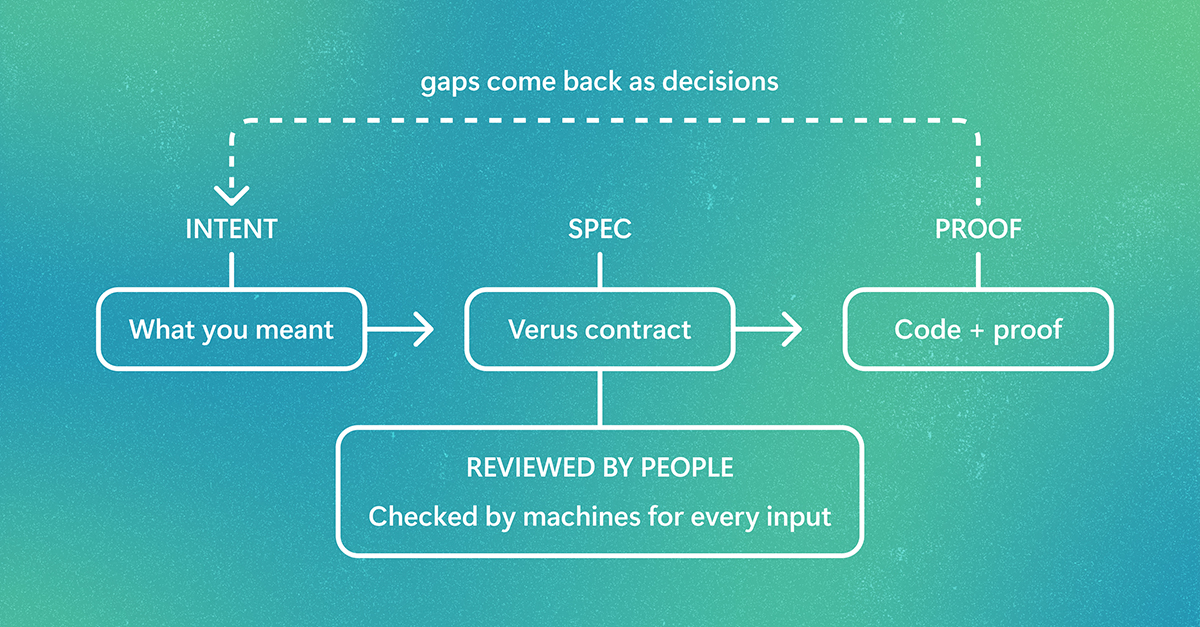
AI agents can generate code at a scale that’s hard for humans to review line-by-line. PDD Kit helps ensure the code is doing what the developer intended by creating formal specifications and testing against them. It converts developer intent into a Verus specification, proves AI-generated code meets it for every input, and uses tests where proofs aren't practical. Developers review intent, not every line. The post Formally verifying agent-written full-stack web apps with PDD Kit appeared first o…
Professor Paris Smaragdis develops computers with superhuman hearing for applications like speech recognition, music understanding, and environmental monitoring.
MIT News · Artificial Intelligence· news.mit.eduOct 23, 2026
During the School of Humanities, Arts, and Social Sciences’ 75th Anniversary Symposium, President Sally Kornbluth said “MIT has never needed your particular insight and guidance more than we do now.”
We use cookies to run the site and, with your consent, for analytics and to show ads.
See our Cookie Policy.