Skip to content

Progress and Analysis of Optimization for Large Language Models Based on Reinforcement Learning

Sep 2026 · Exploring Science Academic Conference Series · 0 citations · 11 references

TL;DR

The boundaries of how reinforcement learning optimizes the reasoning capabilities of large language models under different resource and scale constraints are reviewed, as well as the adaptability of reinforcement learning's optimization of large language models in different scenarios are analyzed.

Abstract

Large language models (LLMs) are one of the current research focuses in society and have extensive applications in various fields. However, when facing complex tasks such as mathematical reasoning at present, it will exhibit problems such as weak generalization ability. Reinforcement Learning (RL) can effectively optimize these issues through reward-guided strategies, thus becoming the core technical path for enhancing the reasoning capabilities of large language models. This article systematically reviews and analyzes the boundaries of how reinforcement learning optimizes the reasoning capabilities of large language models under different resource and scale constraints, as well as the adaptability of reinforcement learning's optimization of large language models in different scenarios. The analysis shows that reinforcement lea rning algorithms are beneficial for aligning model reasoning and improving the reasoning chain of the model; based on reinforcement learning, strategies such as data minimization training and small model optimization can enhance the resource utilization ef ficiency of the model during training; however, the improvement of reinforcement learning algorithms on large language models still has problems such as difficulties in expanding the reasoning boundaries.

Read PDF

Similar papers

#large language models Open access Sep 2026

Reinforcement Learning Methods and Optimization Strategies in Preference Alignment Techniques for Large Language Models

The growing pre-training scale has improved large language models' performance in language generation and knowledge representation. However, their training objectives remain limited to fitting data distributions, thus making it difficult to guarantee that the output satisfies human intentions and safety constraints. Th...

Hong-Yu Jiang · 0 citations
Open access Aug 2026

Large Language Models and Reinforcement Learning: A Taxonomy of Integration Paradigms, Challenges, and Future Directions

This paper highlights the transition from static prediction to sequential decision-making, emphasizing RL’s strengths in long-term reward optimization and interaction modeling, and LLMs’ advantages in semantic understanding and reasoning.

Xi-Qian Lu · 0 citations
Conference Open access 2026

Towards Automated Reinforcement Learning: Applications and Prospects of Large Language Models as Cognitive Components in the Full RL Lifecycle

: Deep reinforcement learning (DRL) has made significant progress in recent years. However, it still faces multiple bottlenecks in real-world applications. Agents suffer from low sample efficiency, and designing effective reward functions remains very difficult. Furthermore, traditional DRL lacks general cognitive abil...

Sheng-Hao Yuan · 0 citations
#large language models Review Open access Sep 2026

A Survey on Reinforcement Learning Optimization Methods for Multi-Agent Collaboration of Large Language Models

The integration of reinforcement learning (RL) into the optimization of multi-agent collaboration for Large Language Models (LLMs) is an important combination of two advanced areas, Multi-Agent Systems (MAS) and LLMs. This paper thoroughly examines the main approaches, evaluation standards, recent progress and existing...

Qian-Ling Zhang · 0 citations
Review Open access Aug 2026

Reinforcement Learning in the Era of Large Language Models: Challenges and Opportunities

A systematic literature review on how RL are adapted and scaled as a fundamental post-training tools and how innovations in the RL pipeline enhance the domain-specific LLMs is conducted.

Qianyue Hao, Lin Chen, Xiao-Qian Qi et al. · 1 citation
Review Sep 2026

Reinforcement Learning Post-Training for Reasoning Large Language Models: Methods, Systems, and Evaluation

Reinforcement learning (RL) has become a central post-training approach for reasoning and agentic large language models (LLMs), particularly when task outcomes can be verified automatically. Comparisons across this literature remain difficult because a reported gain may combine changes to the learning signal, policy co...

Liu Yang, Han Zhu, Zheng-Yang Zhong et al. · 1 citation

Related blog posts

GPT-Lab Aug 28, 2026

We built an AI factory for HVAC control

What does it take to trust AI-driven HVAC optimization? Our AI Model Factory combines agents, machine learning, reinforcement learning and deterministic checks in a governed workflow designed for messy, real-world building data. The post We built an AI factory for HVAC control appeared first on GPT-Lab.

Microsoft Research Blog Jul 30, 2026

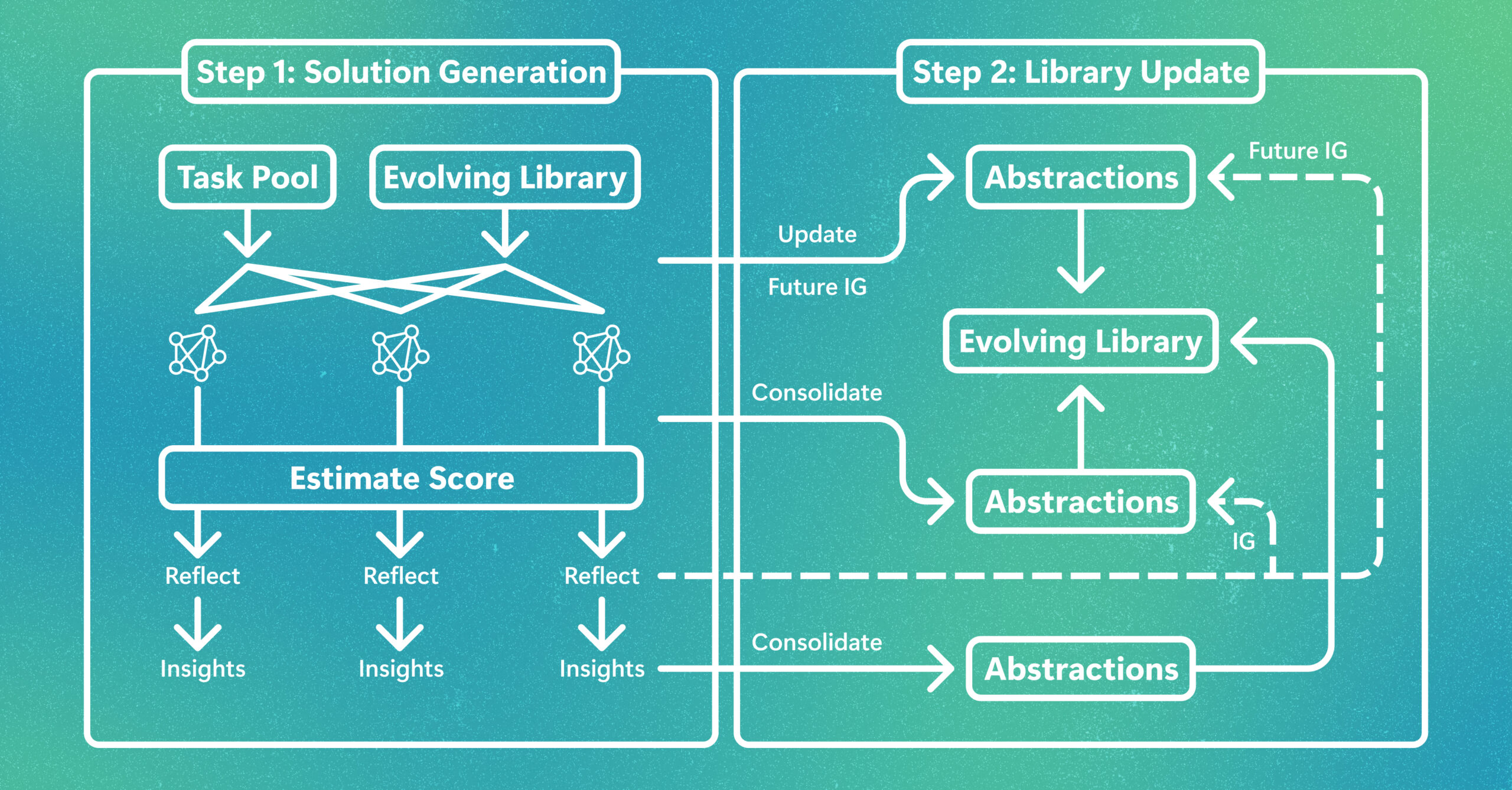
EvoLib: Turning experience into evolving knowledge

LLMs do not get smarter just by remembering more. EvoLib turns experience into evolving knowledge, taking reusable skills and insights that help models learn and adapt across tasks long after deployment. The post EvoLib: Turning experience into evolving knowledge appeared first on Microsoft Research.

We use cookies to run the site and, with your consent, for analytics and to show ads. See our Cookie Policy.