A novel framework for analyzing metastability using Koopman theory is proposed, using a finite set of system trajectories to learn a representation of the dynamics that defines a latent space in which the system evolves linearly, thereby enabling a systematic characterization of metastable behavior through the spectral properties of the linear mapping.
Abstract
Metastability---a phenomenon where systems remain trapped in quasi-stable states before abruptly transitioning under rare perturbations---is ubiquitous in physical systems. Although metastability is a widely observed phenomenon, its identification and analysis present significant challenges. To address these challenges, we propose a novel framework for analyzing metastability using Koopman theory. We use a finite set of system trajectories to learn a representation of the dynamics that defines a latent space in which the system evolves linearly, thereby enabling a systematic characterization of metastable behavior through the spectral properties of the linear mapping. Empirical evaluations demonstrate that our approach is capable of anticipating metastable behavior significantly earlier than its actual manifestation, even with $10\%$ of the simulation duration. Moreover, we establish that the dominant eigenvalue of the learned Koopman matrix in the latent space serves as a critical indicator for detecting metastability across both single-server and multi-server configurations.

Metastability separates apparent equilibration from true convergence: a dynamical system can remain near an intermediate state long before reaching its stationary state. In quantum dynamics used for optimization, such a plateau can delay progress toward a target concentrated near the global minimizers of a nonconvex po...
Metastability is typically formulated for systems with finitely many metastable states, most often in positively recurrent settings. In this article, we extend the resolvent framework for metastability to Markov processes with countably many metastable states, thereby encompassing null-recurrent and transient dynamics....
We study the emergence of non-equilibrium steady states (NESS) in stochastic processes under threshold resetting, an event-driven protocol in which the system resets to its initial configuration upon crossing a prescribed spatial boundary (threshold). In contrast to externally driven resetting, whose steady-state prope...
Memory is an inherent feature of the dynamics of physical systems. It typically emerges when the complex structure of the system is simplified during the modeling process, obscuring a part of its underlying behavior. Consequently, the correct description of such a physical model requires knowledge of not only its prese...
This work proposes a learning procedure for system identification in interacting particle systems from single-snapshot observations of collective behaviors, unlike existing approaches that rely on observations of trajectories, and test it on a variety of representative models with steady-state and quasi-stationary patt...
Bao-Li Hao, Mauro Maggioni, Ming Zhong· 0 citations
Tipping points---abrupt, potentially irreversible reorganizations of a system's statistical state---are commonly anticipated through critical slowing down: recovery slows, autocorrelation and variance rise, and spectra redden. This paradigm is powerful near simple equilibrium bifurcations but is not a general theory fo...
M. Chekroun, V. Lucarini· 1 citation
Related blog posts
MIT News · Artificial Intelligence· news.mit.eduNov 17, 2026
By studying the computational foundations of language learning, Associate Professor Jacob Andreas builds intelligent systems that can communicate effectively with humans.
Microsoft Research Blog· microsoft.comNov 16, 2026
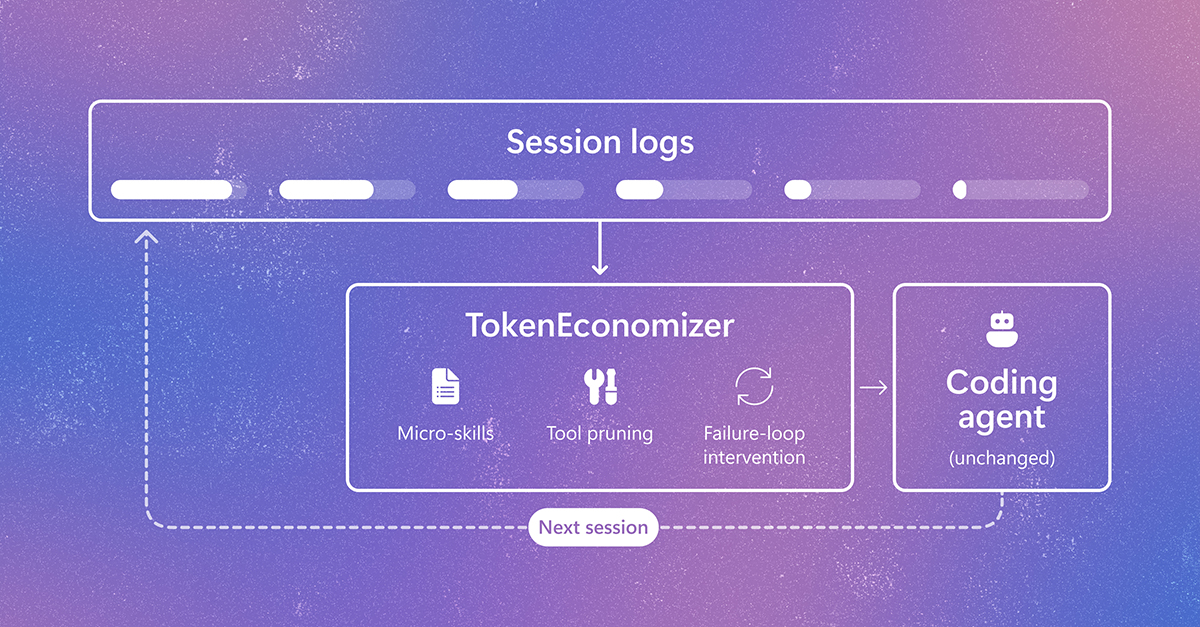
AI coding agents are increasingly help developers fix bugs and build features largely on their own, but every interaction with their models consumes tokens. In each session, an agent sends instructions, tool descriptions, and session history to its model. Most efforts to reduce this cost focus on individual tasks. Yet developers return to the same […] The post TokenEconomizer: Learning from Experience to Make AI Coding Agents More Efficient appeared first on Microsoft Research.
MIT News · Artificial Intelligence· news.mit.eduNov 13, 2026