Skip to content

Accelerating Transfer-Learning-Based Autotuning with Predictive LLVM IR Performance Ranking

Sep 2026 · 0 citations · 35 references
Computer Science

TL;DR

This work proposes an autotuning framework that designs a machine learning-based ensemble LLVM Intermediate Representation ranker, Neural Configuration Scorer (NCS), which ranks the performance of IRs sampled by a transfer-learning-based autotuner, improving the efficiency of the tuning process by reducing tuning overheads and circumventing subpar evaluations.

Abstract

As the complexity of High Performance Computing (HPC) ecosys- tems continually increases, achieving optimal performance becomes a challenge. Traditional performance autotuning techniques pro- vide promising means to navigate this complexity, these techniques remain computationally intensive and require many evaluations to find optimal configurations. This work proposes an autotuning framework that designs a machine learning-based ensemble LLVM Intermediate Representa- tion (IR) ranker, Neural Configuration Scorer (NCS). NCS ranks the performance of IRs sampled by a transfer-learning-based autotuner, improving the efficiency of the tuning process by reducing tuning overheads and circumventing subpar evaluations. By leveraging knowledge from related tasks, we are able to effectively exploit the transfer relationship to access high-performing configurations in fewer samples than traditional techniques that rely upon itera- tive refinement. Our framework can achieve similar performance improvements as state-of-the-art autotuning techniques with up to 61.67% fewer evaluations, averaging 27.85% fewer evaluations across various HPC benchmarks.


View source

Similar papers

Open access Sep 2026

Leveraging High-Performance Scientific Computing for the Limited-Memory Hyperparameter Tuning of Large-Scale Unconstrained Continuous Optimization Solvers

This work investigates a data-driven selection of the L-BFGS memory parameter (mem) for large-scale unconstrained optimization and proposes a two-stage hybrid machine-learning framework that predicts intermediate solver quantities and then forecasts runtime for each candidate memory value.

Yu-Chen Gao · 0 citations
Conference Aug 2026

XAI-AutoDL: An Explainable Automated System for Deep Learning-Based Classification Using Meta-Features

The increasing use of machine learning (AutoML) and deep learning means hyperparameter optimization can save time. Nevertheless, it is not clear how they compare on structured tabular classification under tight computational constraints. Here we present a resource-aware benchmark that compares the performance of Random...

Priya Surana, Palash Hemade, Ishan Patil et al. · 0 citations
Preprint Aug 2026

Task-CoEvolve: Efficient Harness Optimization via Adaptive Validation Task Selection

Task-CoEvolve builds on the observation that tasks on which candidate harnesses disagree are more informative for distinguishing among them than tasks that are consistently solved or failed, and uses variance-weighted sampling based on past outcomes to focus evaluation on tasks near the capability frontier.

Atsuyuki Miyai, Kiyoharu Aizawa, Toshihiko Yamasaki · 5 citations
Book Open access Sep 2026

Execution-Driven Auto-Tuning of Static Schedules for Resource-Efficient HPC

Task-based HPC runtimes are typically tuned under a performance-first requirement with the assumption that the fastest configuration requires all available cores. This paper asks whether that assumption holds, and whether high performance can be achieved with fewer resources. We study this question using SWITCHES, a ta...

Hui-Min Zhang, Andreas Diavastos · 0 citations
#machine learning Preprint Oct 2026

ML-OPF-Bench: Benchmarking Machine Learning for Optimal Power Flow

Machine Learning (ML) methods promise a fast solution process for Optimal Power Flow (OPF). While inconsistent test cases, implementations, and evaluation metrics across existing studies make it challenging to determine which algorithmic advances are most critical for real-world deployment. To this end, we propose ML-O...

Xin-Yi Liu, Xuan He, Danny H. K. Tsang et al. · 0 citations
Preprint Aug 2026

BOOSTEDSOSA: Accelerated Inferencing for Low Variance Stochastic Online Scheduling

BOOSTEDSOSA is introduced, a dual-FPGA ML-assisted Scheduling architecture that integrates a Machine Learning predictor for expected processing times, with a novel temporal-aware training policy, enabling its use in existing HPC systems.

Adam H. Ross, Riccardo Revalor, Aryan Singh et al. · 0 citations

Related blog posts

MIT News · Artificial Intelligence Nov 17, 2026

Learning the language of machine learning

By studying the computational foundations of language learning, Associate Professor Jacob Andreas builds intelligent systems that can communicate effectively with humans.

Microsoft Research Blog Nov 16, 2026

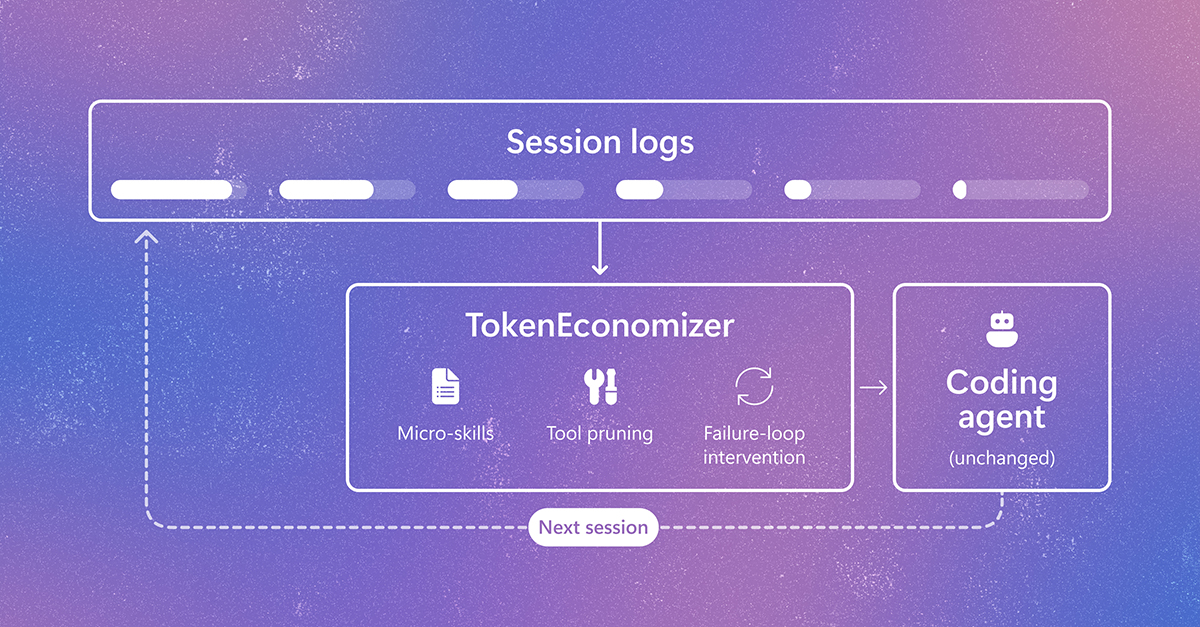
TokenEconomizer: Learning from Experience to Make AI Coding Agents More Efficient

AI coding agents are increasingly help developers fix bugs and build features largely on their own, but every interaction with their models consumes tokens. In each session, an agent sends instructions, tool descriptions, and session history to its model. Most efforts to reduce this cost focus on individual tasks. Yet developers return to the same […] The post TokenEconomizer: Learning from Experience to Make AI Coding Agents More Efficient appeared first on Microsoft Research.

We use cookies to run the site and, with your consent, for analytics and to show ads. See our Cookie Policy.