A hybrid modeling framework for coupling pre-trained numerics-informed neural networks (NINNs) with classical full order models (FOMs) using the overlapping Schwarz alternating method, and the resulting hybrid NINN-FOM solutions agree closely with the corresponding FOM-FOM Schwarz solutions.
Abstract
We develop a hybrid modeling framework for coupling pre-trained numerics-informed neural networks (NINNs) with classical full order models (FOMs) using the overlapping Schwarz alternating method. We consider the two-dimensional advection-diffusion equation in the advection-dominated, Peclet-number 10^6 regime. We first demonstrate that, unlike the corresponding physics-informed neural network (PINN), a monolithic NINN can be accurately trained on our model problem without domain decomposition. We then employ overlapping multiplicative Schwarz as a deployment mechanism for coupling a pre-trained, subdomain-local NINN with a neighboring FOM, with the NINN weights held fixed throughout the Schwarz iteration. We consider two training approaches for the subdomain-local NINNs: a top-down approach, in which boundary data are obtained from a coupled Schwarz solve on the full domain with a FOM on each subdomain (FOM-FOM Schwarz), and a bottom-up approach, in which boundary traces are generated synthetically on the NINN subdomain without requiring any full-domain solves. The resulting hybrid NINN-FOM solutions agree closely with the corresponding FOM-FOM Schwarz solutions, with the top-down and bottom-up training approaches yielding comparable accuracy.
This work introduces a reinforcement learning (RL)-based approach for online adaptation of FOM-ROM models coupled via the overlapping Schwarz alternating method (O-SAM), an iterative domain decomposition method that solves subdomain-local problems while exchanging solution information through transmission boundary cond...
Trishit Mondal, Irina Tezaur, Anthony Gruber· 0 citations
A novel domain decomposition-based approach for creating adaptive hybrid models with the help of the Schwarz alternating method and some recent extensions of SAM are presented to enable the overlapping and non-overlapping coupling of non-intrusive polynomial and neural network-(NN-)based Operator Inference (OpInf) ROMs...
Irina Tezaur, Eric J. Parish, Anthony Gruber et al.· 0 citations
This paper presents a comparative study of classical numerical and machine learning techniques for solving the nonlinear Monge–Ampère Equation (MAE). A finite difference method (FDM) implemented in MATLAB is first validated using a quadratic exact solution on a square domain. Two neural network approaches are then inve...
Christopher Ogbonna, Maliki Olaniyi S, N. Ogbonna· International journal of re...· 0 citations
In this paper, a hybrid semi-analytical–deep learning framework for the solution of nonlinear partial differential equations (PDEs) is proposed that integrates the New Iterative Method (NIM) with Physics-Informed Neural Networks (PINNs). Low–order NIM expansion provides an analytic baseline that meets the required init...
A. Alshehry, Saima Noor, Humaira Yasmin et al.· Scientific Reports· 0 citations
In this work, a hybrid semi-analytical and deep learning framework is proposed for solving nonlinear damped Burgers equations by combining the New Iterative Method (NIM) with Physics-Informed Neural Networks (PINNs). The developed methodology consists of the use of NIM to build an analytical baseline approximation, and...
A. Alshehry, Saima Noor, Humaira Yasmin et al.· Boundary Value Problems· 0 citations
Related blog posts
MIT News · Artificial Intelligence· news.mit.eduNov 17, 2026
By studying the computational foundations of language learning, Associate Professor Jacob Andreas builds intelligent systems that can communicate effectively with humans.
Microsoft Research Blog· microsoft.comNov 16, 2026
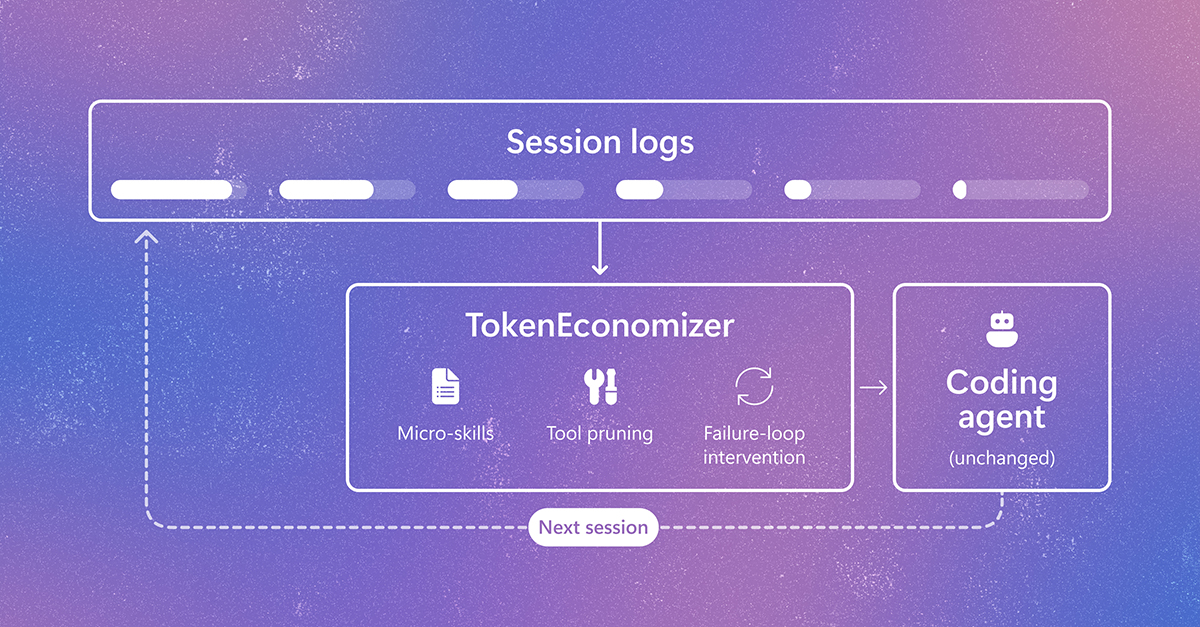
AI coding agents are increasingly help developers fix bugs and build features largely on their own, but every interaction with their models consumes tokens. In each session, an agent sends instructions, tool descriptions, and session history to its model. Most efforts to reduce this cost focus on individual tasks. Yet developers return to the same […] The post TokenEconomizer: Learning from Experience to Make AI Coding Agents More Efficient appeared first on Microsoft Research.
MIT News · Artificial Intelligence· news.mit.eduNov 13, 2026