It is argued that local LLM systems need explicit guarantees for prompt lifetime, persistent storage, and tenant isolation, because the surrounding serving software handles prompt data before, during, and after inference.
Abstract
Running large language models (LLMs) locally is often considered more private than cloud-hosted inference because user prompts remain on the device. We ask whether keeping inference local is, by itself, sufficient to keep those prompts confidential. Our results show that it is not: prompt confidentiality also depends on how the surrounding serving software handles prompt data before, during, and after inference. We examine four boundaries at which prompt confidentiality can fail in consumer local-LLM serving systems: model loading, runtime memory, wrapper-level persistence, and the serving interface. To study these boundaries, we develop LLAnalyzer, a measurement framework that tests each boundary separately and traces observed failures to the responsible software component. Applying LLAnalyzer to four open-weight model families and two consumer deployment platforms, we find markedly different behaviour across boundaries. In a 24-hour AFL++ campaign with more than 12 million executions, we observe no parser crashes or successful malformed GGUF loads within the explored state space. Runtime memory tells a different story: we recover prompts after inference because multiple plaintext representations survive in allocator-managed memory, and sanitisation reduces this residue without eliminating it. We also find that consumer wrappers can extend prompt lifetime through plaintext persistence. At the serving boundary, we uncover a previously undocumented authorization flaw in llama.cpp that allows one authenticated client to restore another tenant's saved conversation state; the attack succeeds in 200/200 controlled trials. Separately, shared prompt-prefix caching exposes a remote timing oracle that remains distinguishable under WAN conditions. We argue that local LLM systems need explicit guarantees for prompt lifetime, persistent storage, and tenant isolation.
A residual-stream covert-channel attack is introduced that maps messages to codewords and injects them into an intermediate residual stream through a compromised runtime hook and is scaled with the local residual norm using the signal-to-residual-norm ratio.
Privacy exposure displacement, the mismatch between a local evaluation proxy and target-grounded session exposure, and ASLEval, an authorization-aware framework that pre-registers a hidden target set, measures all declared visible exits, and reserves internal traces for diagnosis are introduced.
Guo-Xin Wu, Hui-Zhen Huang, Guo-Xiong Long et al.· 0 citations
Language model agents are increasingly deployed to automate everyday digital chores from managing emails and social media to handling banking and bills allowing users to step away from supervision. However, this capability also exposes sensitive information to phishing. Safe execution requires distinguishing malicious...
Rafid Ahmed, Joseph Fioresi, Mubarak Shah et al.· 0 citations
This work presents Claw in Plain Sight, an authority- pressure attack in which task-adjacent content frames protected attributes as operationally or procedurally required, causing a model to include them in otherwise valid generated arguments.
Ben Dong, Zhonghao Guo, Tianyi Lu et al.· 0 citations
This work analyzes the cryptographic design and the collaborative editing protocol of Proton Docs/Sheets inspecting the open-source Web client and webpage code and demonstrates three distinct “integrity” attacks against Proton Docs/Sheets that can cause history rewriting, context manipulation, and censorship.
Ya-NanLi, Ya-Qing Song, QiangTang et al.· 0 citations
Related blog posts
Microsoft Research Blog· microsoft.comNov 12, 2026
What's new in research at Microsoft? Host Anson Ho explores the latest, including AI-powered universal translation, a breakthrough in a 31-year-old mathematics challenge, and advances making AI coding agents faster and more efficient. The post Microsoft Research Focus – Edition #98 appeared first on Microsoft Research.
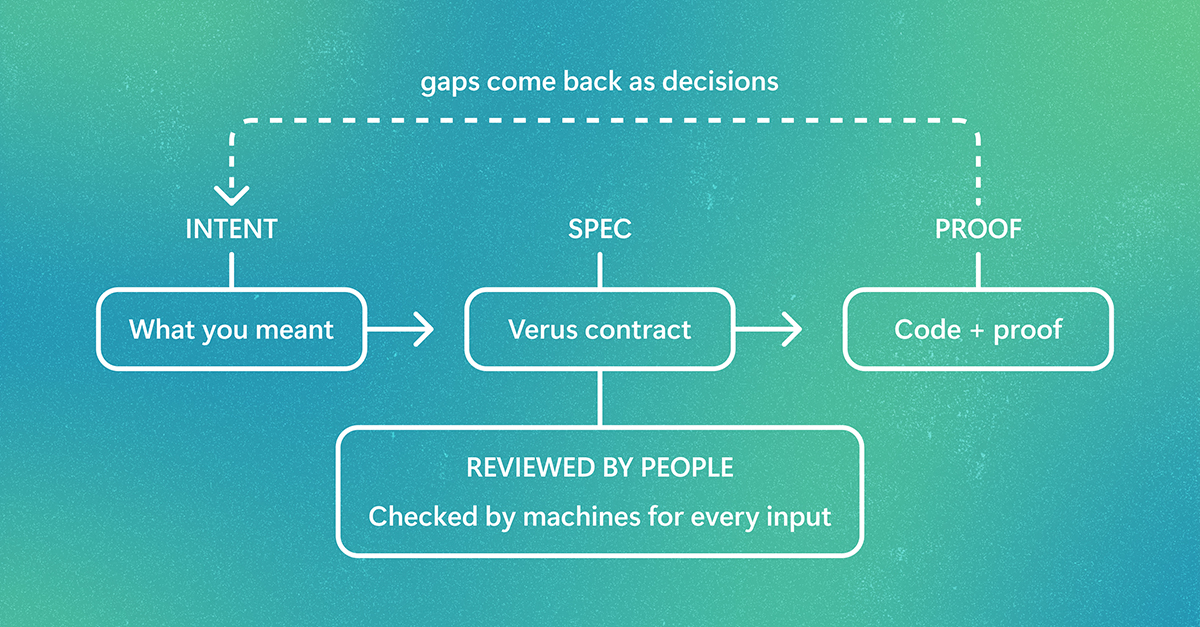
AI agents can generate code at a scale that’s hard for humans to review line-by-line. PDD Kit helps ensure the code is doing what the developer intended by creating formal specifications and testing against them. It converts developer intent into a Verus specification, proves AI-generated code meets it for every input, and uses tests where proofs aren't practical. Developers review intent, not every line. The post Formally verifying agent-written full-stack web apps with PDD Kit appeared first o…