Skip to content

Beyond PINNs: A Unified Gauss-Newton and Petrov-Galerkin Framework for Neural and Hybrid PDE Solvers

Sep 2026 · arXiv.org · Vol abs/2609.20641 · 0 citations · 46 references
Computer Science Mathematics

TL;DR

This work introduces a common framework based on the discretization of functional Gauss--Newton problems by finite families of linear measurements and shows that, through an appropriate duality pairing, the linear measurements can be represented by test functions.

Abstract

Physics-informed neural networks and finite element methods provide two different paradigms for the numerical approximation of partial differential equations: the former are commonly trained by minimizing pointwise strong residuals, whereas the latter are naturally built from weak variational formulations and the finite-dimensional systems obtained after discretization. In this work, we introduce a common framework based on the discretization of functional Gauss--Newton problems by finite families of linear measurements. We show that, through an appropriate duality pairing, the linear measurements can be represented by test functions. The resulting Gauss--Newton system is then precisely a Petrov--Galerkin discretization of the linearized functional problem. This perspective recovers pointwise collocation and natural-gradient constructions as particular cases, while making the choice of test functions an explicit algorithmic design choice. We specialize this framework to elliptic problems, where it naturally leads to weak residual formulations and to a hybrid finite element--neural construction acting on complementary approximation spaces. Numerical experiments support the proposed framework and demonstrate the effectiveness of weak Gauss--Newton formulations and hybrid finite element--neural approximations.


View source

Similar papers

Preprint Aug 2026

Bosonic Encodings for Hermite-Galerkin Discretizations of High-Dimensional PDEs and Bayesian Inverse Problems

The Koopman-von Neumann framework is applied to Bayesian inverse problems with Gaussian priors and observation noise, reducing posterior-state preparation to the preparation of a structured Hamiltonian's ground state and introducing a qubit encoding that supports efficient block encodings of the truncated operators.

Alice Barthe · 0 citations
Open access Sep 2026

A Spectral Galerkin Framework for the Fractional Reaction–Subdiffusion Equation Using Legendre Cardinal Functions

In this work, we introduce an efficient spectral Galerkin method for solving one-dimensional time-fractional reaction–subdiffusion equations. Traditional fractional operators often pose severe computational challenges and exhibit weak singularities near the initial time. To address these issues, we analytically transfo...

H. Bin Jebreen · 0 citations

Tensor-Train Compressed Separable PINNs: A Curvature-Aware Optimization Framework for Parametric PDEs in High Dimensions

In this work, we develop a second-order optimization framework for physics-informed neural networks (PINNs) applied to high-dimensional parametric partial differential equations (PDEs). The framework is built on the Gauss--Newton pullback metric, which provides an operator-informed notion of curvature in parameter spac...

Denis Korolev, Martin Eigel · 0 citations
Aug 2026

A Neural-network-based multiscale Hybridizable Discontinuous Galerkin method for solving PDEs in porous media

A neural-network-accelerated multiscale hybridizable discontinuous Galerkin method for elliptic problems with heterogeneous coefficients demonstrating the potential of neural surrogates for accelerating multiscale HDG computations while also highlighting the need for improved operator representations and a better under...

Tony Haines, Ke Shi · 0 citations
Open access Aug 2026

A Spectral Galerkin Method with Hybrid Müntz–Jacobi Basis for Space–Time Fractional Advection–Diffusion Equations

For the numerical treatment of space-time fractional advection-diffusion equations, we designed a spectral Galerkin method. We construct the approximation space using a hybrid system of Müntz-Jacobi basis functions, combining the stability and orthogonality properties of Jacobi polynomials and the singularity-resolving...

Shahad Adil Taher · 0 citations

Related blog posts

MIT News · Artificial Intelligence Nov 17, 2026

Learning the language of machine learning

By studying the computational foundations of language learning, Associate Professor Jacob Andreas builds intelligent systems that can communicate effectively with humans.

Microsoft Research Blog Nov 16, 2026

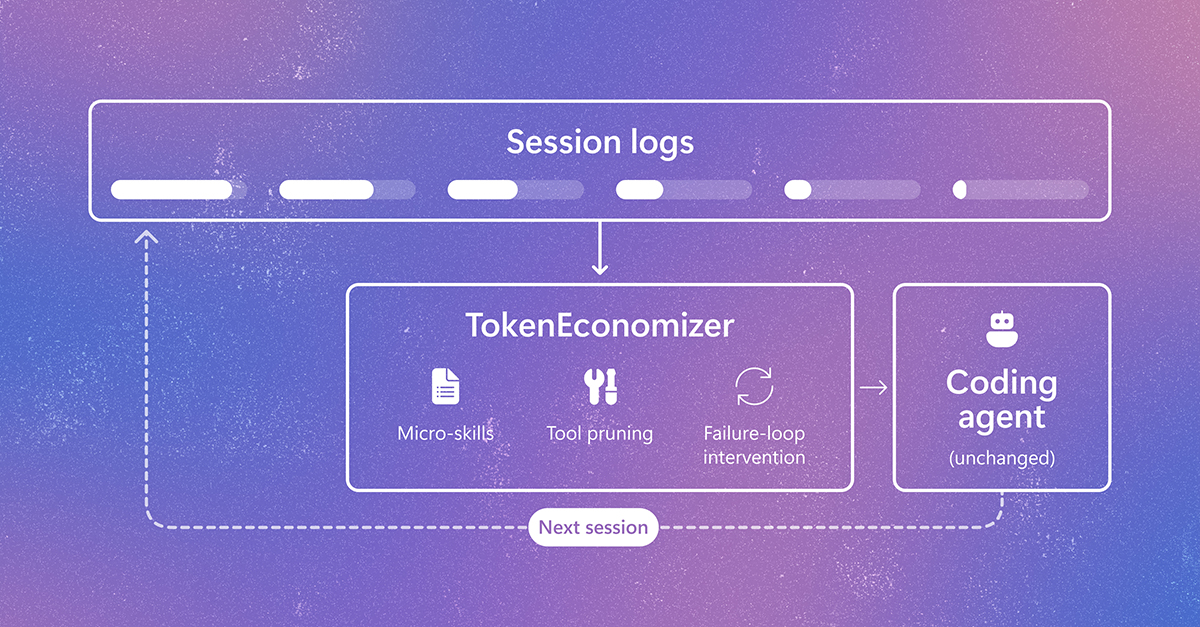
TokenEconomizer: Learning from Experience to Make AI Coding Agents More Efficient

AI coding agents are increasingly help developers fix bugs and build features largely on their own, but every interaction with their models consumes tokens. In each session, an agent sends instructions, tool descriptions, and session history to its model. Most efforts to reduce this cost focus on individual tasks. Yet developers return to the same […] The post TokenEconomizer: Learning from Experience to Make AI Coding Agents More Efficient appeared first on Microsoft Research.

We use cookies to run the site and, with your consent, for analytics and to show ads. See our Cookie Policy.