It is shown that evaluating just one or two steps of TO is sufficiently informative and that the method scales favorably to thousands of hyperparameters at an expense comparable to only a few standard TO runs, and that the method scales favorably to thousands of hyperparameters at an expense comparable to only a few standard TO runs.
Abstract
Topology optimization (TO) represents a significant step towards automating the design process: given a working simulation, TO can produce a viable prototype at the press of a button by differentiating the simulation and iteratively improving the design. In practice, however, TO is riddled with ``magic numbers''---hyperparameters whose tuning significantly affects the outcome. Finding the right values typically requires not only deep problem-specific knowledge but also extensive trial-and-error. While practitioners can use surrogate-assisted hyperparameter optimization as an alternative, this approach requires strictly limiting the number of hyperparameters through careful problem formulation. Here, we propose differentiating TO itself using automatic differentiation. This yields ``hypergradients''that allow us to tune these hyperparameters in tandem with the primary optimization. We show that evaluating just one or two steps of TO is sufficiently informative and that the method scales favorably to thousands of hyperparameters at an expense comparable to only a few standard TO runs. We demonstrate this approach on stress-constrained and compliance problems, with the latter utilizing a neural parameterization of the density field.

The geometric constraints of Zhou et al. (2015) are a widely used technique in topology/freeform optimization to impose minimum lengthscales for manufacturability. However, its efficiency degrades as design binarization is increased, and it requires heuristic tuning of multiple hyperparameters. In this work, we derive...
Rodrigo Arrieta, Giuseppe Romano, Steven G. Johnson· Structural And Multidiscipli...· 4 citations
Generative models are increasingly central to many de novo discovery pipelines, in which designs are generated at scale and filtered through virtual screens to determine a set of candidates to experimentally validate. While Bayesian optimization (BO) is a natural fit for this setting, as it uses past evaluations to gui...
Donney Fan, Colin Doumont, Aleksandra Kalisz et al.· 4 citations· ⚡1
The key innovative new feature in the proof of the analysis are suitable inverse moment bounds for the second moment process in RMSprop that hold not just for all sufficiently large n but hold for every gradient step $n=1,2,3,...$ with all error constants being explicitly specified.
Offline multi-objective optimization (MOO) seeks solutions with better objective trade-offs using only a fixed dataset, without querying the objectives. Diffusion models trained on such data have emerged as a promising approach, but their samples are not inherently better than the data and must be steered toward the Pa...
Yuan-Tong Lu, Esha Singh, Yi-An Ma et al.· 0 citations
Hyperparameter optimization is one example of a broad class of multivariate minimization problems with a complex landscape and often many local minima. As a result, gradient descent typically performs poorly, and easily parallelizable sampling methods are most commonly used, which often require the set of trial point...
Michal Piotr Lipiec, Charles Steinhardt, Jakob Frederiksen et al.· Machine Learning: Science an...· 0 citations
This study introduces four strategies to navigate boundary constraints in online optimization algorithms and demonstrates that adopting boundary strategies outperforms the"boundary"strategy.
Bruno Veloso, João Gama· 0 citations
Related blog posts
MIT News · Artificial Intelligence· news.mit.eduNov 17, 2026
By studying the computational foundations of language learning, Associate Professor Jacob Andreas builds intelligent systems that can communicate effectively with humans.
Microsoft Research Blog· microsoft.comNov 16, 2026
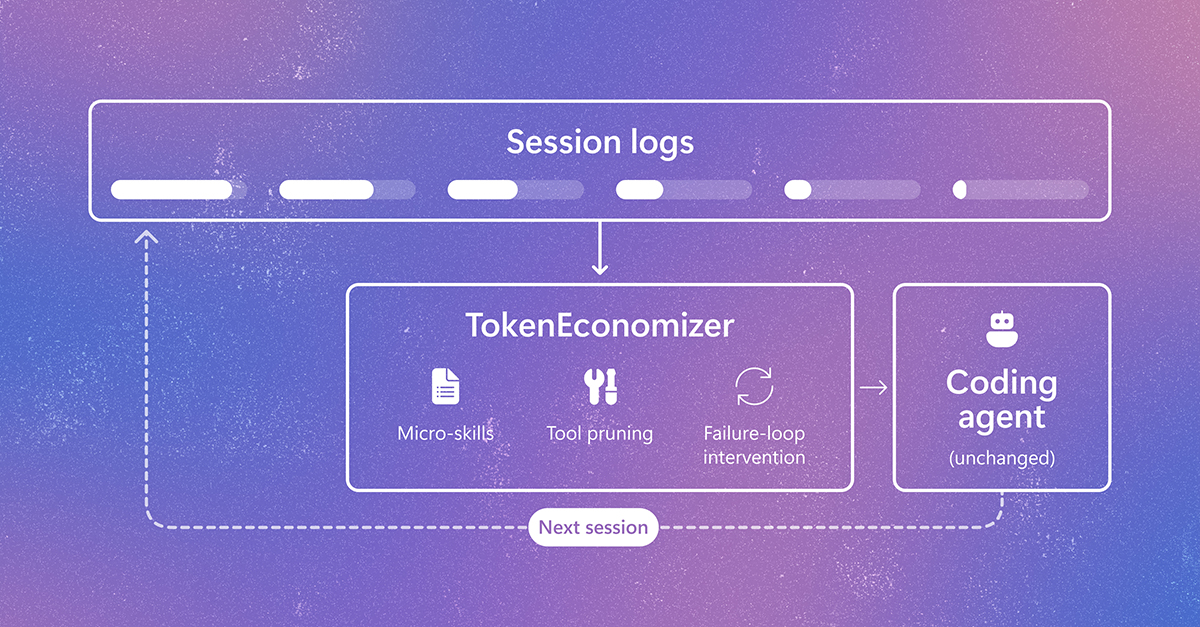
AI coding agents are increasingly help developers fix bugs and build features largely on their own, but every interaction with their models consumes tokens. In each session, an agent sends instructions, tool descriptions, and session history to its model. Most efforts to reduce this cost focus on individual tasks. Yet developers return to the same […] The post TokenEconomizer: Learning from Experience to Make AI Coding Agents More Efficient appeared first on Microsoft Research.
MIT News · Artificial Intelligence· news.mit.eduNov 13, 2026