An iterative framework that automates the extraction of interpretable, schema-bound categorical features from unstructured text for tabular prediction models that guarantees instance-level interpretability and provides a fully transparent, semantic audit trail for every prediction.
Abstract
We introduce an iterative framework that automates the extraction of interpretable, schema-bound categorical features from unstructured text for tabular prediction models. To navigate the feature space, a generator LLM proposes semantic definitions, a separate extractor LLM materializes the features, and a downstream tabular model evaluates their predictive performance. We optimize this search by translating explicit model errors, such as AUC ranking inversions, into natural-language feedback, steering the LLM to resolve specific predictive failures. Evaluated across three public datasets, this error-driven loop accelerates feature discovery by up to $3\times$ compared to unguided search. Empirically, the generated features demonstrate strong multi-view complementarity, strictly outperforming any subset when combined with TF-IDF and dense embeddings. Finally, the framework guarantees instance-level interpretability: the discovered features dominate SHAP importance rankings and provide a fully transparent, semantic audit trail for every prediction.

This work investigates LLM-based evaluators of natural language generation quality mechanistically through an eight-attack perturbation taxonomy across the Readability and Adequacy dimensions of NLG quality, a generation pipeline that produces paired clean and corrupt summaries with controlled error intensity and expli...
Language models can now prove theorems, but people still decide which problems to pursue. We ask whether a model's internal representations can help identify promising mathematical connections. We develop LANTERN, a fast, cost-efficient pipeline that uses a classifier over pretrained-model activations to rank candidate...
P. Tikhonov, Elena Tutubalina, I. Oseledets et al.· arXiv.org· 0 citations
A novel paradigm called Human vs. LLM Identification (HLI) is proposed which introduces a Retrieval-Augmented Generation (RAG)-inspired evidence-based detection strategy alongside a fine-tuned transformer classifier.
Ibtasam Ur Rehman, Muhammad Islam, Muhammad Yousaf Rehman et al.· Knowledge· 0 citations
This work introduces DocHop, a benchmark for integrated chart--context reasoning in document-style images and constructs DocHop via a stochastic logic-first generation pipeline with controllable reasoning depth and visual density, to enable systematic evaluation.
Zhuo-Ran Yu, Le Thien Phuc Nguyen, Jaden Park et al.· 1 citation
Flat machine learning models fit training-distribution statistics and degrade when that distribution shifts at test time. We present a cross-domain research arc demonstrating that hierarchical structured abstraction, which decomposes a prediction task into fewer, topologically-grounded decisions over domain-specific pr...
Loom is presented, a generative consensus framework deployed for real-world RCA that bridges these paradigms and discusses the deployment experience, highlighting lessons learned regarding the trade-offs between agentic depth and inference latency, negative results in redundancy detection, and how deterministic consens...
Ron Begleiter, K. Berg, G. Saban et al.· 0 citations
Related blog posts
MIT News · Artificial Intelligence· news.mit.eduNov 17, 2026
By studying the computational foundations of language learning, Associate Professor Jacob Andreas builds intelligent systems that can communicate effectively with humans.
Microsoft Research Blog· microsoft.comNov 16, 2026
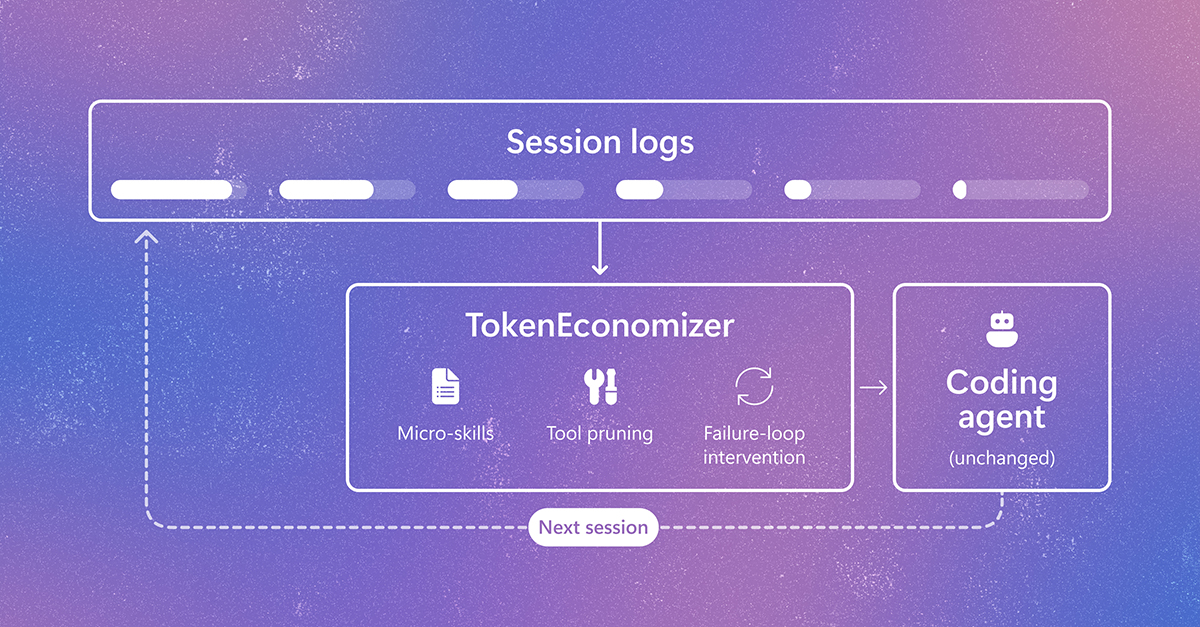
AI coding agents are increasingly help developers fix bugs and build features largely on their own, but every interaction with their models consumes tokens. In each session, an agent sends instructions, tool descriptions, and session history to its model. Most efforts to reduce this cost focus on individual tasks. Yet developers return to the same […] The post TokenEconomizer: Learning from Experience to Make AI Coding Agents More Efficient appeared first on Microsoft Research.
MIT News · Artificial Intelligence· news.mit.eduNov 13, 2026