The conventional testing process quickly fails when applied to ML-based systems such as obstacle detection in vehicles: if an obstacle is not detected in a test, classical bug fixing is impossible and an AI system will always retain shortcomings. Test results can therefore only be interpreted statistically, which in turn requires test sets that are not only complete with respect to the operational design domain (ODD) of the system, but also representative of it. To this end, we introduce probabilistically extended ontologies (PEONs): ontologies describing the ODD, augmented with a probability distribution over the partitioning they induce. Instead of unmaintainable conditional probability tables, only marginal distributions and functionally described dependencies need to be specified; algorithms based on couplings and optimal transport complete this specification to a Bayesian network. From a PEON we derive the sampling of representative test cases, rigorous end-of-test criteria for given quality targets and significance levels, and methods for re-evaluating existing test results and for assessing the balance of training data. We demonstrate the practical modelling of a complex ODD using the example of automatic train operation.

AI reliability concerns whether an AI system performs its intended function dependably over a stated period and under stated operating conditions, with clear evidence. As these systems become more autonomous, this function should include more than only a correct output. Retrieval, memory, tool use, permissions, human o...
Rong Pan, Yi-Li Hong, Min Xie· arXiv.org· 0 citations
Physical Artificial Intelligence (Physical AI) brings learning-enabled functions into systems that interact directly with the physical world. Examples range from autonomous robots and mobile platforms to industrial machinery and road vehicles. Reliability of the physical part of such systems is commonly addressed using...
M. Bjelica, Bogdan Pavković, Denis Vranješ· International journal of ele...· 0 citations
Context. The increasing complexity of modern software systems is accompanied by a dramatic expansion of the possible test scenario space. The number of potential execution sequences, environment configurations, and component interactions rapidly exceeds the capabilities of traditional testing strategies, complicating t...
D. Symonov, I. Demenko· Radio Electronics, Computer...· 0 citations
Classical robot control, Finite State Machines and Behavior Trees (BTs), is deterministic and inspectable but fixed at design time: it fails on situations its designers did not anticipate. Foundation models can synthesize new control logic at runtime, at a cost in latency and non-determinism hard to accept in safety-cr...
Artificial intelligence (AI) components are increasingly embedded in software, challenging established assumptions of software testing practice. This article presents a systematic mapping review of testing approaches for AI-based systems, grounded in ISO/IEC 29119 and ISO/IEC TR 29119-11. The contribution is a structur...
Lidija Vincekovič, Luka Pavlič, Tina Beranič· Applied Sciences· 0 citations
Related blog posts
MIT News · Artificial Intelligence· news.mit.eduNov 17, 2026
By studying the computational foundations of language learning, Associate Professor Jacob Andreas builds intelligent systems that can communicate effectively with humans.
Microsoft Research Blog· microsoft.comNov 16, 2026
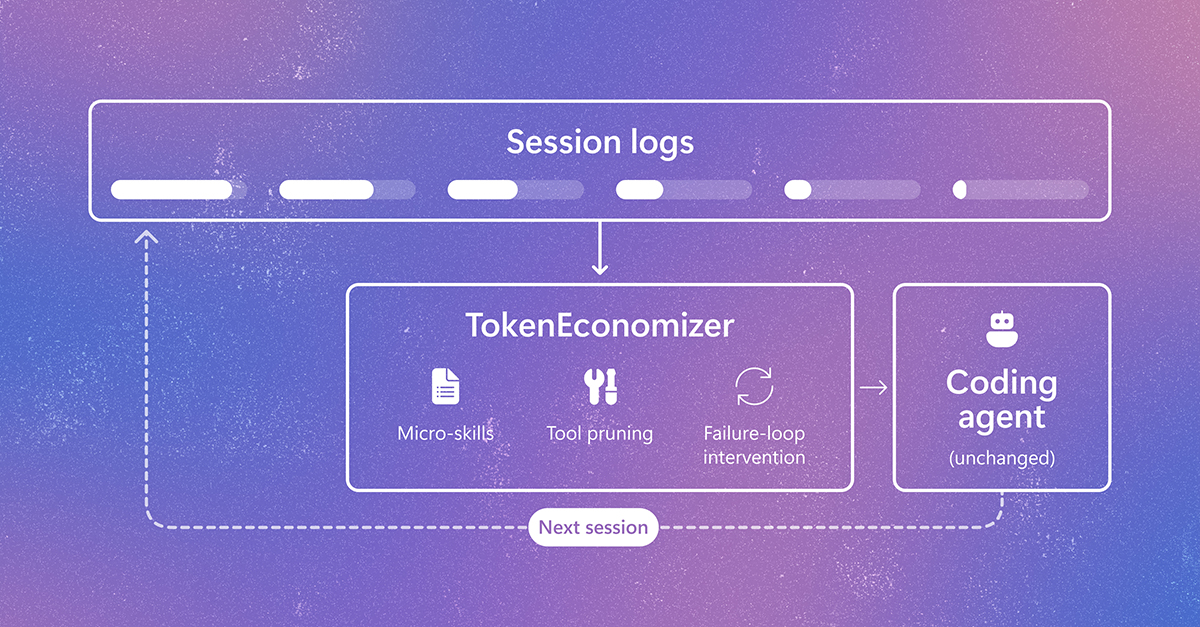
AI coding agents are increasingly help developers fix bugs and build features largely on their own, but every interaction with their models consumes tokens. In each session, an agent sends instructions, tool descriptions, and session history to its model. Most efforts to reduce this cost focus on individual tasks. Yet developers return to the same […] The post TokenEconomizer: Learning from Experience to Make AI Coding Agents More Efficient appeared first on Microsoft Research.
MIT News · Artificial Intelligence· news.mit.eduNov 13, 2026