Skip to content

A Horizon-Independent Regret Bound for Optimistic Hedge in General-Sum Games

Sep 2026 · arXiv.org · Vol abs/2609.22839 · 1 citation · 45 references
Computer Science

TL;DR

This work proves that plain Optimistic Hedge with a constant step size can attain individual regret in general-sum games with n players and d=(d_1,\ldots,d_n) actions, under expected loss-vector feedback.

Abstract

Can simple learning rules keep their regret bounded in self-play? Recent work achieves constant regret bounds through modified regularization and higher-order prediction. Yet for Optimistic Hedge, arguably the most canonical method in games, the best known individual regret bound remains logarithmic. In this work, we prove that plain Optimistic Hedge with a constant step size can attain $O_{n,d}(1)$ individual regret in general-sum games with $n$ players and $d=(d_1,\ldots,d_n)$ actions, under expected loss-vector feedback. As a corollary, its time-averaged play enjoys an $O_{n,d}(1/T)$ coarse correlated equilibrium (CCE) gap. Our analysis represents Optimistic Hedge as a real-analytic recurrence on a compact space, which yields an exact finite-order difference relation that eliminates horizon dependence. Our proof hinges on nonconstructive Noetherianity argument of Frisch (1967), so the $(n,d)$-dependence remains implicit.


View source

Similar papers

#machine learning Preprint Nov 2026

Optimistic Hedge in General-Sum Games: Fundamental Limits and Regret Bounds via Temporal Approximation

The upper bound is based on a temporal approximation framework for the analysis of Optimistic Hedge, and approximate the losses over time-localized windows by well-behaved functions, whose total variation is a small fraction of their cumulative variance.

Y. Dagan, Nadav Eisen, Liad Erez et al. · 0 citations
Sep 2026

A Logarithmic Regret Bound for Optimistic Hedge in General-Sum Games

Optimistic Hedge with a constant step size can further achieve individual external regret under expected loss-vector feedback and proves factorial bounds on high-order differences of probability-weighted pairwise loss gaps, then applies finite-difference interpolation in a fixed Euclidean norm.

Junsoo Ha · 2 citations

Constant Swap Regret in General-Sum Games via Two-Scale Higher-Order Optimism

We give deterministic and uncoupled learning dynamics for finite multiplayer general-sum games under full-information feedback that achieve constant individual swap regret in self-play, independent of the horizon $T$. With $n$ players and at most $m$ actions each, every player's individual swap regret is $O(\sqrt n\,m\...

Tung Mai · 2 citations
#machine learning Preprint Oct 2026

High-Probability Regret Bounds for Feel-Good Thompson Sampling

Feel-good Thompson sampling (FGTS) augments the posterior of vanilla Thompson sampling with an exploration term that favors reward functions with high predicted optimal values. This modification achieves minimax-optimal regret up to logarithmic factors in linear contextual bandits, but existing analyses of its two stan...

Xu-Heng Li, Qing-Yue Zhao, Quan-Quan Gu · 0 citations
#machine learning Preprint Nov 2026

Logarithmic Regret for Alternating Mirror Descent

Alternating online mirror descent (AltOMD) is a simple learning rule for zero-sum games, which improves upon simultaneous OMD numerically and theoretically. Previous work obtained $O(T^{1/3})$ and $O(T^{1/5})$ regret bounds for AltOMD, by leveraging modified-energy-function-based analyses. However, settling whether Alt...

Tian-Long Nan, C. Kroer · 0 citations

Related blog posts

MIT News · Artificial Intelligence Nov 17, 2026

Learning the language of machine learning

By studying the computational foundations of language learning, Associate Professor Jacob Andreas builds intelligent systems that can communicate effectively with humans.

Microsoft Research Blog Nov 16, 2026

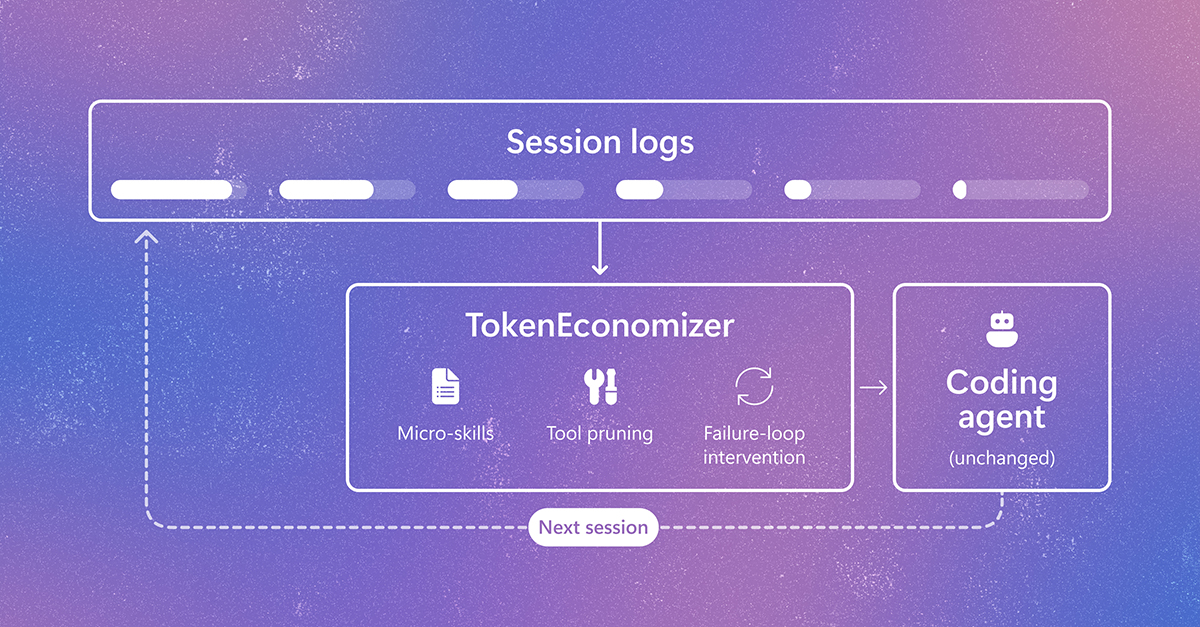
TokenEconomizer: Learning from Experience to Make AI Coding Agents More Efficient

AI coding agents are increasingly help developers fix bugs and build features largely on their own, but every interaction with their models consumes tokens. In each session, an agent sends instructions, tool descriptions, and session history to its model. Most efforts to reduce this cost focus on individual tasks. Yet developers return to the same […] The post TokenEconomizer: Learning from Experience to Make AI Coding Agents More Efficient appeared first on Microsoft Research.

We use cookies to run the site and, with your consent, for analytics and to show ads. See our Cookie Policy.