Parameter-Efficient Adaptation of Pre-Trained Vision Foundation Models for Active and Passive Seismic Data Denoising
Jiahua ZhaoUmair bin WaheedJing SunYang CuiNikos SavvaEric Verschuur
Sep 2026
Machine LearningComputer Vision
Abstract
The demand for high-resolution subsurface imaging and continuous Earth monitoring has driven rapid growth in active and passive seismic data from dense geophone deployments, distributed acoustic sensing (DAS) arrays, and large-scale 2D and 3D surveys. This expansion makes complex noise suppression increasingly challenging, especially when signal fidelity must be preserved. Conventional supervised deep learning methods are often task-specific, require large paired datasets, and can suffer from domain shift under new acquisition conditions. Foundation models offer a promising alternative, but pre-training seismic foundation models from scratch requires massive domain-specific data and substantial computation. We propose an efficient framework that repurposes general-purpose Vision Foundation Models (VFMs) for geophysical tasks through Parameter-Efficient Fine-Tuning. The architecture uses a pre-trained VFM, a DINOv3 encoder, adapted with Low-Rank Adaptation (LoRA) to enable effective feature adaptation with few additional parameters. To improve robustness under unseen field conditions without ground truth, we introduce a kurtosis-guided unsupervised test-time adaptation module that updates only LoRA parameters during inference. This module self-calibrates the model to site-specific noise by identifying information-rich regions via kurtosis and performing self-training without labeled data. Experiments on public exploration seismic images and DAS vertical seismic profiling data from the Utah FORGE site show that the framework matches or outperforms domain-specific models. Tests on unseen cross-site data from a land survey in China and the Gro{\ss} Sch\"onebeck geothermal site in Germany further demonstrate strong generalization and effective signal-noise separation. These results highlight the potential of adapting pre-trained VFMs to data-intensive problems in exploration seismology.

This paper investigates developing real-world perception for active agents, proposes Gibson Environment for this purpose, and showcases a set of perceptual tasks learned therein.
F. Xia, Amir Zamir, Zhi-Yang He et al.· 2018 IEEE/CVF Conference on...· 1,069 citations· ⚡112
This publication proposes a definition and a classification of agile software development approaches and analyses ten software development methods that can be characterized as being "agile" against the defined criterion.
P. Abrahamsson, O. Salo, Jussi Ronkainen et al.· arXiv.org· 727 citations· ⚡54
The study shows that agile practices improve both informal and formal communication, but indicates that, in larger development situations involving multiple external stakeholders, a mismatch of adequate communication mechanisms can sometimes even hinder the communication.
M. Pikkarainen, Jukka Haikara, O. Salo et al.· Empirical Software Engineeri...· 401 citations· ⚡48
The results indicate that software engineering work practices are chosen opportunistically, adapted and configured to provide value under the constrains imposed by the startup context.
Nicolò Paternoster, Carmine Giardino, M. Unterkalmsteiner et al.· Information and Software Tec...· 394 citations· ⚡54
The possibility of inferring high-dimensional data inference in a model that consists of a prior and an auxiliary differentiable constraint given some additional information is considered, thereby allowing a range of potential applications in adapting models to new domains and tasks.
Alexandros Graikos, Esmeralda S. Whitammer, N. Jojic et al.· Neural Information Processin...· 316 citations· ⚡15
Related blog posts
MIT News · Artificial Intelligence· news.mit.eduOct 28, 2026
Professor Paris Smaragdis develops computers with superhuman hearing for applications like speech recognition, music understanding, and environmental monitoring.
Exploring how generative AI could make machine vision more accessible to businesses. The post GenEye in a Box: Making Machine Vision Something You Can Just Ask For appeared first on GPT-Lab.
Microsoft Research Blog· microsoft.comAug 11, 2026
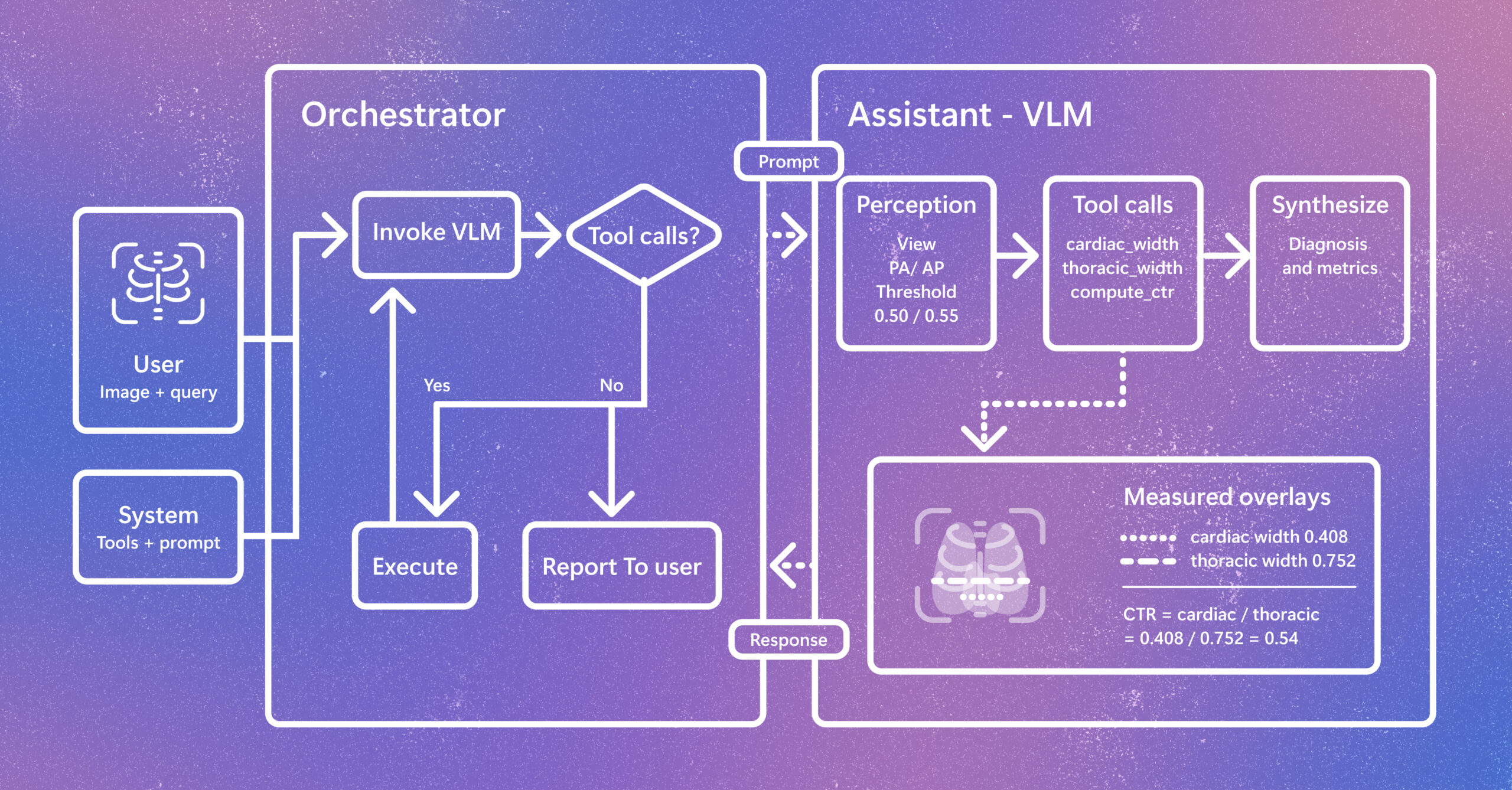
Radiology AI is evolving beyond report generation. CARE-X explores a unified approach that combines flexible reasoning, calibrated predictions, and measurement-based tools for chest X-ray interpretation. The post Introducing CARE-X: Towards Clinically Useful Radiology VLMs with Auxiliary Supervision, Reward-Aligned Learning, and Tool-Augmented Measurement appeared first on Microsoft Research.