This work proposes several architectural changes to the BSF, including a Tournament Top-K selection rule that significantly reduces feature splitting, and extends the block paradigm to the crosscoder.
Abstract
The recently introduced block-sparse featurizer (BSF; Fel et al., 2026) is similar to a sparse autoencoder (SAE), but its atomic unit is a small subspace (a block of directions) rather than a single direction. It is designed for features that live on low-dimensional manifolds, which are especially frequent in vision. This work studies the BSF's strengths and weaknesses, finding how it still somewhat suffers from classic SAE failure modes, like feature splitting and composition. We propose several architectural changes to the BSF, including a Tournament Top-K selection rule that significantly reduces feature splitting, and we also extend the block paradigm to the crosscoder.
The results suggest that trained SAEs need not reach the corresponding minima, and that the phase diagram of trained models may differ fundamentally from that of objective minimizers.
A novel pruning method which uses the oscillations around 0 that a weight has undergone during training in order to determine its saliency and achieves state-of-the-art performance for levels of sparsity of 99 .
A systematic study of how pruning affects SAE behavior is presented and theoretically shows that, for a fixed SAE, its impact is governed by perturbation energy, a covariance-weighted norm.
Suchit Gupte, Xue-Ru Zhang, M. Khalili· 0 citations
Chunked Muon (CMuon) is introduced, a simple yet highly effective strategy that partitions these matrices into independent sub-components prior to orthogonalization, effectively overcoming the late-stage convergence plateaus of vanilla Muon.
This work proposes Normalizing Autoencoder (NAE), which employs a novel conditional loss that aligns the surrogate loss gradient with that of reconstruction loss, directly improving upon the current standard.
A family of difference-informed pruning methods built upon this principle are introduced, suggesting that preserving output differences is a broadly useful and composable signal for post-training LLM sparsification.
Linghao Kong, Inimai Subramanian, Micah Adler et al.· 0 citations
Exploring how generative AI could make machine vision more accessible to businesses. The post GenEye in a Box: Making Machine Vision Something You Can Just Ask For appeared first on GPT-Lab.
Microsoft Research Blog· microsoft.comAug 11, 2026
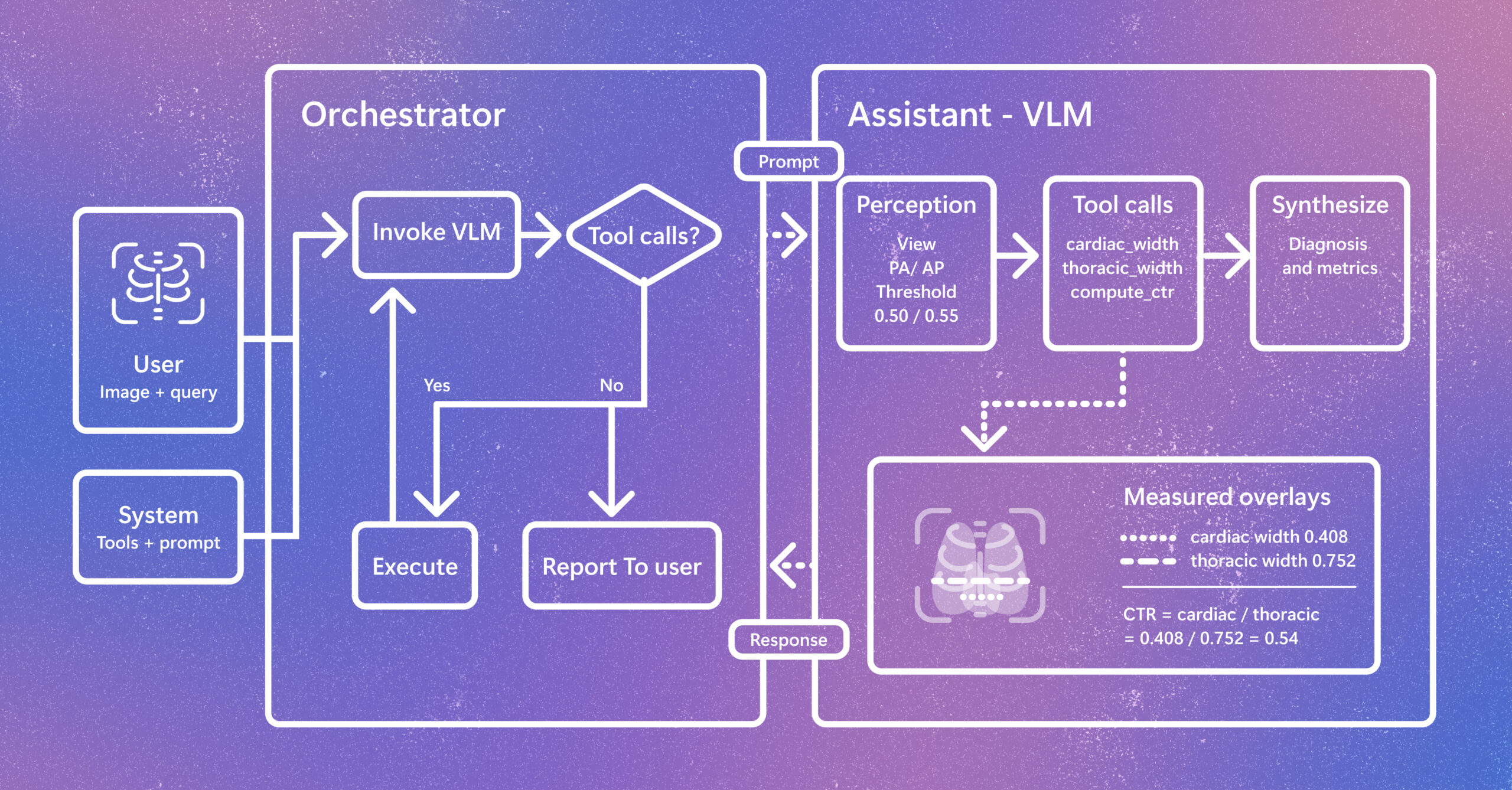
Radiology AI is evolving beyond report generation. CARE-X explores a unified approach that combines flexible reasoning, calibrated predictions, and measurement-based tools for chest X-ray interpretation. The post Introducing CARE-X: Towards Clinically Useful Radiology VLMs with Auxiliary Supervision, Reward-Aligned Learning, and Tool-Augmented Measurement appeared first on Microsoft Research.