Aug 2026· arXiv.org· Vol abs/2609.27913· 0 citations· 17 references
Computer Science
TL;DR
This work proposes a tractable, probabilistic-circuit-based fusion framework that dynamically combines expert responses using context-specific credibility estimates, enabling principled and reliable reasoning.
Abstract
We study the problem of aggregating opinions from multiple black-box experts in noisy, conflict-prone settings where expert reliability varies across inputs. Static aggregation methods, such as majority voting, fail to capture this variability and often yield unreliable outcomes under disagreement. We propose a tractable, probabilistic-circuit-based fusion framework that dynamically combines expert responses using context-specific credibility estimates, enabling principled and reliable reasoning. The framework is agnostic to the underlying experts and does not require access to their internal representations or any retraining. We empirically validate our approach on multiple-choice question answering tasks using multiple LLMs as experts, comparing against individual models and static ensemble baselines. Our method consistently improves predictive performance and produces more reliable decisions under conflict, highlighting the effectiveness of context-aware credibility modeling for robust multi-expert fusion.
Multi-agent reasoning with large language models (LLMs) raises a central question for collective decision-making: when agents disagree, whose decision should be trusted? Resolving such disagreements is difficult because agents'decisions are susceptible to non-semantic biases such as majority pressure and response-style...
Sungjae Lee, Soheil Abbasloo, Jabin Koo et al.· 0 citations
LLM-as-a-judge evaluation commonly aggregates multiple judges'decisions into a majority vote, yet this panel decision process does not guarantee that the evaluation of an individual item is reliable. We propose Structured Cross-fitted Uncertainty Risk (SCUR), a label-free approach for estimating instance-level evaluati...
The jury, with nine experts of up to 3B parameters, performs comparably to the same fusion rule with label-fitted weights, showing no statistically significant advantage from supervision, and outperforms the best single model with matched self-consistency and the strongest label-free alternative on the full benchmark.
A. Rozza, D. Mambelli, S. Motta et al.· 0 citations
Opinion consolidation is a common problem in crowdsourced knowledge collection and data integration, where multiple workers may provide conflicting opinions about the same statements. Accurately aggregating this knowledge is challenging, particularly when workers exhibit varying levels of reliability. Most existing app...
Mauro Dalle Lucca Tosi, Antonio De Santis, Marco Brambilla et al.· Proceedings of the 35th ACM...· 0 citations
Decision-making under uncertainty remains a key issue in Machine Learning (ML), particularly in the deployment of safety-critical systems, where reliable quantification of system behavior is essential for evaluating behavioral impacts and strengthening confidence in ML models. This contribution, influenced by fuzzy set...
Seyedfakhredin Musavishavazi, M. Alipour· 0 citations
During the process of handling multi-view data, conflicts often arise because each view captures distinct aspects of the same condition. Prior studies tend to treat them as undesirable and therefore resort to strategies that either remove or suppress conflicts. Yet, in scenarios involving collective decision-making, co...
Neng-Jun Zhu, Zhi-Yue Zhang, Sheng-Hui Lan et al.· Knowledge and Information Sy...· 0 citations
Related blog posts
MIT News · Artificial Intelligence· news.mit.eduNov 17, 2026
By studying the computational foundations of language learning, Associate Professor Jacob Andreas builds intelligent systems that can communicate effectively with humans.
Microsoft Research Blog· microsoft.comNov 16, 2026
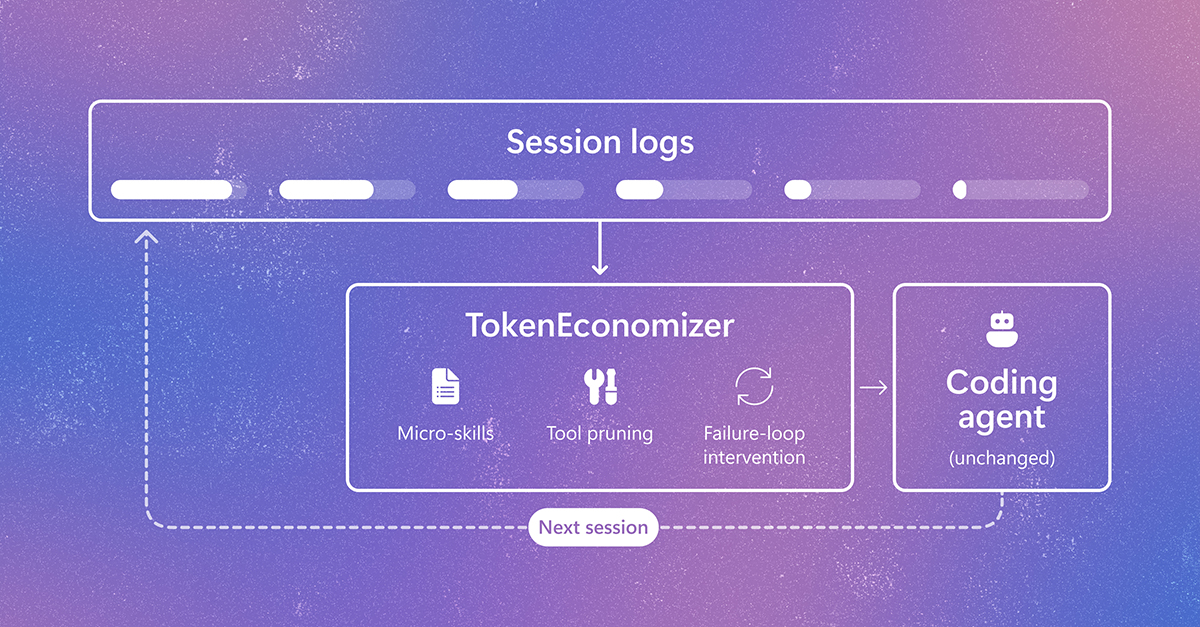
AI coding agents are increasingly help developers fix bugs and build features largely on their own, but every interaction with their models consumes tokens. In each session, an agent sends instructions, tool descriptions, and session history to its model. Most efforts to reduce this cost focus on individual tasks. Yet developers return to the same […] The post TokenEconomizer: Learning from Experience to Make AI Coding Agents More Efficient appeared first on Microsoft Research.
MIT News · Artificial Intelligence· news.mit.eduNov 13, 2026