These results connect operator structure to operating energy and show how update frequency and execution lifetime govern the benefit of computation reuse in physical-field virtual sensing.
Abstract
Virtual sensing repeatedly reconstructs physical fields from changing observations, often on a fixed geometry. We investigate how shared spatial computation reduces the energy of these updates while retaining the selected checkpoint and its evaluated predictions. In a heat-exchanger service, standard compiler freezing and explicit trunk reuse give similar operating energy reductions relative to graph replay: approximately 1% at one request per second and 20% at forty requests per second. In 15 W mode with fixed clocks, reuse with graph replay completes the same request sequence with 22.0 to 22.5% less energy than eager execution, including preparation and waiting. DeepONet and Fourier neural operator (FNO) controls distinguish the effects of reusable arithmetic and launch overhead. Preparation, artifact construction, and worker replacement add costs outside repeated inference. These results connect operator structure to operating energy and show how update frequency and execution lifetime govern the benefit of computation reuse in physical-field virtual sensing.
Real-time monitoring of safety-critical interior states remains an open problem across energy, environmental, and industrial systems where direct instrumentation is infeasible. Existing approaches based on governing equations, discrete state vectors, or fixed sensor locations fail to provide mesh-independent, field-lev...
Kazuma Kobayashi, Farid Ahmed, Jaewan Park et al.· Nature Communications· 0 citations
Can programmable radio propagation serve as computational depth rather than only as a communication channel or one-shot analog transform? We introduce the Radio Alternating Operator Ansatz (RAOA), a recurrent computing architecture that alternates an energy-derived problem update with a mixing update over a persistent...
FieldRT is presented, an algorithm-hardware co-design methodology that uses a common analysis of geometric sensitivity and data lifetime to derive both the deployment profile and its spatial realization, and translates the retained geometric structure into a parameterized streaming architecture that shares field access...
Quantization can lower the energy of language-model calls and free memory for serving more agents, but its benefit per completed task remains unclear when agents share a GPU. Measurements of fixed requests or isolated agents leave open how the agents'generated work interact with competition for compute and cache. We pr...
Stephen Abkin, Alex Flesher, Aldric Yang et al.· 0 citations
Energy is now a primary constraint for modern machine-learning training and inference, from hyperscale data centers to battery-constrained edge devices. Prior surveys cover efficient and green deep learning, edge artificial intelligence (AI), accelerator architectures, lifecycle-level energy reduction, and measurement...
Zu-Xiong Tan, Ali Karkehabadi, Ning Miao et al.· IEEE Access· 0 citations
Training-free feature reuse accelerates diffusion transformer inference by replacing full denoising computation at selected steps with cached approximations. Existing methods mainly improve the reconstruction of skipped features, but we find that once a stable first-order reconstructor is used, increasing reconstructio...
Qinhan Lyu, Jusheng Zhang, Zhixing Zhang et al.· 0 citations
Related blog posts
MIT News · Artificial Intelligence· news.mit.eduNov 17, 2026
By studying the computational foundations of language learning, Associate Professor Jacob Andreas builds intelligent systems that can communicate effectively with humans.
Microsoft Research Blog· microsoft.comNov 16, 2026
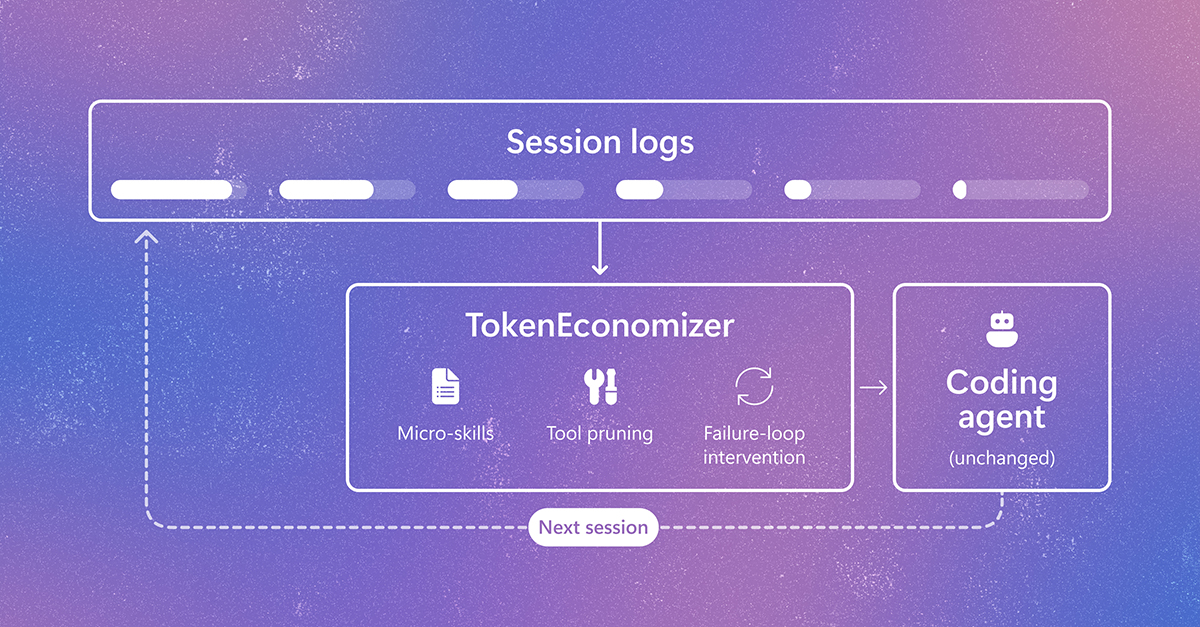
AI coding agents are increasingly help developers fix bugs and build features largely on their own, but every interaction with their models consumes tokens. In each session, an agent sends instructions, tool descriptions, and session history to its model. Most efforts to reduce this cost focus on individual tasks. Yet developers return to the same […] The post TokenEconomizer: Learning from Experience to Make AI Coding Agents More Efficient appeared first on Microsoft Research.
MIT News · Artificial Intelligence· news.mit.eduNov 13, 2026