This work introduces an algorithm for learning Boltzmann distributions that does not require any true samples for training and establishes a new method for sample-free learning of complex physical distributions.
Abstract
Efficient sampling from Boltzmann distributions is central to modelling complex physical systems. Markov Chain Monte Carlo (MCMC) methods suffer from critical slowing down, high autocorrelation, and poor mode-mixing, limiting their scalability. Recent advances, like Boltzmann Generators, offer a promising alternative but remain constrained by costly MCMC-based training, inefficient sampling, and poor ergodicity. We introduce an algorithm for learning Boltzmann distributions that does not require any true samples for training. Our approach draws inspiration from flow matching but departs fundamentally from sample-trajectory matching to distribution-trajectory matching. The algorithm iteratively reshapes the target distribution, using model generated samples to guide learning and ensure comprehensive mode coverage. We validate our method on standard benchmarks, including a 2D Gaussian mixture, Many-Well distributions, and high-dimensional scalar $\phi^4$ theory. The proposed approach not only improves sampling performance and accuracy over traditional MCMC and flow-based baselines but also establishes a new method for sample-free learning of complex physical distributions.
Normalizing Flow Flow Maps (NF$^2$M), which combines the strengths of recent stochastic flow maps with the tractability of classic normalizing flows to build a Boltzmann Generator, and is evaluated on peptide systems, demonstrating improved sampling efficiency and sample quality.
Louis Grenioux, Rui-Kang Ouyang, Lu-Huan Wu· arXiv.org· 0 citations
This work develops a novel sampling algorithm, Neural Transport Nested Sampling (NTNS), which combines the classical strengths of nested sampling with modern neural flow-based methods, and is the first neural sampler to return a calibrated, temperature resolved partition function estimate at this scale.
We introduce an algorithm for efficiently preconditioning log-concave and log-smooth distributions that scales logarithmically with the condition number of the underlying distribution. Based on Gaussian cooling, our multistage method approximately samples from a sequence of well-conditioned distributions to construct a...
Nii-MALA is introduced, a high-performance C implementation of the Metropolis-Adjusted Langevin Algorithm, which leverages Message Passing Interface for parallelization and incorporates automatic differentiation backends for gradient evaluation and benchmark it against several other codes using radial velocity data fro...
Jia-Men Jiao, Sheng Jin, Wen-Xin Jiang et al.· Publications of the Astronom...· 0 citations
SIMANF, a sample free framework that integrates simulated annealing with normalizing flows, and demonstrates its effectiveness on Many-Well distributions and high dimensional Scalar Phi4 lattice field theory distribution.
Sampling from the posterior is the central task of computational Bayesian inverse problems. The standard workhorse in Bayesian inference---Markov chain Monte Carlo (MCMC)---is sequential, yields correlated samples, and must be rerun for each new observation. Conditional flow matching offers an amortized alternative: a...
Jan Blechschmidt, O. Ernst, Moritz Poguntke et al.· 0 citations
Related blog posts
MIT News · Artificial Intelligence· news.mit.eduNov 17, 2026
By studying the computational foundations of language learning, Associate Professor Jacob Andreas builds intelligent systems that can communicate effectively with humans.
Microsoft Research Blog· microsoft.comNov 16, 2026
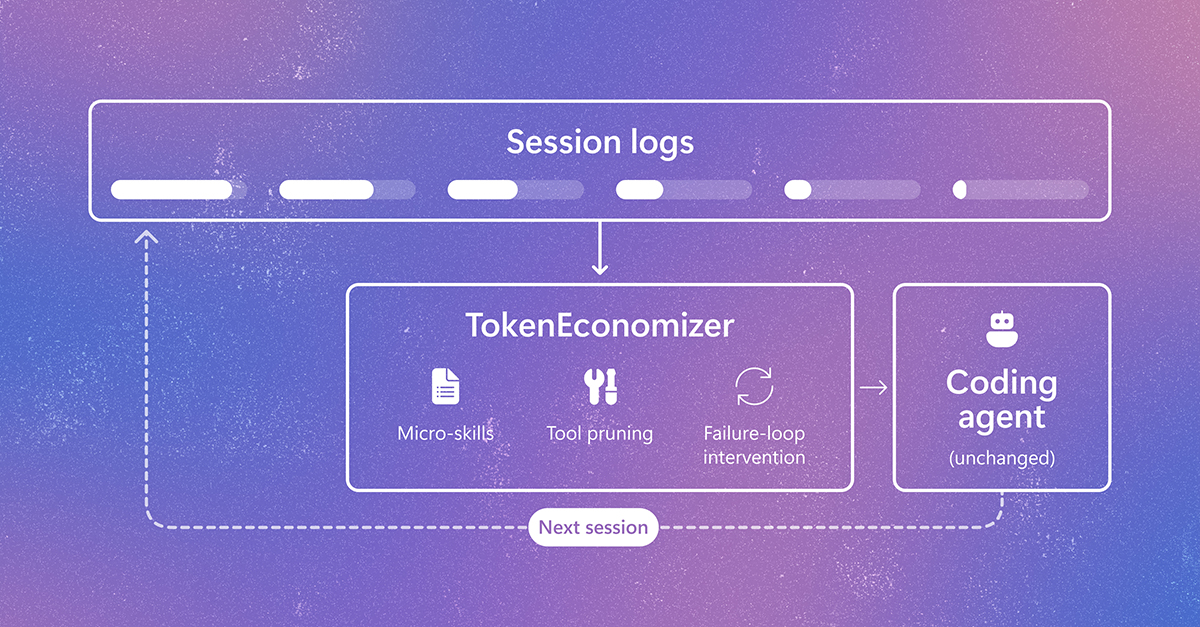
AI coding agents are increasingly help developers fix bugs and build features largely on their own, but every interaction with their models consumes tokens. In each session, an agent sends instructions, tool descriptions, and session history to its model. Most efforts to reduce this cost focus on individual tasks. Yet developers return to the same […] The post TokenEconomizer: Learning from Experience to Make AI Coding Agents More Efficient appeared first on Microsoft Research.
MIT News · Artificial Intelligence· news.mit.eduNov 13, 2026