This paper formalizes data-dependent parameter symmetries and characterize loss invariance and the group-action axioms through infinitesimal conditions, which provide objectives for jointly learning group generators and nonlinear action maps.
Abstract
Parameter space symmetries are important for understanding neural networks'loss landscape, training dynamics, and generalization. However, systematically identifying these symmetries remains a challenge. In this paper, we formalize data-dependent parameter symmetries and characterize loss invariance and the group-action axioms through infinitesimal conditions, which provide objectives for jointly learning group generators and nonlinear action maps. Our framework systematically uncovers parameter symmetries, including previously unknown ones. To study larger networks, we establish conditions under which subnetwork symmetries extend to the full model. The same construction gives an explicit family of finite-batch symmetries, providing both analytical examples and a foundation for discovery through small subnetworks. Using the infinitesimal characterization and subnetwork construction, we implement a framework for automated discovery of parameter symmetries, and successfully uncovered symmetries in various architectures, including pretrained transformer models.
A notion of compositional identifiability is introduced and used to establish a general inheritance principle for complete characterizations of symmetries and conservation laws in multilayer networks.
A systematic understanding of the global structure of neural-network loss landscapes remains challenging due to their high dimensionality. Symmetries arising from network architectures and learning objectives provide a way to investigate aspects of this structure. Although a growing number of studies have drawn attenti...
Learning in a neural network takes place on a high dimensional, non-convex loss landscape, the Hessian curvature of which dictates the learning dynamics. Despite its high dimensionality, the large number of architectural symmetries explains some of the geometric of this landscape, in particular flat directions, i.e. ne...
Ibrahim Talha Ersoy, B. Ladewig, Karoline Wiesner· 0 citations
This work studies the LLC of a graph attention model by exploiting symmetries in both the graph structure and the attention parameters, and develops an analytic framework through a teacher--student setting and explicit LLC estimates after considering the symmetry--induced degeneracies.
Vishnu Varadarajan, Mihir More, Aritra Das et al.· 0 citations
Continuous symmetry discovery is typically formulated as a separate estimation problem for each function or dataset. We instead investigate whether the map from a function to its symmetry structure can be learned across a family of functions from finite observations. Using the infinitesimal differential characterizatio...
Pavan Karjol, Scindhiya Laxmi, A. Prathosh· 0 citations
Representations are routinely used across machine learning, psychology, and neuroscience to draw inferences about the computations of biological and artificial systems. Such inferences presume a meaningful link between representational geometry and the computation being performed. For artificial neural networks, howeve...
Marvin Theiss, Lukas Braun, Andrew M. Saxe et al.· 0 citations
Related blog posts
MIT News · Artificial Intelligence· news.mit.eduNov 17, 2026
By studying the computational foundations of language learning, Associate Professor Jacob Andreas builds intelligent systems that can communicate effectively with humans.
Microsoft Research Blog· microsoft.comNov 16, 2026
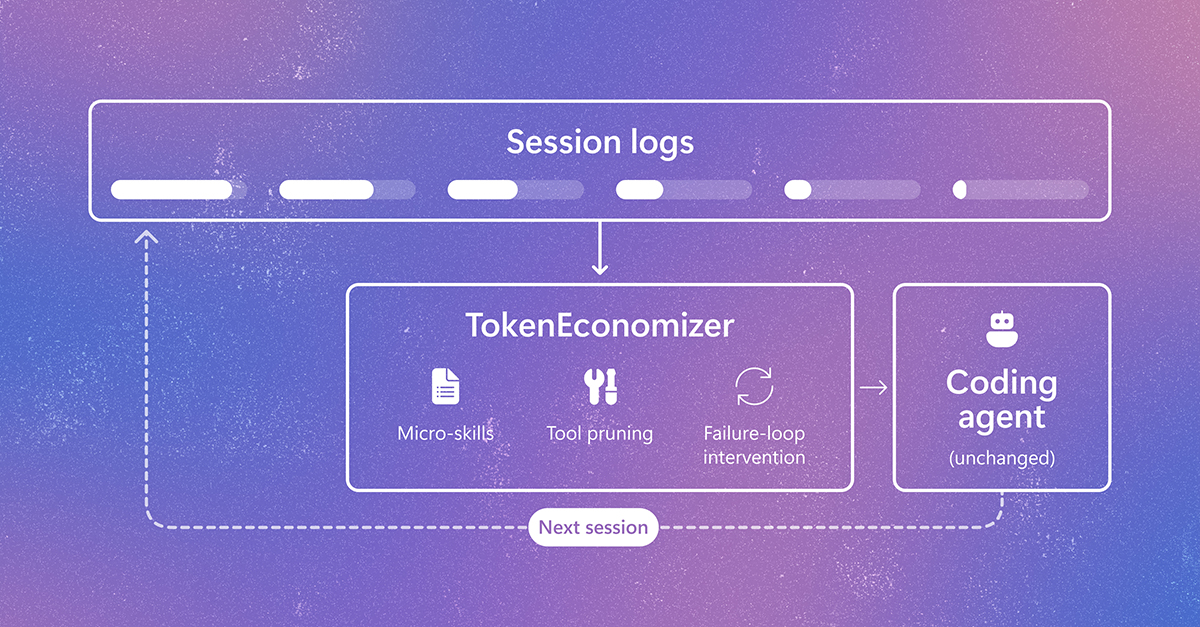
AI coding agents are increasingly help developers fix bugs and build features largely on their own, but every interaction with their models consumes tokens. In each session, an agent sends instructions, tool descriptions, and session history to its model. Most efforts to reduce this cost focus on individual tasks. Yet developers return to the same […] The post TokenEconomizer: Learning from Experience to Make AI Coding Agents More Efficient appeared first on Microsoft Research.
MIT News · Artificial Intelligence· news.mit.eduNov 13, 2026