Skip to content

GeoGAE: Scalable Graph-Level Autoencoding via Hyperball Cloud Representations

Sep 2026 · 0 citations · 53 references
Computer Science

TL;DR

This work proposes GeoGAE, an autoencoder, in which the Transformer encoder translates a hyperball cloud into a graph-level embedding, and the Transformer decoder translates the graph-level embedding back into the graph.

Abstract

Embedding structured objects into Euclidean spaces has enabled a wide range of successful machine learning applications. Such objects include words, documents, image patches, time series, and graph nodes. In contrast, embedding entire graphs remains a challenging problem. Existing methods either sustain the original order of the graph nodes or match the output nodes to the input ones, both of which create scalability issues. In this work, we propose a graph representation as a cloud of hyperballs, which allows us to define a specific, typically unique, node ordering. Based on this representation, we propose GeoGAE, an autoencoder, in which the Transformer encoder translates a hyperball cloud into a graph-level embedding, and the Transformer decoder translates the graph-level embedding back into the graph. This formulation enables the model to capture both the global graph structure and local relational patterns. We evaluate our method on multiple graph datasets, spanning various domains. The results demonstrate effectiveness of our method in encoding and reconstructing graphs from their embeddings.
View source

Similar papers

#artificial intelligence Preprint Oct 2026

Batch Before You Lift: Scalable Topological Deep Learning on Large Graphs

Cluster-TNN is introduced, a domain-agnostic framework that avoids this bottleneck by lifting locally instead, and enables the first training of multiple different higher-order Topological Neural Networks on large datasets such as Reddit and OGBN Products.

David Leko, Luka Beni'c, Guillermo Bernárdez et al. · 1 citation
Preprint Oct 2026

Implicit Feature Reweighting for Label-Free Graph Generalization

Graph-level out-of-distribution (OOD) generalization is critical for deploying graph neural networks in real-world applications where distribution shifts are inevitable. Existing approaches typically require class labels during representation learning to decide which substructures are predictive, limiting their applica...

Tian-Jun Yao, Cheng-Hu Xi, Xin-Yang Li et al. · 0 citations
Review Nov 2026

Multimodal Graph Learning: A Survey of Models, Benchmarks, and Frontiers

Multimodal attributed graphs (MAGs), in which nodes carry text, images, and other modalities while edges encode relations among entities, underlie e-commerce, social media, content platforms, and creative applications. Learning on MAGs has developed along two complementary lines: graph-centric methods redesign how moda...

Rui Xue, Tian-Fu Wu · 0 citations
Book Open access Nov 2026

ID2GL: Incremental Node Representation Learning on Large-Scale Dynamic Directed Graphs

Node representation learning on dynamic graphs is a fundamental task for numerous real-world applications. However, existing dynamic Graph Neural Networks (GNNs) face two critical challenges: (1) the inability to effectively model crucial directional information inherent in many real-world interactions, and (2) suffer...

Ze-Ning Li, Rong-Hua Li, Yi-Chun Yang et al. · 0 citations

Related blog posts

MIT News · Artificial Intelligence Nov 17, 2026

Learning the language of machine learning

By studying the computational foundations of language learning, Associate Professor Jacob Andreas builds intelligent systems that can communicate effectively with humans.

Microsoft Research Blog Nov 16, 2026

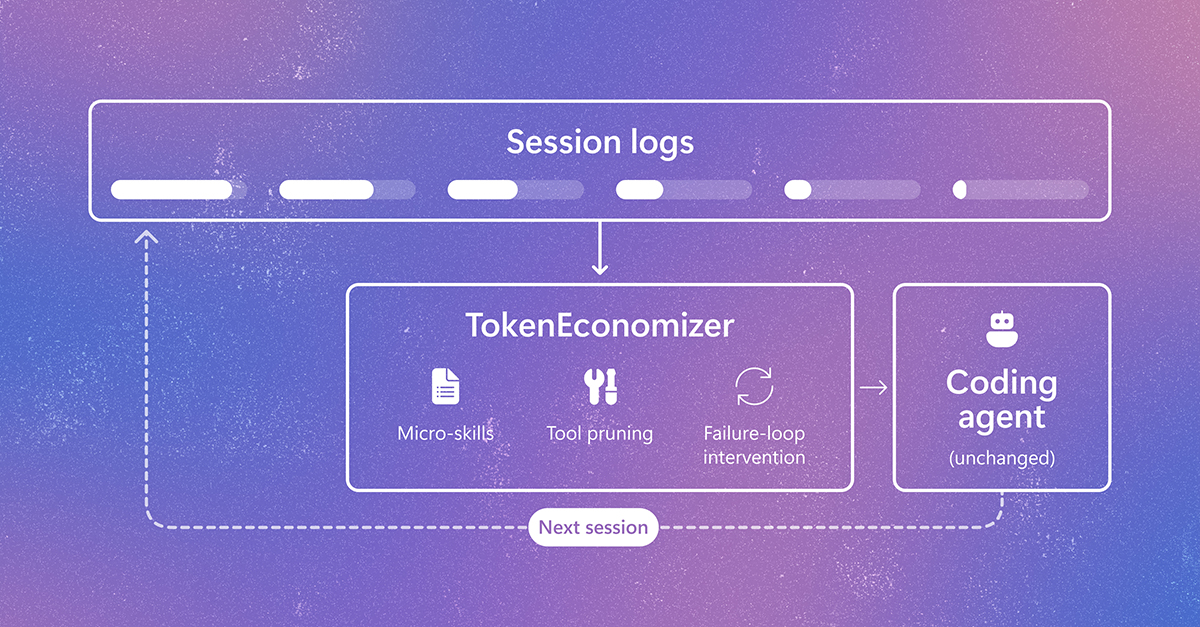
TokenEconomizer: Learning from Experience to Make AI Coding Agents More Efficient

AI coding agents are increasingly help developers fix bugs and build features largely on their own, but every interaction with their models consumes tokens. In each session, an agent sends instructions, tool descriptions, and session history to its model. Most efforts to reduce this cost focus on individual tasks. Yet developers return to the same […] The post TokenEconomizer: Learning from Experience to Make AI Coding Agents More Efficient appeared first on Microsoft Research.

We use cookies to run the site and, with your consent, for analytics and to show ads. See our Cookie Policy.