Joint-embedding predictive architectures are unusually sensitive to how the input is masked: block masks work, scattered masks do not, and the explanations are empirical. We give a measurement account. A mask is a linear measurement, and in a compactly supported wavelet basis every atom whose support lies inside the hidden region falls in the measurement's null space and leaves no trace in the data. The JEPA loss asks only that the encoded context suffice for the target, so a target that a low-level prior can recover admits a shortcut, one the moving-average target encoder can make self-consistent. What removes the shortcut is the coarse-scale content the mask leaves unrecoverable, provided enough context stays within reach of each target. We score that content before training and test the account's distinctive predictions in 151 pre-training runs. On ImageNet-100, strip masks match blocks in area and contiguity yet are recoverable, and they land at 40.3% linear top-1, beside random masks at 40.8%, against 64.3% for blocks; within one geometry family, the placements that leave the least unrecoverable content lose 6.5 points to those that leave the most, over five seed pairs; pixel targets span 7 points where latent targets span 25; and against a frozen target the gap between random and block masks, 19 points on the same kind of GPU, closes to 1.5, so the geometry acts through the target the encoder produces for itself. On UCF101 the masking ratio decides which condition, content or reach, binds; removing whole frames, unrecoverable in space but recoverable from neighbouring frames, is worst at both ratios; and on V-JEPA's own masks, batching them intact instead of truncated changes little (36.0% against 35.1%), whereas making 100 target tokens inside the blocks visible lifts them to 48.7% and hiding 100 context tokens outside the blocks does not (33.7%).
This publication proposes a definition and a classification of agile software development approaches and analyses ten software development methods that can be characterized as being "agile" against the defined criterion.
P. Abrahamsson, O. Salo, Jussi Ronkainen et al.· arXiv.org· 727 citations· ⚡54
The study shows that agile practices improve both informal and formal communication, but indicates that, in larger development situations involving multiple external stakeholders, a mismatch of adequate communication mechanisms can sometimes even hinder the communication.
M. Pikkarainen, Jukka Haikara, O. Salo et al.· Empirical Software Engineeri...· 401 citations· ⚡48
The results indicate that software engineering work practices are chosen opportunistically, adapted and configured to provide value under the constrains imposed by the startup context.
Nicolò Paternoster, Carmine Giardino, M. Unterkalmsteiner et al.· Information and Software Tec...· 394 citations· ⚡54
The possibility of inferring high-dimensional data inference in a model that consists of a prior and an auxiliary differentiable constraint given some additional information is considered, thereby allowing a range of potential applications in adapting models to new domains and tasks.
Alexandros Graikos, Esmeralda S. Whitammer, N. Jojic et al.· Neural Information Processin...· 316 citations· ⚡15
Exploring how generative AI could make machine vision more accessible to businesses. The post GenEye in a Box: Making Machine Vision Something You Can Just Ask For appeared first on GPT-Lab.
Microsoft Research Blog· microsoft.comAug 11, 2026
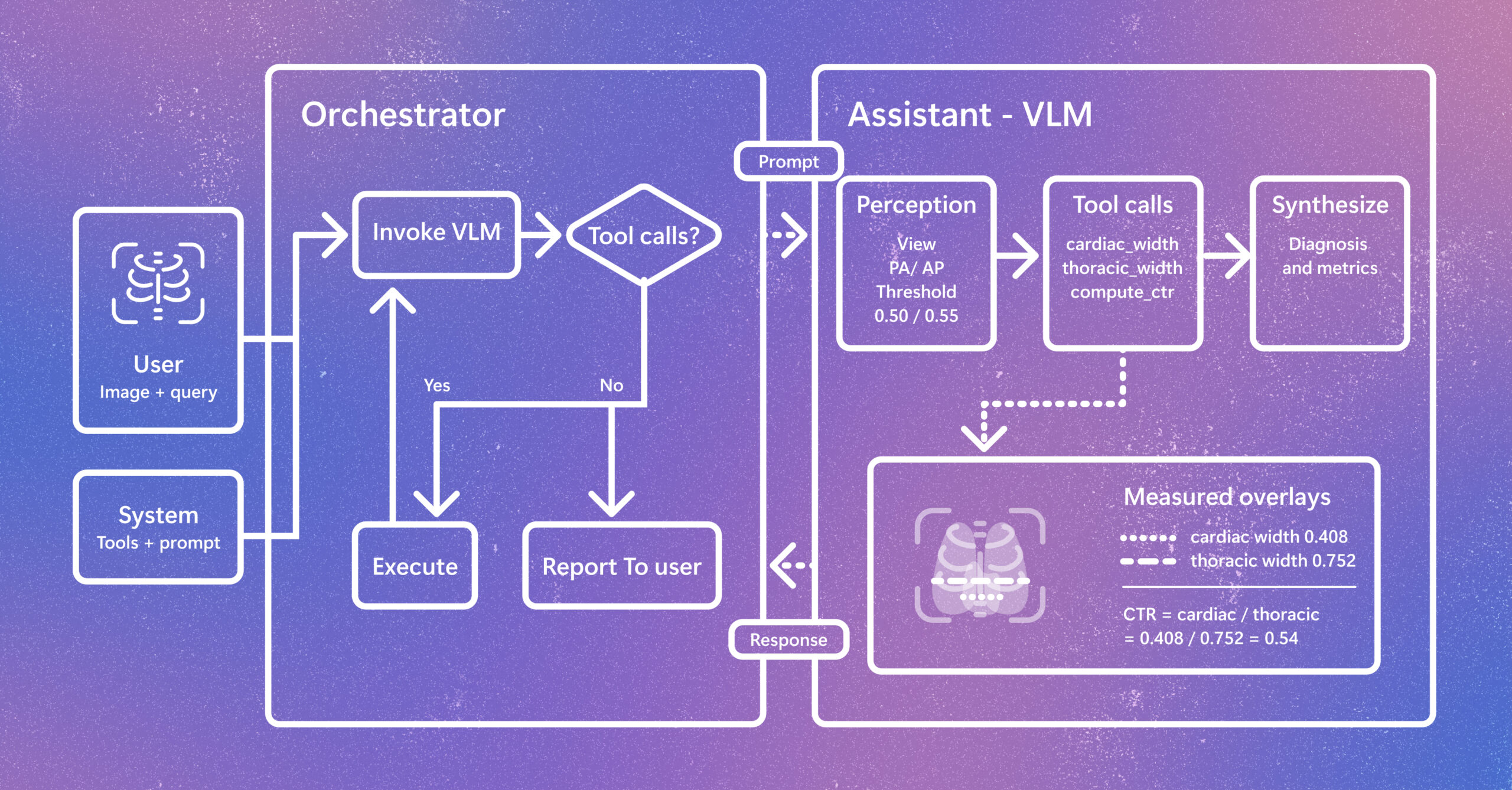
Radiology AI is evolving beyond report generation. CARE-X explores a unified approach that combines flexible reasoning, calibrated predictions, and measurement-based tools for chest X-ray interpretation. The post Introducing CARE-X: Towards Clinically Useful Radiology VLMs with Auxiliary Supervision, Reward-Aligned Learning, and Tool-Augmented Measurement appeared first on Microsoft Research.
Students in MIT’s Concourse program delve deeply into the human condition, debate challenging questions, and learn to develop judgment about issues that can’t be quantified.
We use cookies to run the site and, with your consent, for analytics and to show ads.
See our Cookie Policy.