A unified theory for RE(S) is developed that covers the full spectrum of S, and can be interpreted as a stage-wise optimization process, where each stage takes $S$ gradient steps for minimizing the Kullback-Leibler distance to a fixed reward-weighted rollout distribution.
Abstract
We study the learning dynamics of fine-tuning a policy model on self-generated and reward-weighted data, with particular focus on a generalized version of REINFORCE -- referred to as RE(S) -- that updates the rollout distribution once every $S \ge 1$ gradient steps. Prior work in bandits and reinforcement learning has developed rich theory for policy gradient methods, and on-policy sampling (i.e., a small $S$, ideally $1$) is often viewed as crucial to their success; yet in prominent application like post-training large language models, reward-guided self-training has proved to be effective even when the rollout distribution is updated infrequently, but theoretical understanding remains limited for the convergence properties of these off-policy methods. To bridge these gaps, we develop a unified theory for RE(S) that covers the full spectrum of $S \ge 1$: it can be interpreted as a stage-wise optimization process, where each stage takes $S$ gradient steps for minimizing the Kullback-Leibler distance to a fixed reward-weighted rollout distribution. For multi-arm bandits with softmax policies, our in-depth analysis and numerical experiments reveal three key findings: (1) for any fixed $S$, RE(S) enjoys global convergence to the optimal policy as the number of rollout distribution updates $B = \lfloor T / S \rfloor \rightarrow \infty$, where $T$ denotes the number of gradient steps; (2) we prove tight two-sided bounds showing that the suboptimality gap of RE(S) achieves an asymptotic $\Theta(1 / T)$ convergence rate, while $S$ only affects the length of a burn-in phase; (3) when initialized at a weak policy with a small optimal-action probability, RE(1) gets trapped around suboptimal policies for a long period, whereas RE(S) with a suitable $S$ avoids the detour and achieves significantly faster convergence to the global optimum, highlighting the benefits of off-policyness in this case.

The results indicate that software engineering work practices are chosen opportunistically, adapted and configured to provide value under the constrains imposed by the startup context.
Nicolò Paternoster, Carmine Giardino, M. Unterkalmsteiner et al.· Information and Software Tec...· 394 citations· ⚡54
The possibility of inferring high-dimensional data inference in a model that consists of a prior and an auxiliary differentiable constraint given some additional information is considered, thereby allowing a range of potential applications in adapting models to new domains and tasks.
Alexandros Graikos, Esmeralda S. Whitammer, N. Jojic et al.· Neural Information Processin...· 316 citations· ⚡15
It is proved that any global minimizer of the trajectory balance objective can define a policy that samples exactly from the target distribution, and empirically demonstrate the benefits of the trajectories balance objective for GFlowNet convergence, diversity of generated samples, and robustness to long action sequenc...
Esmeralda S. Whitammer, Moksh Jain, Emmanuel Bengio et al.· Neural Information Processin...· 302 citations· ⚡60
The results are packaged in the Greenfield Startup Model (GSM), which explains the priority of startups to release the product as quickly as possible, and the need to shorten time-to-market, by speeding up the development through low-precision engineering activities.
Carmine Giardino, Nicolò Paternoster, M. Unterkalmsteiner et al.· IEEE Transactions on Softwar...· 178 citations· ⚡14
This state-of-practice investigation was performed using a literature review followed by a multiple-case study approach and presents how inconsistency between managerial strategies and execution can lead to failure by means of a behavioral framework.
Carmine Giardino, Xiaofeng Wang, P. Abrahamsson· International Conference on...· 175 citations· ⚡19
Software startup companies develop innovative, software-intensive products within limited timeframes and with few resources, searching for sustainable and scalable business models.
M. Unterkalmsteiner, P. Abrahamsson, Xiaofeng Wang et al.· e-Informatica Software Engin...· 157 citations· ⚡17
Adaptive AI agents can help make BIM data more machine-readable by navigating IFC models, interpreting inconsistent information, and mapping it to defined standards. In this blog, Alok Rawat shares findings from a real-world pilot in construction workflows. The post Adaptive AI Agents in Construction Workflows appeared first on GPT-Lab.
What does it take to trust AI-driven HVAC optimization? Our AI Model Factory combines agents, machine learning, reinforcement learning and deterministic checks in a governed workflow designed for messy, real-world building data. The post We built an AI factory for HVAC control appeared first on GPT-Lab.
MIT News · Artificial Intelligence· news.mit.eduAug 18, 2026
A new method for surgically removing training examples from a model reveals that as datasets grow, the link between what a model learns and what it produces dissolves.
Microsoft Research Blog· microsoft.comJul 30, 2026
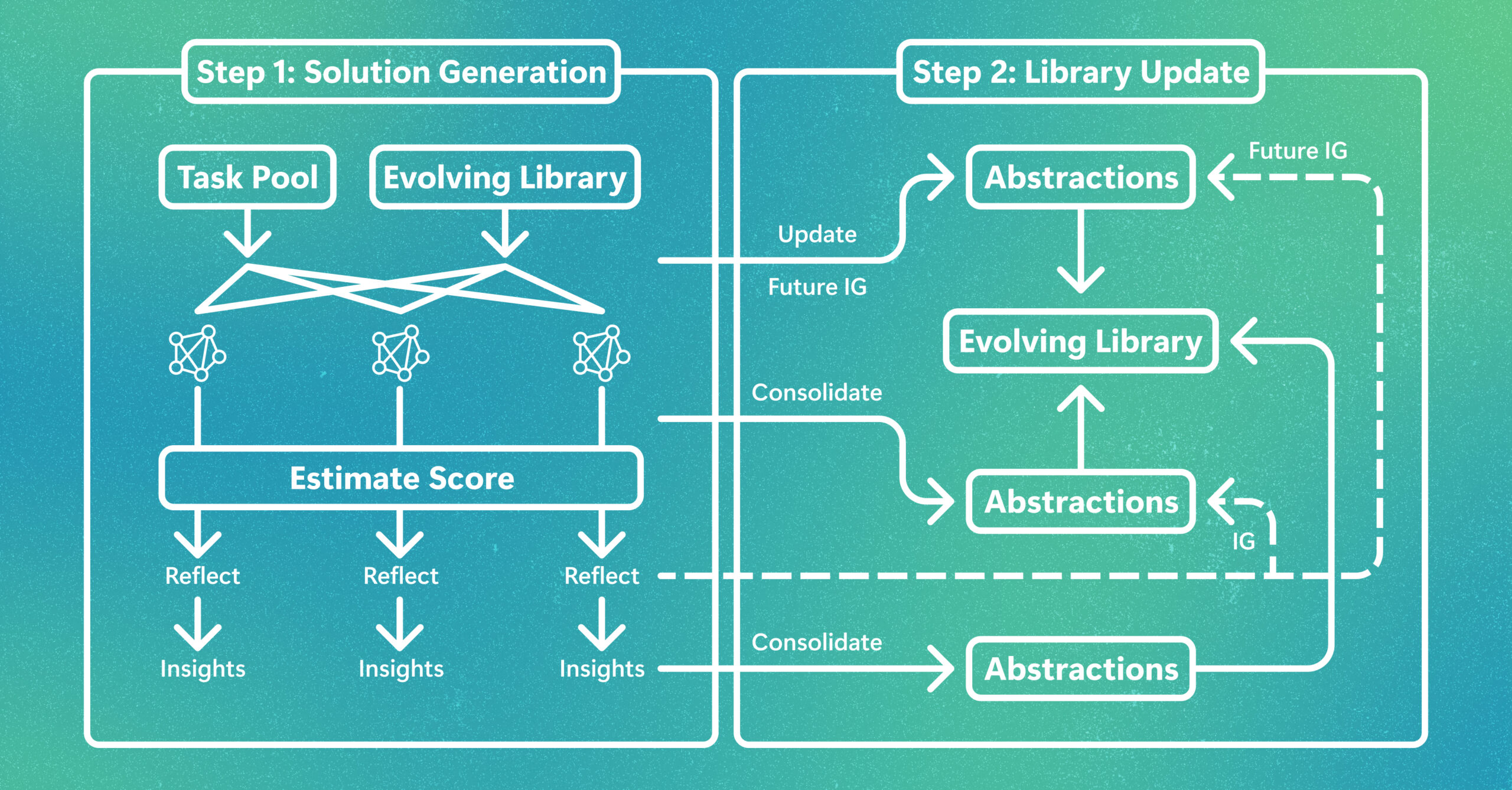
LLMs do not get smarter just by remembering more. EvoLib turns experience into evolving knowledge, taking reusable skills and insights that help models learn and adapt across tasks long after deployment. The post EvoLib: Turning experience into evolving knowledge appeared first on Microsoft Research.
We use cookies to run the site and, with your consent, for analytics and to show ads.
See our Cookie Policy.