The proposed World-As-Graph (WAG) is a graph-based object-centric world model that introduces relational inductive bias into JEPA-style predictive representation learning and could demonstrate the superior performance of the proposed WAG on both visual reasoning and robotic manipulation tasks.
Abstract
World models aim to learn representations of real-world environments and predict their future evolution. Recent object-centric world models have made expressive progress by representing visual scenes as sets of object-level latent states, but object-object relations are often captured only implicitly, which limits explicit relational and temporal structure modeling and object-centric dynamic memory modeling. To address such challenges, we propose World-As-Graph (WAG), a graph-based object-centric world model that introduces relational inductive bias into JEPA-style predictive representation learning. The proposed WAG contains two main modules: (1) Relation-aware structure induction, which constructs time-varying latent graphs from object-centric slots and designs relation-aware object masking policies to guide relational object representation learning in latent space; (2) Object-centric memory transition, which maintains and updates object-level dynamic states by combining relational information from neighboring objects with historical memory, enabling effective autoregressive future prediction. Extensive experiments on both visual reasoning and robotic manipulation tasks could demonstrate the superior performance of our proposed WAG.

World models infer latent states of an environment to capture its underlying dynamics and predict future evolution. Many real-world environments, however, are inherently relational and observed as evolving graphs, where entities, relations, and their properties change over time. Prior graph-related world models use gra...
This work constructs actor-centric scene graphs from nuScenes 3D annotations, encode their serialized relational structure using a frozen text embedding model, and align the visual latent representations with this semantic target during training, supporting the benefit of explicit relational structure for latent world-...
Fabian Schmidt, Markus Enzweiler, Abhinav Valada· 0 citations
As a prototypical latent world model, Joint-Embedding Predictive Architectures (JEPAs) provide strong semantic representations. However, dense patch representations expose a redundant interface to downstream predictors, which must implicitly infer spatial organization and temporal correspondence, presenting three chall...
Pei-Song Wen, Qian-Qian Xu, Min-Ye Lei et al.· 1 citation
DyG-WM is proposed, the first framework to jointly predict future node and relation representations from temporal context by answering three questions: what has evolved, how it evolved, and what will evolve next.
Joint-embedding predictive architectures (JEPAs) learn world models in latent space, enabling efficient planning but leaving their states opaque. We introduce Inside-JEPA, which places relational channels for ordered entity pairs inside the JEPA latent state and shows that an inverse-dynamics loss can ground these chan...
Graph-based world models have recently emerged as a means of learning transitions over relational state representations. However, existing approaches are largely limited to fixed-topology graphs or deterministic, fully observable environments. We propose the Graph Dynamics Model (GDM), a world model for graph-structure...
Alex Schutz, Nick Hawes, Victor-Alexandru Darvariu· 0 citations
Related blog posts
MIT News · Artificial Intelligence· news.mit.eduOct 28, 2026
Professor Paris Smaragdis develops computers with superhuman hearing for applications like speech recognition, music understanding, and environmental monitoring.
Exploring how generative AI could make machine vision more accessible to businesses. The post GenEye in a Box: Making Machine Vision Something You Can Just Ask For appeared first on GPT-Lab.
Microsoft Research Blog· microsoft.comAug 11, 2026
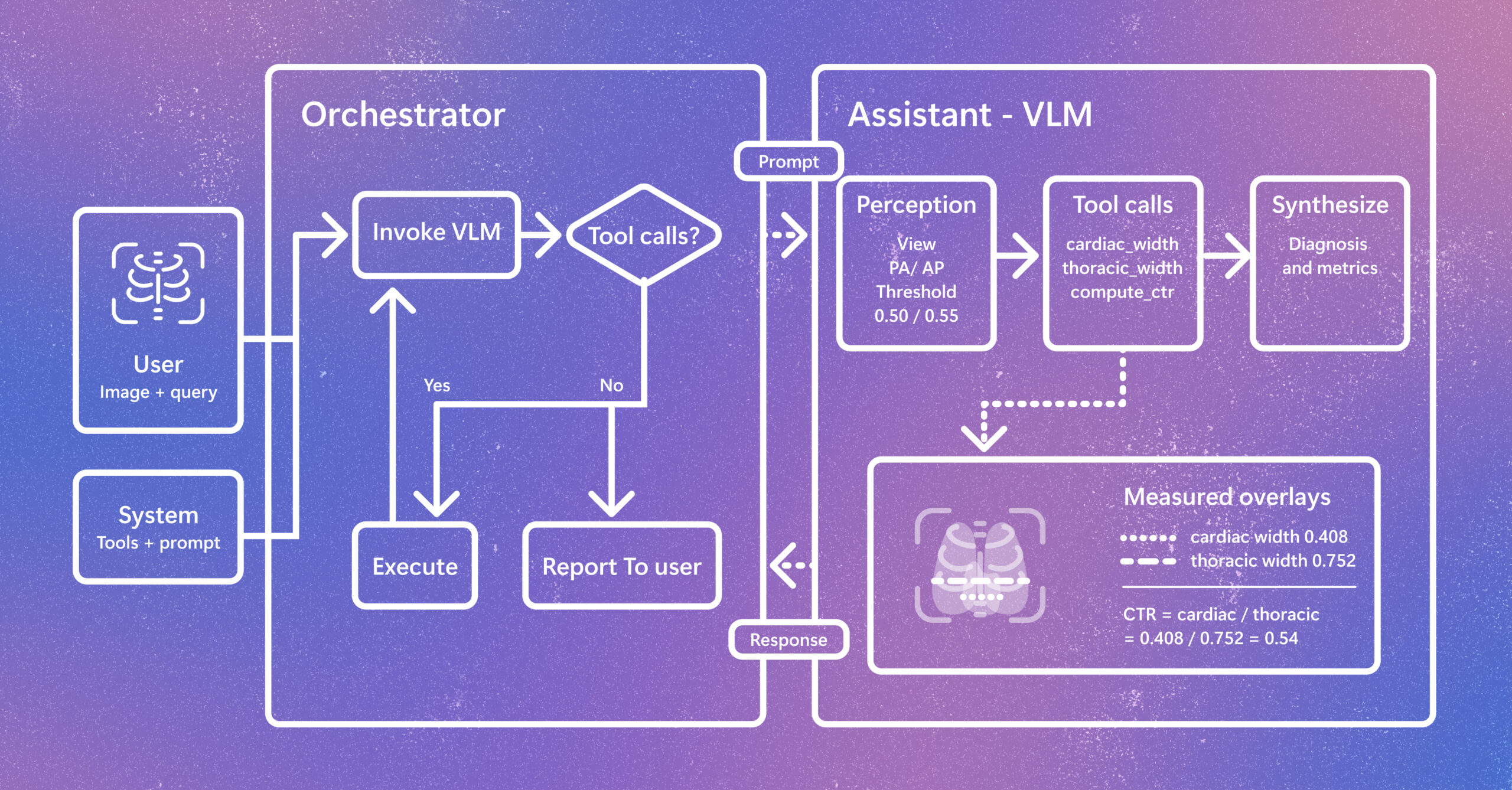
Radiology AI is evolving beyond report generation. CARE-X explores a unified approach that combines flexible reasoning, calibrated predictions, and measurement-based tools for chest X-ray interpretation. The post Introducing CARE-X: Towards Clinically Useful Radiology VLMs with Auxiliary Supervision, Reward-Aligned Learning, and Tool-Augmented Measurement appeared first on Microsoft Research.