Skip to content

Backward-State Policy Is Part of the Learning Algorithm

Sep 2026 · 0 citations · 52 references
Computer Science

TL;DR

Backward-state policy is argued that it is part of the learning algorithm, and that neither check shows whether it is right, and should be specified and checked use by use, not settled by copy accuracy and final loss.

Abstract

Low-precision training rounds tensors that the backward pass reads again, often for several gradients; each use can read the forward's rounded value, the original, or a new random rounding. This backward-state policy looks like a memory and precision detail, settled by copy accuracy and final loss. We argue that it is part of the learning algorithm, and that neither check shows whether it is right. Copy accuracy does not decide the outcome: in three pairs of 390M runs with an emulated FP8 backward, training fails when attention's backward reuses the forward's rounded output and succeeds with a new rounding from the same distribution. Even the most accurate copy, the original itself, can be wrong by our reference: the gradient of the forward pass as it actually ran, with gradients passed through rounding unchanged. For example, a normalization output stored in low precision feeds two gradients: the gain's gradient needs the original, but the next layer's weight gradient needs the rounded value that layer multiplied. Final loss, the other check, does not rule out the error of reading the original for both: it persists in models trained with such a store, while planned loss comparisons stay within a margin fixed in advance. We therefore derive from this reference which value each use must read, or which substitute gives the same gradient on average with the forward held fixed, and check these per-use requirements on single operators, without training. In three tests using PyTorch and Transformer Engine, the requirements predicted beforehand whether reuse changes what the backward computes on average relative to an independent copy, and every prediction held. Backward-state policy is thus part of the learning algorithm: it should be specified and checked use by use, not settled by copy accuracy and final loss.


View source

Similar papers

#machine learning Preprint Sep 2026

When Does Backpropagating Through Policy Memory Matter? Physical Credit, Optimizer Updates, and Observability

M measuring the cost of a memory cut by training with it from initialization, and comparing backward graphs by the updates the optimizer applies rather than by raw gradients suggest the cost of a memory cut should be measured by training with it from initialization.

Xing-Jian Li, Yi Han, Jian-Hua Z. Huang · 0 citations
#machine learning Preprint Oct 2026

Error Correction in Trained TTT Layers

Test-time-training (TTT) layers update fast-weight memory while processing an input sequence. A gradient-based update, however, does not by itself establish how the memory revises an existing association. We study the structure and empirical role of prediction-derived updates in released TTT implementations. For dot-pr...

Yu-He Hu · 0 citations

Same Loss, Different Gradients

Differentiable learning typically assumes that the scalar objective evaluated in the forward pass and the gradient supplied to the optimizer in the backward pass describe the same mathematical object. We show that this correspondence can fail when probabilistic objectives rely on finite special-function recurrences, cu...

Ning-Kang Peng, Xiao-Qian Peng, Yi-Fan He et al. · 0 citations
#machine learning Preprint Oct 2026

Towards Looped Models Done Right, Part II: Rethinking at Fixed Points

This work improves the two components of training that shape these fixed points: the depth prior and input injection, and learns the prior from prediction feedback, with an entropy term that keeps it broad.

Benhao Huang, Chu-Fan Shi, Jun-Lin Chen et al. · 5 citations · ⚡1
#machine learning Preprint Oct 2026

The Gradient That Top-k Distillation Never Computes

It is proved that it removes the visibility of tail mass, not the freedom to move it, in the top-k distillation pipeline: keep the top-k probabilities, renormalize, and minimize a divergence on what remains.

Rasul Khanbayov, Hasan Kurban · 0 citations
#machine learning Preprint Oct 2026

Planning to Learn

On MNIST and on ImageNet with ResNet-50, ResNet-101 and ViT-S/16, the horizon loss improves top-1 accuracy over cross-entropy at a flat learning rate, and the gain grows with label noise.

Ian Osband · 0 citations

Related blog posts

MIT News · Artificial Intelligence Nov 17, 2026

Learning the language of machine learning

By studying the computational foundations of language learning, Associate Professor Jacob Andreas builds intelligent systems that can communicate effectively with humans.

Microsoft Research Blog Nov 16, 2026

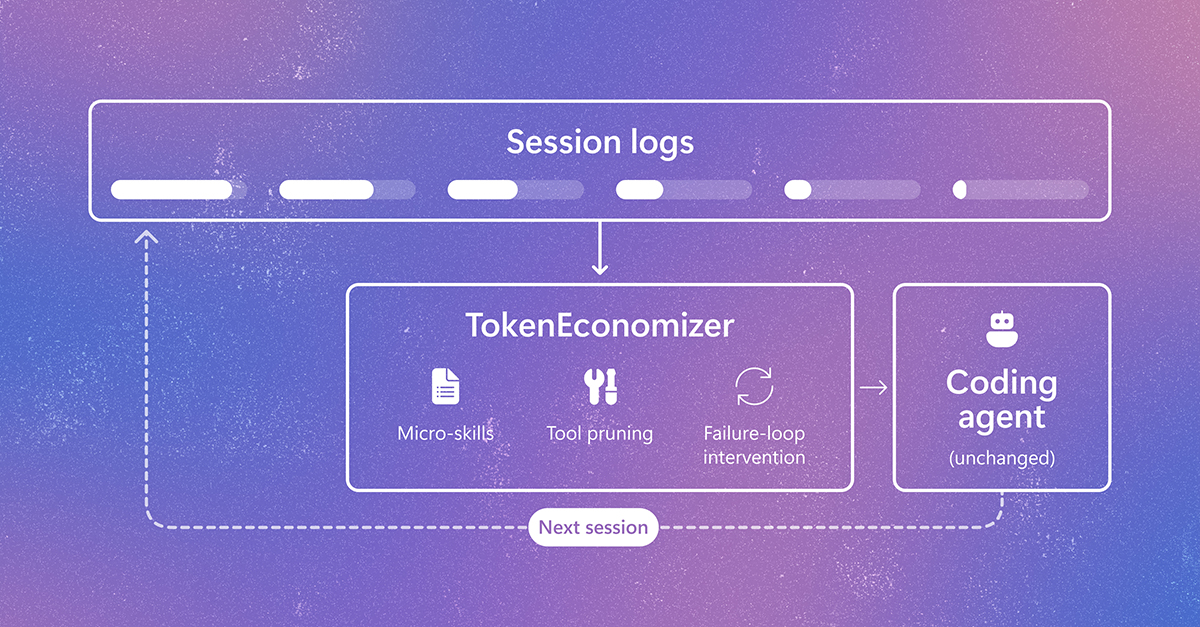
TokenEconomizer: Learning from Experience to Make AI Coding Agents More Efficient

AI coding agents are increasingly help developers fix bugs and build features largely on their own, but every interaction with their models consumes tokens. In each session, an agent sends instructions, tool descriptions, and session history to its model. Most efforts to reduce this cost focus on individual tasks. Yet developers return to the same […] The post TokenEconomizer: Learning from Experience to Make AI Coding Agents More Efficient appeared first on Microsoft Research.

We use cookies to run the site and, with your consent, for analytics and to show ads. See our Cookie Policy.