A historical whitening identifies input directions with strong current-task response relative to accumulated historical response, yielding a task-adaptive basis that remains fixed during training, and an orthonormal basis connects these mechanisms by transferring the factor-update spectrum exactly to the induced weight update.
Abstract
Low-rank adaptation (LoRA) provides a parameter-efficient approach to continual learning, but its nominal rank can conceal a loss of effective adaptation capacity. We identify \emph{spectral plasticity collapse}: during sequential adaptation, update energy becomes concentrated in a small subset of singular modes, leaving much of the available low-rank space underutilized. This exposes a limitation of interference avoidance alone: protecting historical representations does not ensure that the remaining adaptation capacity is responsive to new tasks or effectively utilized. To address this problem, we propose \texttt{MuLoRA}, which jointly controls capacity allocation and utilization. First, historical whitening identifies input directions with strong current-task response relative to accumulated historical response, yielding a task-adaptive basis that remains fixed during training. Second, approximate polar orthogonalization of momentum updates reduces spectral concentration within theselected space. An orthonormal basis connects these mechanisms by transferring the factor-update spectrum exactly tothe induced weight update. We establish a max--min characterization of exact subspace selection and derive cumulative spectral bounds under controlled cross-step anisotropy. Across five class-incremental benchmarks and eight incremental settings, \texttt{MuLoRA} achieves the highest mean accuracy in 15 of 16 reported metrics.

Exemplar-free continual learning on pre-trained Vision Transformers increasingly relies on Low-Rank Adaptation (LoRA), yet prevailing methods govern the low-rank update space through strict subspace isolation. By projecting each incoming task into the approximate null space of historical token activations, isolation-ba...
Tom Saliencro, Wen-Hsuan Liu, Rohan Desai et al.· 0 citations
LoRA-based continual learning methods mitigate catastrophic forgetting through various mechanisms, yet nearly all complement these with small learning rates as a heuristic to restrict gradient scaling magnitude. Such fixed heuristics lack theoretical guidance on how the strength of this restriction should evolve as tas...
This study addresses the catastrophic forgetting problem that occurs when sequentially learning successive tasks using Low-Rank Adaptation (LoRA) from a lifelong learning perspective and proposes Subspace Protection with Allocated Capacity for Efficient Continual Adaptation (SPACE-LoRA).
Seunghyun Yoo, Kiseok Kim, Hyeontae Joo et al.· 1 citation
Low-Rank Adaptation (LoRA) achieves parameter-efficient fine-tuning by constraining model updates to a low-rank subspace and has been widely used in practice. However, LoRA typically employs a shared low-rank update across tokens, which limits its ability to fully exploit the adaptation subspace for tokens from differe...
Guang Yang, Chang-Hao Guan, Chao Huang et al.· 1 citation
Low-rank adaptation (LoRA) often underperforms full fine-tuning. We investigate this performance gap through a tangent-space lens: factorized updates are confined to the tangent space of the current low-rank factors, leaving gradient components outside this space unexploited. An analysis of ten representative LoRA vari...
Yang-Ming Zhang, Ling Yi, Da-Tong Li et al.· 0 citations
Residual-Gradient Adaptation (ReGRA) is proposed, a two-stage method for making more effective use of a fixed rank budget and achieves stronger performance than alternatives with the same total rank and even matches LoRA adapters with twice the rank.
Fan-Yao Li, Yu-Xi Liu, Xiao-Hao Liu et al.· 0 citations
Related blog posts
MIT News · Artificial Intelligence· news.mit.eduNov 17, 2026
By studying the computational foundations of language learning, Associate Professor Jacob Andreas builds intelligent systems that can communicate effectively with humans.
Microsoft Research Blog· microsoft.comNov 16, 2026
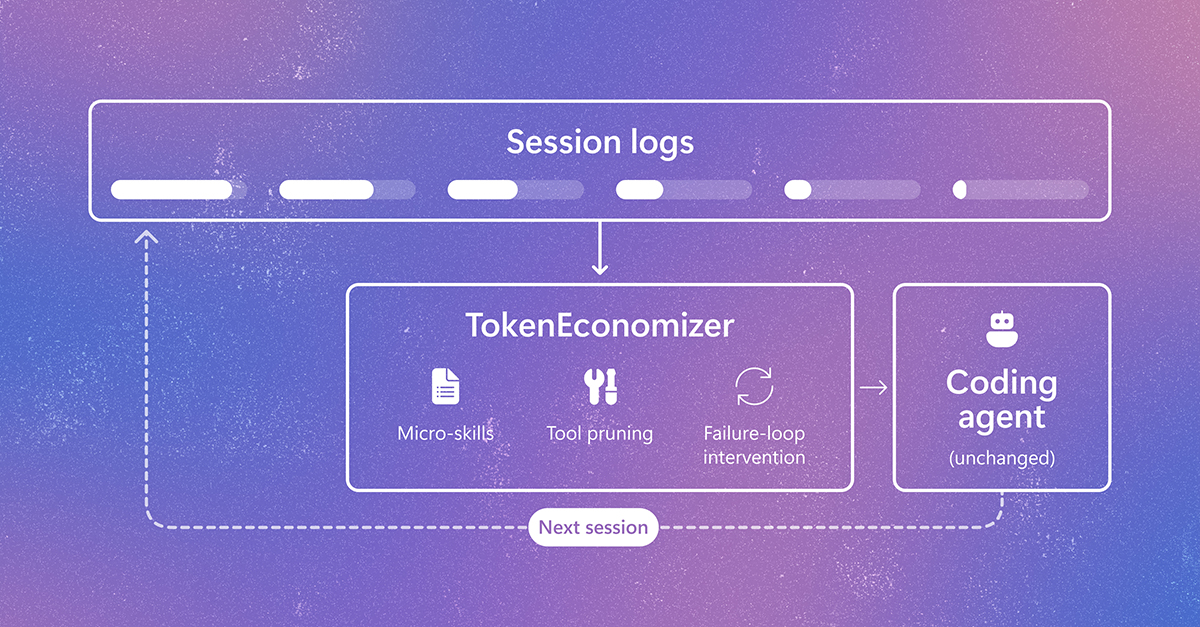
AI coding agents are increasingly help developers fix bugs and build features largely on their own, but every interaction with their models consumes tokens. In each session, an agent sends instructions, tool descriptions, and session history to its model. Most efforts to reduce this cost focus on individual tasks. Yet developers return to the same […] The post TokenEconomizer: Learning from Experience to Make AI Coding Agents More Efficient appeared first on Microsoft Research.
MIT News · Artificial Intelligence· news.mit.eduNov 13, 2026