This work analyzes a deceiver-victim pair in the minimal two-player strongly monotone setting and proves that the deceptive bandit learning dynamics converge to an arbitrarily small neighborhood of the DNE while retaining optimal convergence rates.
Abstract
Randomized exploration is central to bandit learning, multi-agent reinforcement learning, and zeroth-order policy search, yet its independence and privacy are usually only treated as technical assumptions. We show that these properties are critical for security purposes and demonstrate how an adversarial agent can exploit privileged information on another agent's exploration. We analyze a deceiver-victim pair in the minimal two-player strongly monotone setting, where a deceptive player obtains leaked signals that are merely correlated with the victim's exploration. We show that, by coupling their own exploratory action with this information, the deceptive player injects an externality that steers the learning dynamics to a new steady state, called the deceptive Nash equilibrium (DNE). We prove that the deceptive bandit learning (DBL) dynamics converge to an arbitrarily small neighborhood of the DNE while retaining optimal convergence rates. Interestingly, our analysis attains these optimal rates while relaxing second-order smoothness conditions from standard bandit optimization literature. We characterize conditions under which deception strictly shifts the steady state and its effect on the deceiver's cost, illustrating the results in a resource-allocation game.
Many modern systems involve the strategic interaction of multiple agents. In such settings, observed actions typically reflect equilibrium behavior under utilities that are only partially known. Recovering these hidden utilities from data - the central goal of inverse game theory - is key for prediction, counterfactual...
Andreas Feik, P. Pinson, Dario Paccagnan· arXiv.org· 0 citations
. It is a universal truth that classical multi-armed bandit (MAB) theory relies on the stationary assumption of reward distributions. However, this assumption is not viable in systems with multiple adaptive interacting agents where interactions endogenously redefine rewards. This paper explores bandit learning in non-s...
Bei-Shen Guo· Proceedings of the 4th Inter...· 0 citations
This paper presents a theoretical analysis of the oblivious common-reward multi-player multi-armed bandit (OC-MPMAB), a minimal multi-player bandit model in which multiple players select arms simultaneously and observe only a shared reward. Crucially, the players are fully oblivious: they do not observe the actions of...
Classical inverse bandit methods typically aim to recover true reward parameters. In contrast, we infer a demonstrator's subjective beliefs, specifically its internal estimates of suboptimality gaps. We consider no-regret demonstrators that follow randomized policies, such as Thompson sampling, and characterize a famil...
Michela Petriconi, Nicolas Menet, Claire Vernade· 0 citations
We study the problem of average reward Multi-Agent Reinforcement Learning (MARL) where agents interact within a network. Each agent in the network conducts local updates with information within its $k$-hop neighborhood and collaboratively maximizes the overall reward of the entire network. We first provide impossibilit...
Yi-Zhou Zhang, Yashaswini Murthy, Lai-Xi Shi et al.· 0 citations
The results provide a modular framework that can be used to analyze linear bandit algorithms and explicitly connect quality of parameter estimation to optimal regret accumulation.
Arda Güçlü, Subhonmesh Bose, J. Birge· arXiv.org· 0 citations
Related blog posts
MIT News · Artificial Intelligence· news.mit.eduNov 17, 2026
By studying the computational foundations of language learning, Associate Professor Jacob Andreas builds intelligent systems that can communicate effectively with humans.
Microsoft Research Blog· microsoft.comNov 16, 2026
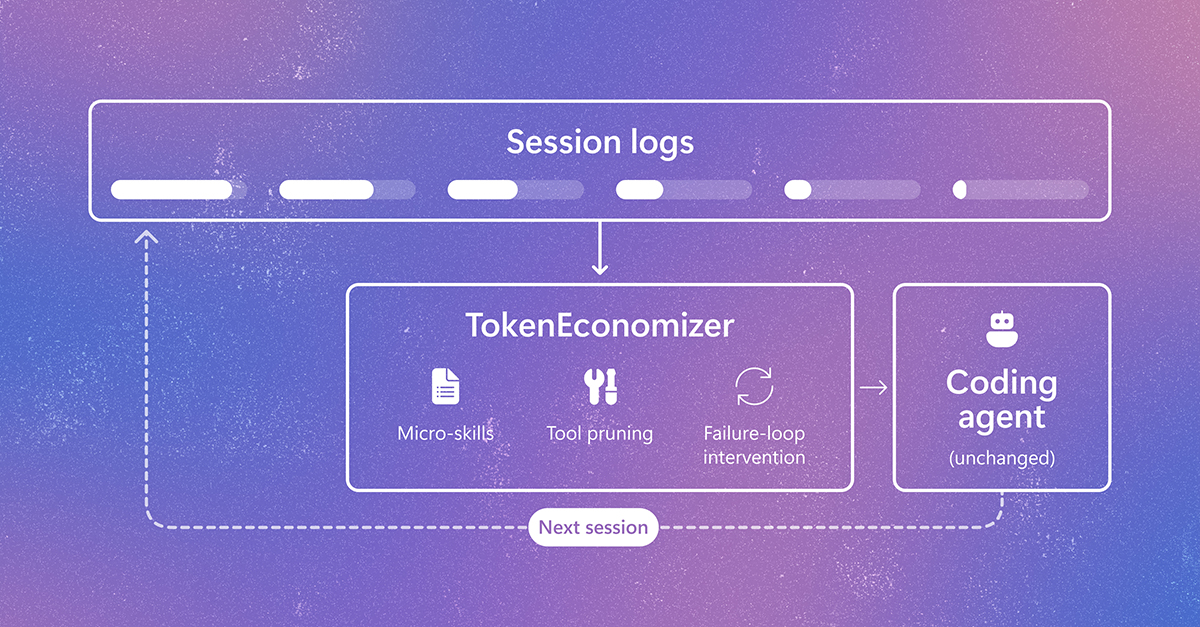
AI coding agents are increasingly help developers fix bugs and build features largely on their own, but every interaction with their models consumes tokens. In each session, an agent sends instructions, tool descriptions, and session history to its model. Most efforts to reduce this cost focus on individual tasks. Yet developers return to the same […] The post TokenEconomizer: Learning from Experience to Make AI Coding Agents More Efficient appeared first on Microsoft Research.
MIT News · Artificial Intelligence· news.mit.eduNov 13, 2026