Results show that NVE is sensitive to redundant and poorly separated biclusters, while NVE changes solution rankings when low-error biclusters cover only a negligible part of the matrix, and suggest that NVE-based measures are useful complementary criteria for internal co-clustering validation, especially when coherence, separability, and coverage must be considered jointly.

Abstract
Biclustering, or co-clustering, aims to discover coherent submatrices by grouping rows and columns of a data matrix simultaneously. This local two-dimensional structure makes validation more difficult than in ordinary clustering, where internal indices usually rely on compactness and separation in a single shared feature space. Existing popular internal biclustering measures such as Mean Squared Residue (MSR), and Virtual Error (VE) mainly evaluate within-bicluster coherence. Although useful, these measures do not directly assess whether the extracted biclusters are mutually distinct or whether they explain a meaningful portion of the data matrix. This paper investigates Normalised Virtual Error (NVE), an internal validation metric that extends VE using a super-bicluster normalization strategy. By comparing the VE of each bicluster with the VE obtained after merging it with other biclusters, NVE introduces a relative notion of separability and redundancy. We also study a coverage-adjusted variant, NVE\textsubscript{cov}, which penalizes solutions that obtain low error by selecting only very small submatrices. Through controlled synthetic benchmarks and yeast gene-expression datasets, we examine whether NVE and NVE\textsubscript{cov} provide information beyond standard coherence-based metrics. The results show that NVE is sensitive to redundant and poorly separated biclusters, while NVE\textsubscript{cov} changes solution rankings when low-error biclusters cover only a negligible part of the matrix. These findings suggest that NVE-based measures are useful complementary criteria for internal co-clustering validation, especially when coherence, separability, and coverage must be considered jointly.

This work presents a novel methodology that integrates biclustering with causal analysis, incorporating Directed Acyclic Graph (DAG) constraints to ensure causal interpretability. The proposed approach is particularly effective in scenarios where it is important to identify causal relationships alongside cluster patter...
A novel finite mixture model for biclustering ordinal data matrices is introduced, simultaneously clustering rows and columns within the Underlying Response Variable (URV) framework, and model parameters are estimated using a Composite Likelihood (CL) approach.
M. Ranalli, F. Martella· Computational statistics (Ze...· 0 citations
This work presents 3CPO, a clustering algorithm based on statistically solid modeling of count data, and proposes a simple iterative algorithm that maximizes the posterior probability to find good clustering solutions and discusses its properties.
Collin Leiber, K. Puolamäki, H. Mannila· Data mining and knowledge di...· 0 citations
The objective is not to construct a low-rank projection, but to retain an interpretable subset of the original coordinates that preserves the distributional information distinguishing the clusters that preserves the distributional information distinguishing the clusters.
S. Jha, Rishikesh Muralimohan, Praveen Athauda Arachchi et al.· 0 citations
Partial Least Squares (PLS) regression extracts a few outcome-aligned directions in a high-dimensional X and is widely used across applied science, but inference on the resulting fit is either expensive, biased and discouraged, or absent. We reduce inference to held-out OLS refits of the supervised subspace, a primitiv...
By studying the computational foundations of language learning, Associate Professor Jacob Andreas builds intelligent systems that can communicate effectively with humans.
Microsoft Research Blog· microsoft.comNov 16, 2026
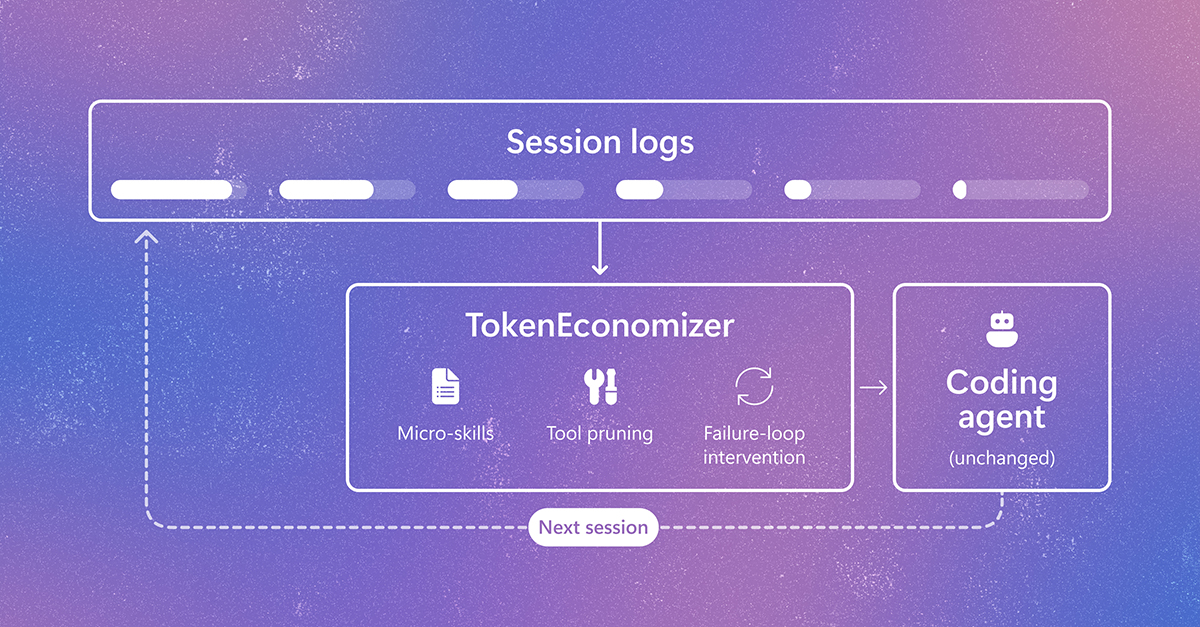
AI coding agents are increasingly help developers fix bugs and build features largely on their own, but every interaction with their models consumes tokens. In each session, an agent sends instructions, tool descriptions, and session history to its model. Most efforts to reduce this cost focus on individual tasks. Yet developers return to the same […] The post TokenEconomizer: Learning from Experience to Make AI Coding Agents More Efficient appeared first on Microsoft Research.
MIT News · Artificial Intelligence· news.mit.eduNov 13, 2026