A scalable bandit-based system that optimizes product page layouts in real time while preserving human control over design intent, providing a scalable path toward learning-to-design the web.
Abstract
E-commerce platforms increasingly personalize user experiences through machine learning, yet page layout decisions remain dominated by static rules and manual curation. We present a scalable bandit-based system that optimizes product page layouts in real time while preserving human control over design intent. A contextual bandit model dynamically selects the most effective layout for each session using user, item, and category-level features. The system leverages a LinUCB-based policy to balance exploration and exploitation as it learns from live user interactions. The architecture is designed for seamless integration into large-scale web serving stacks, supporting low-latency inference and continuous model updates. The system was first tested on entry product pages. In online A/B deployments on a major retail platform, our approach achieved positive lifts in session-level performance metrics over a strong heuristic baseline. Our results demonstrate that contextual bandits can effectively optimize visual and structural aspects of product discovery for user engagement, providing a scalable path toward learning-to-design the web.

This work investigates language models as scalable evaluators by comparing direct prompt-based, prompt-derived feature, and representation-based methods, and shows that representation-based approaches consistently outperform prompt-based judging in predicting user engagement, suggesting they provide a reliable foundati...
Varun Joshi, Eva C. Song, Cheng-Xiang Zhai· 0 citations
Fashion e-commerce routes every shopper through the same fixed category tree and reads a dislike as a permanent verdict. Both assumptions fail during exploratory browsing, where shoppers have no clear target and a “No” often means not this, right now. This work-in-progress note proposes navigation built per user, per s...
Gwendolyn Rippberger Fonseca, Julia Neidhardt· Proceedings of the 20th ACM...· 0 citations
Homepage personalisation is a core challenge for large-scale media platforms. A homepage is not only a recommendation surface; it is a continuously changing product interface where multiple editorial, programmatic, and algorithmic modules compete for user attention. Static layouts and offline-trained ranking systems pr...
Siddharth Narayanan· East African Journal of Info...· 0 citations
News publishers usually present recommendations in fixed locations outside the main reading flow, where engagement tends to be low, and maintaining high-quality recommendations at scale is expensive. Although research has improved what is recommended, the way recommendations are presented has changed little. This demon...
Piriyakorn Piriyatamwong, Satvik Garg· Proceedings of the 20th ACM...· 0 citations
Carousel interfaces are widely used in modern recommendation systems. Unlike traditional interfaces that present a single ranked list, carousels simultaneously present several ranked lists to the user, as horizontally swipeable rows stacked on top of each other. In this design, the rankings are closely tied to the two-...
Jingwei Kang· Proceedings of the 20th ACM...· 0 citations
Control via Request-Aware Masking for Editing Recommenders (CRAMER), a framework that takes users' natural-language requests to immediately change sequential recommendation models' behavior, establishing a new paradigm for request-aware sequential recommendation.
Zhiyuan Su, Naihe Feng, Zhen Qin et al.· 0 citations
Related blog posts
MIT News · Artificial Intelligence· news.mit.eduNov 17, 2026
By studying the computational foundations of language learning, Associate Professor Jacob Andreas builds intelligent systems that can communicate effectively with humans.
Microsoft Research Blog· microsoft.comNov 16, 2026
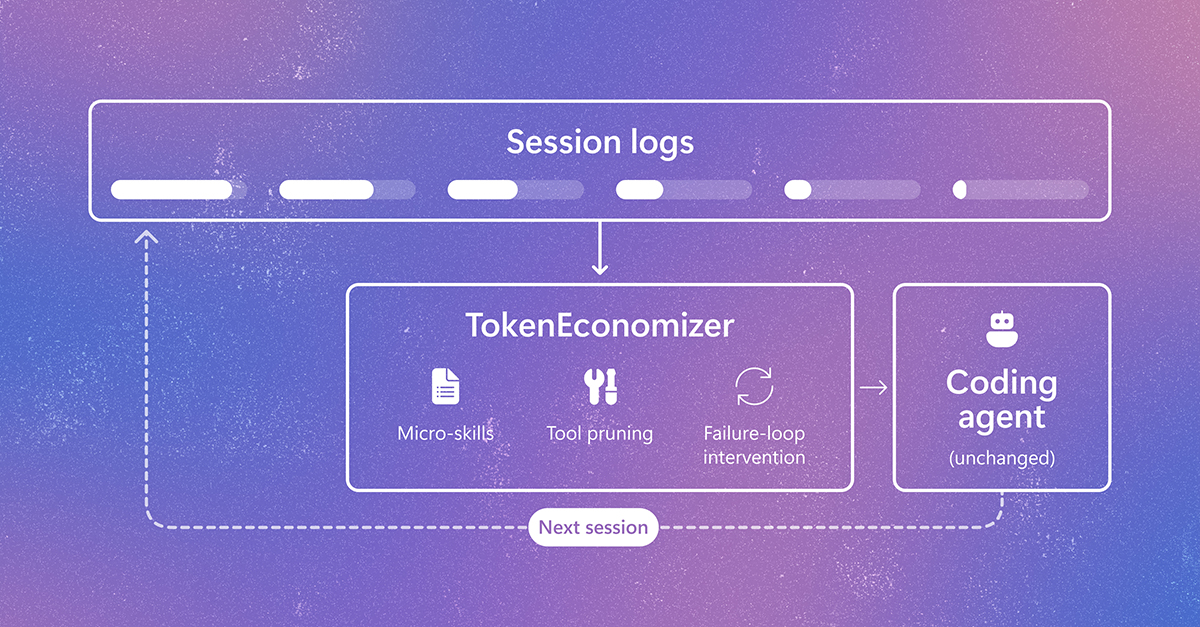
AI coding agents are increasingly help developers fix bugs and build features largely on their own, but every interaction with their models consumes tokens. In each session, an agent sends instructions, tool descriptions, and session history to its model. Most efforts to reduce this cost focus on individual tasks. Yet developers return to the same […] The post TokenEconomizer: Learning from Experience to Make AI Coding Agents More Efficient appeared first on Microsoft Research.
MIT News · Artificial Intelligence· news.mit.eduNov 13, 2026