May 2026· arXiv.org· Vol abs/2606.01216· 0 citations· 28 references
Computer ScienceMathematics
TL;DR
This work proposes a novel block-diagonal Riemannian metric derived from the pullback of the Frobenius inner product and develops a Riemannian gradient descent algorithm that uses a tuning-free Gaussian step size and scales linearly in the number of observed entries per iteration.
Abstract
The elementwise Hadamard product of two low-rank matrices provides a parameter-efficient model for data with multiplicative structure, but its modeling is challenging due to the presence of additional symmetries under coupled row/column scalings between the two factors. In order to leverage the geometry of the space, we formulate the learning of such matrices as optimization on a Riemannian quotient manifold. We propose a novel block-diagonal Riemannian metric derived from the pullback of the Frobenius inner product. The metric is shown to be invariant under these symmetries. We develop a Riemannian gradient descent algorithm that uses a tuning-free Gauss--Newton step size and scales linearly in the number of observed entries per iteration. The versatile framework of Riemannian quotient optimization enables both first-order and second-order Riemannian methods, the latter through a closed-form connection and the Riemannian Hessian. Experiments on real and synthetic datasets illustrate the efficacy of our proposed Riemannian approach.

This paper derives the essential Riemannian tools and proposes efficient algorithms for their implementation of orthogonal two-factor matrices -- a flexible family of structured matrices formed by block-diagonal factors interleaved with fixed permutations.
Aliev S. E. Aliev, Maxim V. Rakhuba· arXiv.org· 0 citations
This work is concerned with the numerical computation of Gross-Pitaevskii ground states using the tensor train (TT) format. We regard the problem as the minimization of the Gross-Pitaevskii energy functional under a unit mass constraint, and propose a first-order Riemannian optimization scheme that preserves both the m...
Ivan Bioli, Carlo Marcati, M. Rakhuba· 0 citations
Projection-free methods replace projections by linear minimization oracles, making their convergence fundamentally sensitive to the geometry of the feasible region. We develop a geometric framework for this dependence in Riemannian Frank--Wolfe optimization. A power-type double-geodesic modulus quantifies the intrinsic...
This paper investigates the numerical resolution of the Beurling-LASSO (BLASSO), a convex optimization framework that promotes sparsity in the space of measures. We consider its application to the estimation of Gaussian mixture models (GMMs) with an unknown number of components and unknown diagonal covariance matrices....
Romane Giard, Y. de Castro, Roland Denis et al.· 0 citations
We propose an approach based on Riemannian optimization to compute a nearest normal matrix to a given one. The problem can be formulated as the minimization of a smooth function either on the manifold $U(n)$ of unitary matrices of size n or on the flag manifold $U (n)/U (1)^n$. The flag manifold is particularly suitabl...
The proposed adaptive block-weighted modewise Riemannian gradient descent method combines memory-efficient modewise measurements with a normalized adaptive weighting strategy for the core and factor components of the Riemannian gradient.
Yu-Shi Zhou, Feng Zhang· 0 citations
Related blog posts
MIT News · Artificial Intelligence· news.mit.eduNov 17, 2026
By studying the computational foundations of language learning, Associate Professor Jacob Andreas builds intelligent systems that can communicate effectively with humans.
Microsoft Research Blog· microsoft.comNov 16, 2026
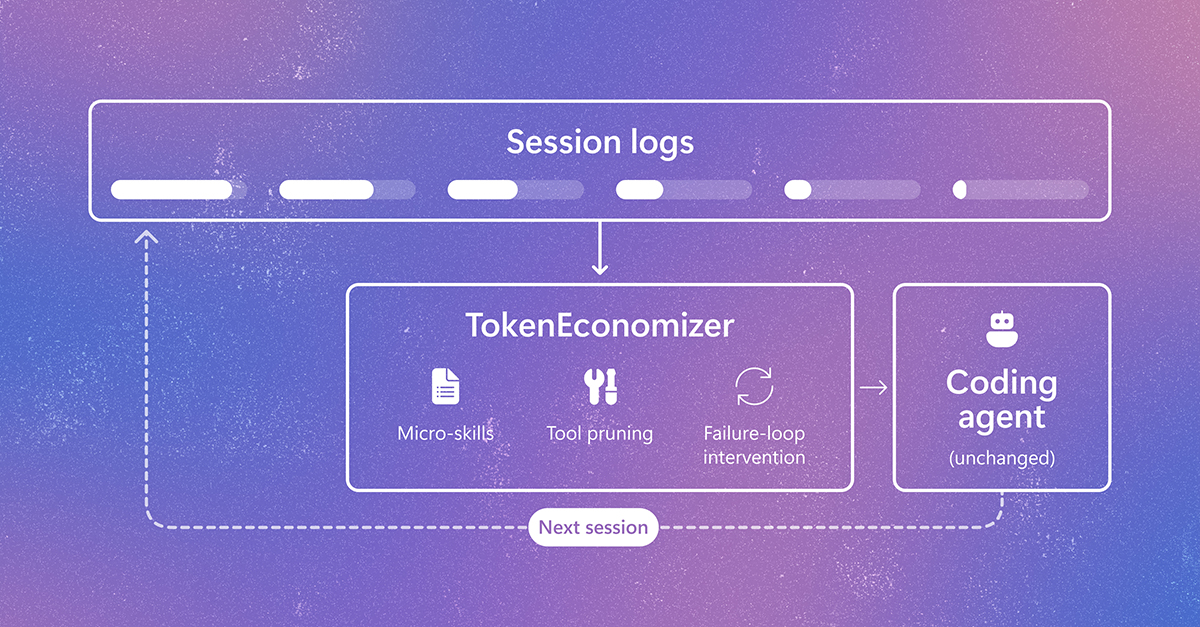
AI coding agents are increasingly help developers fix bugs and build features largely on their own, but every interaction with their models consumes tokens. In each session, an agent sends instructions, tool descriptions, and session history to its model. Most efforts to reduce this cost focus on individual tasks. Yet developers return to the same […] The post TokenEconomizer: Learning from Experience to Make AI Coding Agents More Efficient appeared first on Microsoft Research.
MIT News · Artificial Intelligence· news.mit.eduNov 13, 2026