Truncation Samplers Are Nested: Comparing Decoding Rules Is a Measurement Problem
Rasul KhanbayovHasan Kurban
Oct 2026
Machine LearningComputer Vision
Abstract
Settling one comparison between two truncation samplers has cost six thousand A100-hours, and nothing says in advance how far apart two samplers can be. We observe that almost every deployed truncation rule keeps a prefix of the probability-sorted vocabulary, so any two such rules are nested at every decoding step. Nesting yields a closed-form per-step distance and a coupling under which both samplers emit identical text until they first disagree. Accumulated over a generation, this gives a separation certificate that bounds the difference between two samplers on any bounded outcome, is computable from logs a comparison already produces, and equals their sequence-level total variation distance exactly when neither rule ever overtakes the other. Two consequences follow without measurement: exactness is fragile, and certifying a small difference requires the two retained masses to agree to very high precision at every step. On six open-weight models over four math and science benchmarks, the certificate for every hyperparameter grid we tested is at least 0.998, so a bound alone rarely settles a comparison, although two members of one family can be far closer. What remains useful is the coupling, which gives an unbiased paired estimator that cuts variance $1.2$-$3.8\times$ against prompt-level pairing. Read against benchmark sizes at the default pair's variance and our point estimate of its between-prompt component, resolving a one-point difference needs 8 to 32 samples per prompt on GSM8K, MATH-500 and GPQA-Diamond and about 210 on AIME 2025; at that component's upper confidence bound GPQA-Diamond needs more than 32 and AIME 2025 cannot be resolved at any sample count. Choosing a truncation sampler is a measurement problem at least as much as a design one. The code is available at https://github.com/KurbanIntelligenceLab/truncation-samplers.

This paper investigates developing real-world perception for active agents, proposes Gibson Environment for this purpose, and showcases a set of perceptual tasks learned therein.
F. Xia, Amir Zamir, Zhi-Yang He et al.· 2018 IEEE/CVF Conference on...· 1,069 citations· ⚡112
This publication proposes a definition and a classification of agile software development approaches and analyses ten software development methods that can be characterized as being "agile" against the defined criterion.
P. Abrahamsson, O. Salo, Jussi Ronkainen et al.· arXiv.org· 727 citations· ⚡54
The study shows that agile practices improve both informal and formal communication, but indicates that, in larger development situations involving multiple external stakeholders, a mismatch of adequate communication mechanisms can sometimes even hinder the communication.
M. Pikkarainen, Jukka Haikara, O. Salo et al.· Empirical Software Engineeri...· 401 citations· ⚡48
The results indicate that software engineering work practices are chosen opportunistically, adapted and configured to provide value under the constrains imposed by the startup context.
Nicolò Paternoster, Carmine Giardino, M. Unterkalmsteiner et al.· Information and Software Tec...· 394 citations· ⚡54
The possibility of inferring high-dimensional data inference in a model that consists of a prior and an auxiliary differentiable constraint given some additional information is considered, thereby allowing a range of potential applications in adapting models to new domains and tasks.
Alexandros Graikos, Esmeralda S. Whitammer, N. Jojic et al.· Neural Information Processin...· 316 citations· ⚡15
Exploring how generative AI could make machine vision more accessible to businesses. The post GenEye in a Box: Making Machine Vision Something You Can Just Ask For appeared first on GPT-Lab.
Microsoft Research Blog· microsoft.comAug 11, 2026
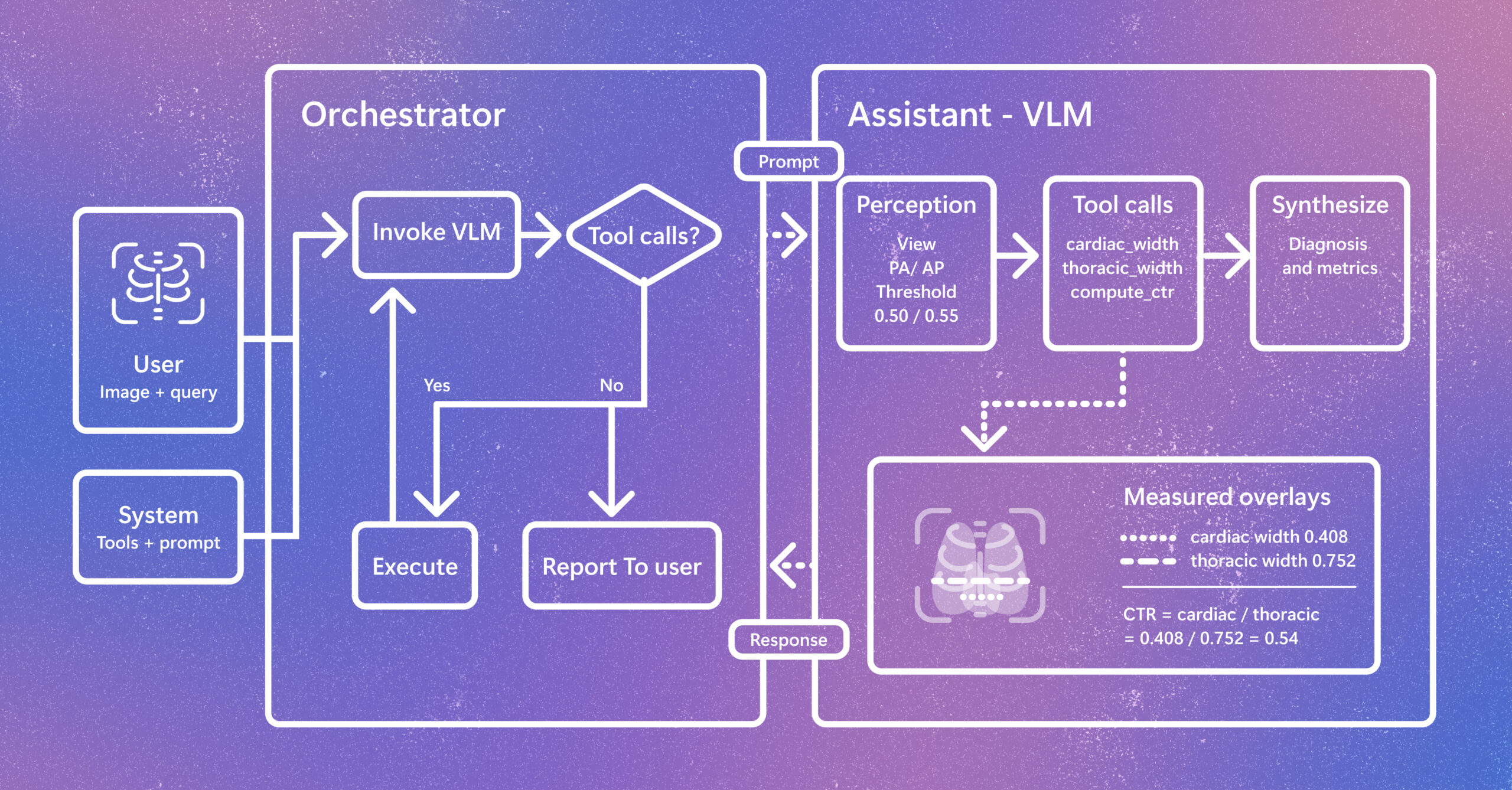
Radiology AI is evolving beyond report generation. CARE-X explores a unified approach that combines flexible reasoning, calibrated predictions, and measurement-based tools for chest X-ray interpretation. The post Introducing CARE-X: Towards Clinically Useful Radiology VLMs with Auxiliary Supervision, Reward-Aligned Learning, and Tool-Augmented Measurement appeared first on Microsoft Research.
Assistant Professor Benjamin Lindquist studies how engineers deliberately injected randomness into early AI, giving rise to deep-learning models that sometimes hallucinate.
We use cookies to run the site and, with your consent, for analytics and to show ads.
See our Cookie Policy.