Unsupervised anomaly detection, which learns only from normal images, is a central task in medical image analysis and remains an open problem. Reconstruction-based methods pass an image through an encoder-decoder network trained on normal data and detect anomalies from the residual between the image and its reconstruction. This works only if the information passed from the encoder to the decoder is limited; otherwise the network learns an identity mapping and reconstructs anomalies too. This limit is usually imposed through architectural choices, tuned per dataset, that cannot be stated in bits. We introduce the quasi-binarizing (QB) layer, which squashes each latent element into [0, 1] and adds Laplace noise of scale 1/epsilon. Each element is then epsilon-locally differentially private, and the mutual information between an image and its reconstruction is bounded by a quantity that depends only on epsilon and the number of QB elements, whatever the encoder and decoder. Placing a QB layer on every encoder-decoder path, including all skip connections, we build QBAE, a seven-level attention U-Net with 32,768 QB elements. On the seven datasets of the MedIAnomaly benchmark, QBAE with one architecture and one configuration reaches a mean image-level AUROC of 0.828, the highest among methods that do not adapt to each dataset, and the best reported results on BraTS2021 (AUROC 0.911, pixel-level AP 0.838). The noise is kept at test time, so that every reconstruction satisfies the bound. Without input corruption, the bottleneck alone prevents identity collapse (mean AUROC 0.805 vs. 0.590). Code is available at https://github.com/hanaokalog/MedIAnomalyQB.

This paper investigates developing real-world perception for active agents, proposes Gibson Environment for this purpose, and showcases a set of perceptual tasks learned therein.
F. Xia, Amir Zamir, Zhi-Yang He et al.· 2018 IEEE/CVF Conference on...· 1,069 citations· ⚡112
This publication proposes a definition and a classification of agile software development approaches and analyses ten software development methods that can be characterized as being "agile" against the defined criterion.
P. Abrahamsson, O. Salo, Jussi Ronkainen et al.· arXiv.org· 727 citations· ⚡54
The study shows that agile practices improve both informal and formal communication, but indicates that, in larger development situations involving multiple external stakeholders, a mismatch of adequate communication mechanisms can sometimes even hinder the communication.
M. Pikkarainen, Jukka Haikara, O. Salo et al.· Empirical Software Engineeri...· 401 citations· ⚡48
The results indicate that software engineering work practices are chosen opportunistically, adapted and configured to provide value under the constrains imposed by the startup context.
Nicolò Paternoster, Carmine Giardino, M. Unterkalmsteiner et al.· Information and Software Tec...· 394 citations· ⚡54
The possibility of inferring high-dimensional data inference in a model that consists of a prior and an auxiliary differentiable constraint given some additional information is considered, thereby allowing a range of potential applications in adapting models to new domains and tasks.
Alexandros Graikos, Esmeralda S. Whitammer, N. Jojic et al.· Neural Information Processin...· 316 citations· ⚡15
Exploring how generative AI could make machine vision more accessible to businesses. The post GenEye in a Box: Making Machine Vision Something You Can Just Ask For appeared first on GPT-Lab.
Microsoft Research Blog· microsoft.comAug 11, 2026
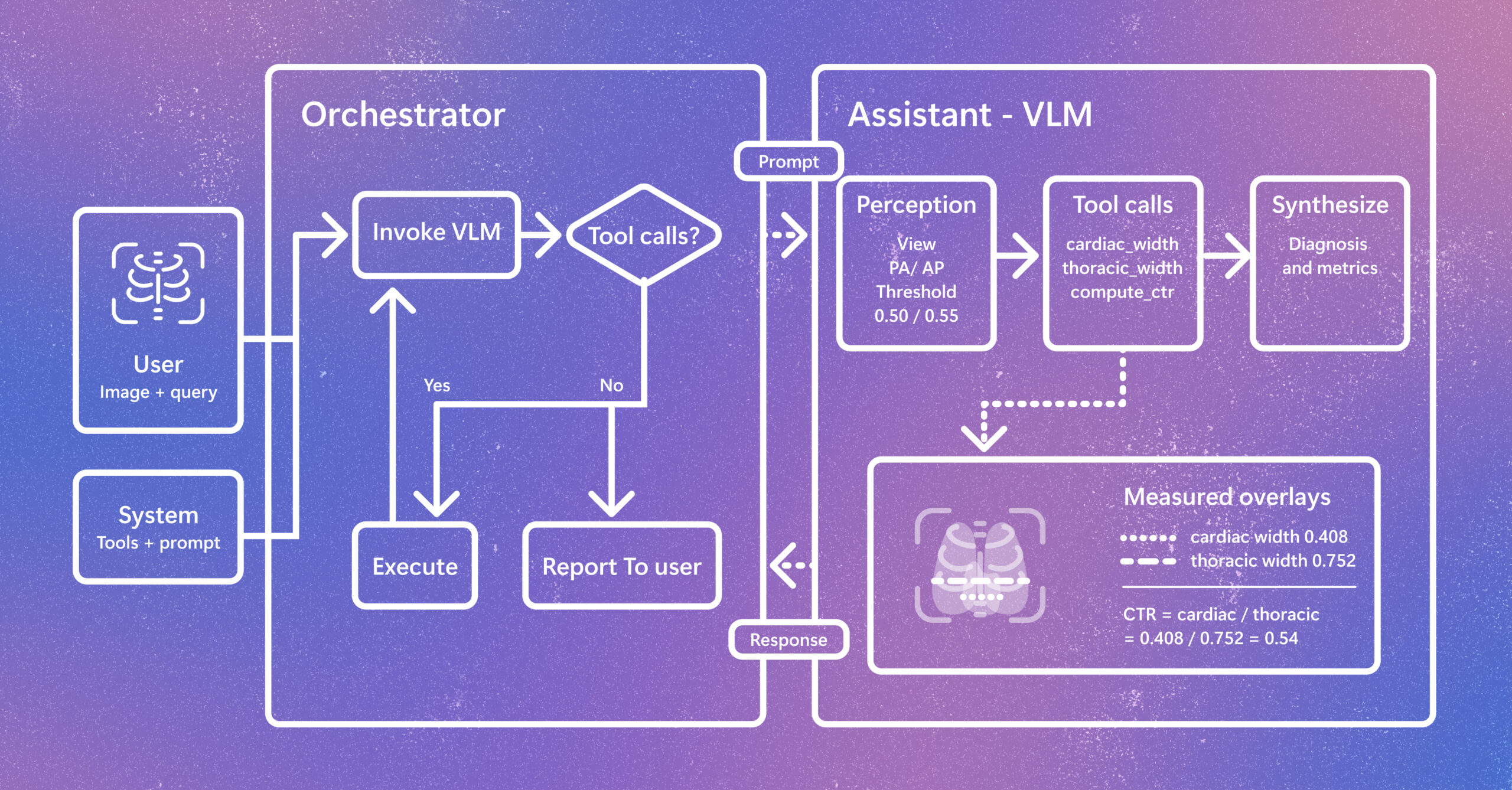
Radiology AI is evolving beyond report generation. CARE-X explores a unified approach that combines flexible reasoning, calibrated predictions, and measurement-based tools for chest X-ray interpretation. The post Introducing CARE-X: Towards Clinically Useful Radiology VLMs with Auxiliary Supervision, Reward-Aligned Learning, and Tool-Augmented Measurement appeared first on Microsoft Research.
Assistant Professor Benjamin Lindquist studies how engineers deliberately injected randomness into early AI, giving rise to deep-learning models that sometimes hallucinate.
We use cookies to run the site and, with your consent, for analytics and to show ads.
See our Cookie Policy.