Anirudh Sundara RajanKrishna Kumar SinghRichard ZhangYong Jae Lee
Oct 2026
Machine LearningComputer Vision
Abstract
Training on broad, unfiltered data enables high-quality image generation, but can also teach models concepts that should not be generated; restricting the training data ensures safety, but reduces quality because examples containing unsafe concepts also provide useful knowledge that is not itself unsafe. Existing approaches largely address this trade-off post hoc through concept unlearning, which can lead to catastrophic forgetting as the number of concepts to remove grows. We instead ask whether unsafe concept knowledge can be compartmentalized during pretraining so that access to it can be disabled at inference. We introduce Pristine Models, a novel text-to-image generation architecture with an attention mechanism that encourages the separation of safe and unsafe knowledge into independently parameterized branches. The branch-specific parameters are learned during training, while the unsafe branch can be detached at inference. On ImageNet, Pristine Models enable safer generation while retaining much of the utility of full-data pretraining, achieving higher image quality and better text alignment than training only on safe data or applying post-hoc concept removal. We further scale our approach to CC12M, demonstrating that it remains effective in a substantially larger and more diverse open-world pretraining setting.

This paper investigates developing real-world perception for active agents, proposes Gibson Environment for this purpose, and showcases a set of perceptual tasks learned therein.
F. Xia, Amir Zamir, Zhi-Yang He et al.· 2018 IEEE/CVF Conference on...· 1,069 citations· ⚡112
This publication proposes a definition and a classification of agile software development approaches and analyses ten software development methods that can be characterized as being "agile" against the defined criterion.
P. Abrahamsson, O. Salo, Jussi Ronkainen et al.· arXiv.org· 727 citations· ⚡54
The study shows that agile practices improve both informal and formal communication, but indicates that, in larger development situations involving multiple external stakeholders, a mismatch of adequate communication mechanisms can sometimes even hinder the communication.
M. Pikkarainen, Jukka Haikara, O. Salo et al.· Empirical Software Engineeri...· 401 citations· ⚡48
The results indicate that software engineering work practices are chosen opportunistically, adapted and configured to provide value under the constrains imposed by the startup context.
Nicolò Paternoster, Carmine Giardino, M. Unterkalmsteiner et al.· Information and Software Tec...· 394 citations· ⚡54
The possibility of inferring high-dimensional data inference in a model that consists of a prior and an auxiliary differentiable constraint given some additional information is considered, thereby allowing a range of potential applications in adapting models to new domains and tasks.
Alexandros Graikos, Esmeralda S. Whitammer, N. Jojic et al.· Neural Information Processin...· 316 citations· ⚡15
Exploring how generative AI could make machine vision more accessible to businesses. The post GenEye in a Box: Making Machine Vision Something You Can Just Ask For appeared first on GPT-Lab.
Microsoft Research Blog· microsoft.comAug 11, 2026
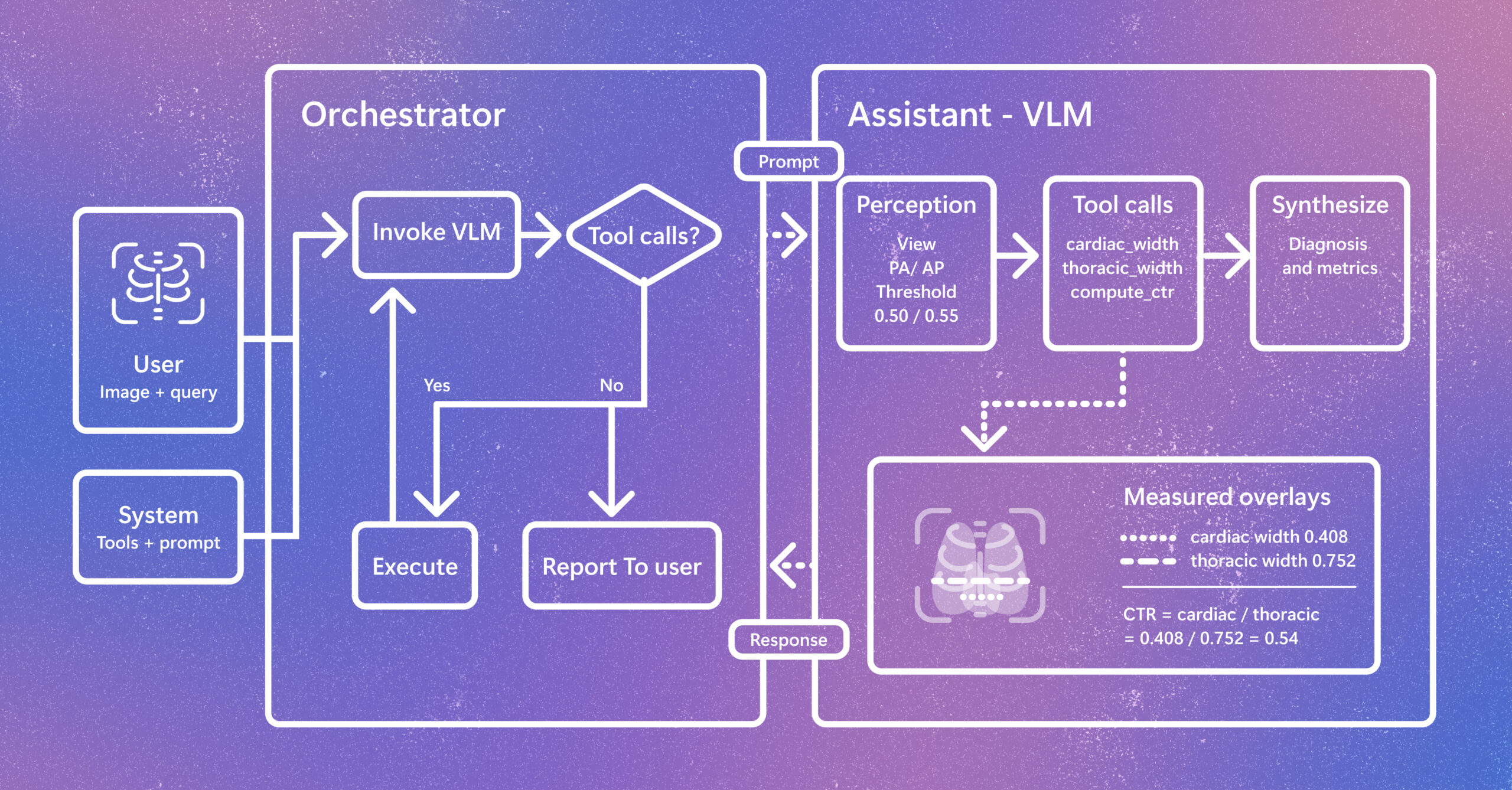
Radiology AI is evolving beyond report generation. CARE-X explores a unified approach that combines flexible reasoning, calibrated predictions, and measurement-based tools for chest X-ray interpretation. The post Introducing CARE-X: Towards Clinically Useful Radiology VLMs with Auxiliary Supervision, Reward-Aligned Learning, and Tool-Augmented Measurement appeared first on Microsoft Research.
Assistant Professor Benjamin Lindquist studies how engineers deliberately injected randomness into early AI, giving rise to deep-learning models that sometimes hallucinate.
We use cookies to run the site and, with your consent, for analytics and to show ads.
See our Cookie Policy.