Token-Budgeted Candidate Retrieval for 3D Scene-Grounded VLMs: Category Names vs. Pairwise Geometry
Micha{\l} ZakrzewskiMariia ShpirTaras Rumezhak
Oct 2026
Machine LearningComputer Vision
Abstract
Under a fixed context budget, which objects and relations should a 3D scene-grounded VLM see first? On ScanNet indoor referring benchmarks (Dai et al., 2017), matching the query to object category names outperforms pairwise geometry scoring at every reported K. The gaps are largest at high recall. Analytic pairwise cues beat per-object cue scoring and query-agnostic kNN graphs, including on paraphrases. MiniLM and BGE-small still score higher on those splits. We evaluate token-budgeted candidate retrieval with axis-aligned boxes, a token-ratio metric, training-free baselines, two small encoders that match q to each object's category name, and QCRR (Query-Conditioned Relation Retrieval), a deterministic pairwise-geometry scorer. Across ScanRefer gt_val plus a custom 20% scan-id split of Nr3D and Sr3D (35,504 queries; not official ReferIt3D val), additive noun matching reaches R@10 0.864 on ScanRefer against QCRR's 0.626; MiniLM and BGE-small reach 0.911 to 0.913 on ScanRefer and 0.941 to 0.947 on Nr3D. A corrected 3DGraphLLM harness (native Acc@0.25 0.67 on the full graph, n=300 ScanRefer queries) shows that context selection changes downstream accuracy under a matched object budget (Random 0.44, QCRR 0.56, MiniLM 0.67, oracle 0.70). Semantic retrieval beats hand-designed geometry on that harness. We will release the protocol, retriever implementations, and per-query outputs so new selectors can be swapped in without rewriting the analysis.

This paper investigates developing real-world perception for active agents, proposes Gibson Environment for this purpose, and showcases a set of perceptual tasks learned therein.
F. Xia, Amir Zamir, Zhi-Yang He et al.· 2018 IEEE/CVF Conference on...· 1,069 citations· ⚡112
This publication proposes a definition and a classification of agile software development approaches and analyses ten software development methods that can be characterized as being "agile" against the defined criterion.
P. Abrahamsson, O. Salo, Jussi Ronkainen et al.· arXiv.org· 727 citations· ⚡54
The study shows that agile practices improve both informal and formal communication, but indicates that, in larger development situations involving multiple external stakeholders, a mismatch of adequate communication mechanisms can sometimes even hinder the communication.
M. Pikkarainen, Jukka Haikara, O. Salo et al.· Empirical Software Engineeri...· 401 citations· ⚡48
The results indicate that software engineering work practices are chosen opportunistically, adapted and configured to provide value under the constrains imposed by the startup context.
Nicolò Paternoster, Carmine Giardino, M. Unterkalmsteiner et al.· Information and Software Tec...· 394 citations· ⚡54
The possibility of inferring high-dimensional data inference in a model that consists of a prior and an auxiliary differentiable constraint given some additional information is considered, thereby allowing a range of potential applications in adapting models to new domains and tasks.
Alexandros Graikos, Esmeralda S. Whitammer, N. Jojic et al.· Neural Information Processin...· 316 citations· ⚡15
Exploring how generative AI could make machine vision more accessible to businesses. The post GenEye in a Box: Making Machine Vision Something You Can Just Ask For appeared first on GPT-Lab.
Microsoft Research Blog· microsoft.comAug 11, 2026
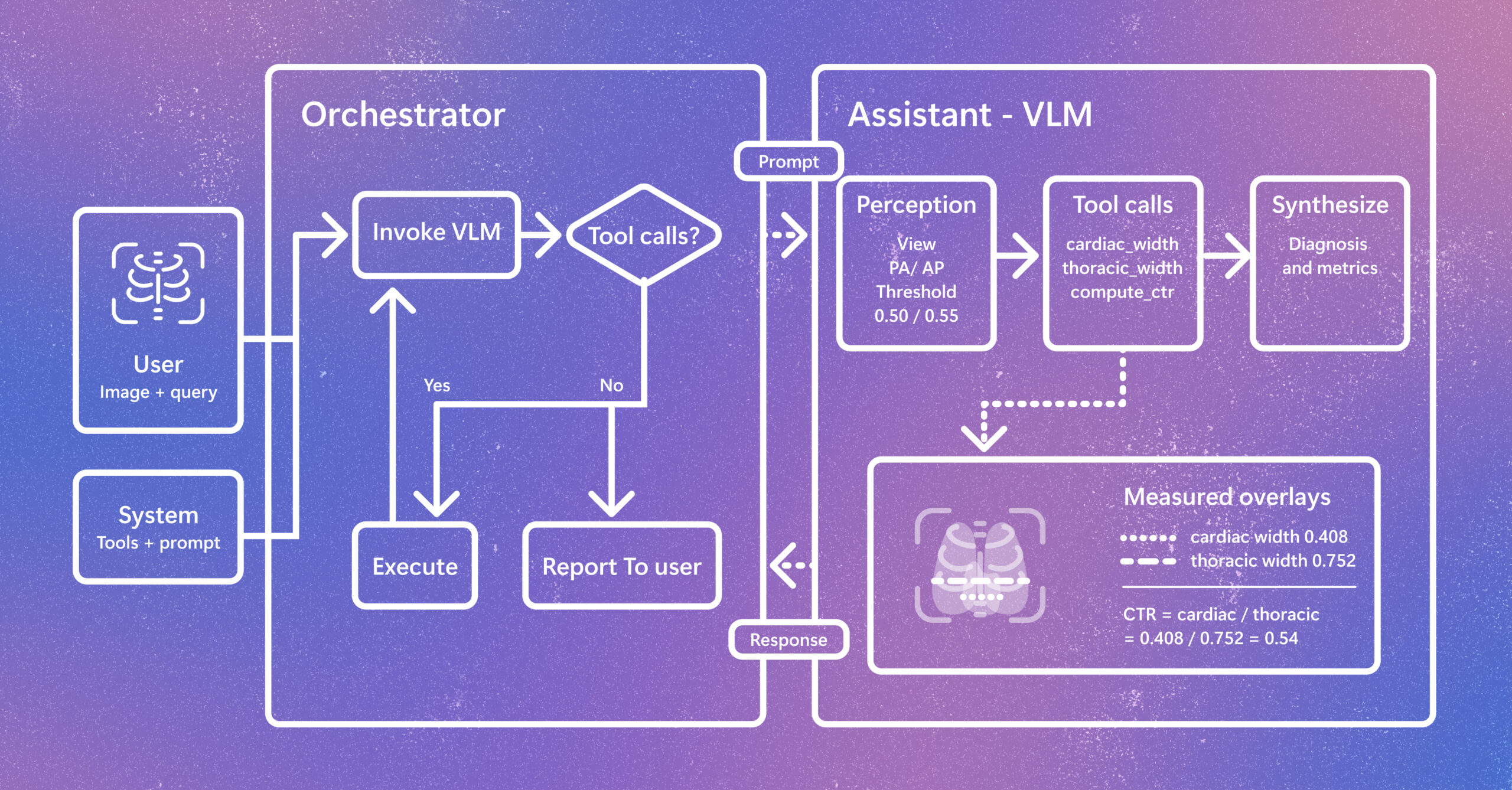
Radiology AI is evolving beyond report generation. CARE-X explores a unified approach that combines flexible reasoning, calibrated predictions, and measurement-based tools for chest X-ray interpretation. The post Introducing CARE-X: Towards Clinically Useful Radiology VLMs with Auxiliary Supervision, Reward-Aligned Learning, and Tool-Augmented Measurement appeared first on Microsoft Research.
Assistant Professor Benjamin Lindquist studies how engineers deliberately injected randomness into early AI, giving rise to deep-learning models that sometimes hallucinate.
We use cookies to run the site and, with your consent, for analytics and to show ads.
See our Cookie Policy.