Srikar YellapragadaAlexandros GraikosZilinghan LiKostas TriaridisTarak Nath NandiJi Dong K BaiBeatrice KnudsenTahsin KurcPrateek PrasannaRajarsi R. GuptaRavi K MadduriJoel SaltzDimitris Samaras
Oct 2026
Machine LearningComputer Vision
Abstract
Whole-slide images (WSIs) are gigapixel-scale digital scans of histopathology tissue and serve as the primary basis for cancer diagnosis. Existing histopathology generative models operate at the patch scale, producing fixed-size tiles of at most 1024$\times$1024 pixels which encompass only a small fraction of the WSI. In contrast, text reports for clinical diagnoses and slide-level diagnostic labels -- the supervision that exists at scale -- operate at the whole-slide level. We present BigCell, the first approach to generate coherent whole-slide histopathology images at native gigapixel resolution. BigCell trains a flow-matching transformer at 2048$\times$2048 pixels on over 120,000 publicly available WSIs spanning multiple organ types. Conditioning on embeddings from pathology foundation models and using an inference-time sliding-window pipeline, BigCell generates coherent images of up to 32,768$\times$32,768 pixels, outperforming prior tile generators on both tile-level and slide-level fidelity metrics. To make gigapixel synthesis practical, we introduce an adaptive scheduling strategy that prioritizes important slide regions, speeding up image generation by over 3\ttimes with minimal quality degradation. Furthermore, we propose the first text-to-image synthesis at 8k resolution by training a separate model that produces dense conditioning grids directly from pathology text reports. We demonstrate that augmenting with synthetic samples improves slide-level few-shot classification performance by up to $18 \%$ over baselines trained on real data.

This paper investigates developing real-world perception for active agents, proposes Gibson Environment for this purpose, and showcases a set of perceptual tasks learned therein.
F. Xia, Amir Zamir, Zhi-Yang He et al.· 2018 IEEE/CVF Conference on...· 1,069 citations· ⚡112
This publication proposes a definition and a classification of agile software development approaches and analyses ten software development methods that can be characterized as being "agile" against the defined criterion.
P. Abrahamsson, O. Salo, Jussi Ronkainen et al.· arXiv.org· 727 citations· ⚡54
The study shows that agile practices improve both informal and formal communication, but indicates that, in larger development situations involving multiple external stakeholders, a mismatch of adequate communication mechanisms can sometimes even hinder the communication.
M. Pikkarainen, Jukka Haikara, O. Salo et al.· Empirical Software Engineeri...· 401 citations· ⚡48
The results indicate that software engineering work practices are chosen opportunistically, adapted and configured to provide value under the constrains imposed by the startup context.
Nicolò Paternoster, Carmine Giardino, M. Unterkalmsteiner et al.· Information and Software Tec...· 394 citations· ⚡54
The possibility of inferring high-dimensional data inference in a model that consists of a prior and an auxiliary differentiable constraint given some additional information is considered, thereby allowing a range of potential applications in adapting models to new domains and tasks.
Alexandros Graikos, Esmeralda S. Whitammer, N. Jojic et al.· Neural Information Processin...· 316 citations· ⚡15
Exploring how generative AI could make machine vision more accessible to businesses. The post GenEye in a Box: Making Machine Vision Something You Can Just Ask For appeared first on GPT-Lab.
Microsoft Research Blog· microsoft.comAug 11, 2026
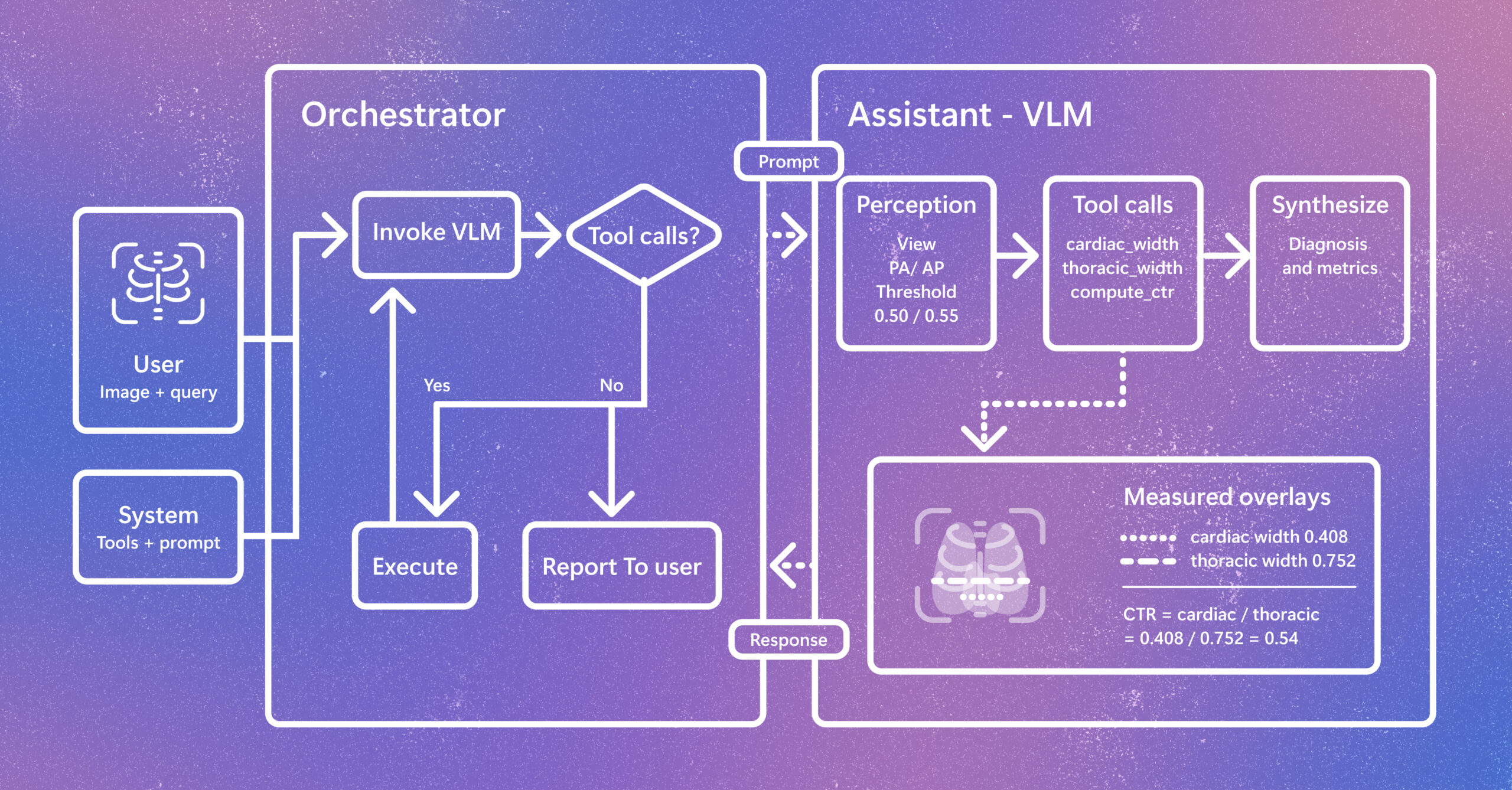
Radiology AI is evolving beyond report generation. CARE-X explores a unified approach that combines flexible reasoning, calibrated predictions, and measurement-based tools for chest X-ray interpretation. The post Introducing CARE-X: Towards Clinically Useful Radiology VLMs with Auxiliary Supervision, Reward-Aligned Learning, and Tool-Augmented Measurement appeared first on Microsoft Research.
Assistant Professor Benjamin Lindquist studies how engineers deliberately injected randomness into early AI, giving rise to deep-learning models that sometimes hallucinate.
We use cookies to run the site and, with your consent, for analytics and to show ads.
See our Cookie Policy.