We study forecasting rigid-body motion from a single image: generating diverse and physically plausible future trajectories for arbitrary points in a scene, without building rigidity into the architecture or relying on geometric inputs such as depth. Like video generators, recent trajectory generators fail at this task, even in simple synthetic Kubric scenes, despite scaling up model size and training on real data.
We show how to solve this with the right architecture and parameterization. Our model, JtT, is a simple diffusion transformer that operates directly in coordinate space and decodes arbitrary and dense query patterns, without the trajectory VAEs or fixed grids assumed in prior work. Through a systematic study of the design space of point trajectory diffusion, we find that diffusing per-frame velocities is the only parameterization that captures rigidity, that it must be paired with the right timestep schedule, and that adding full-resolution RGB at the query points resolves the boundary failures of prior methods.
However, evaluating such 2D models rigorously is itself non-trivial. To our knowledge, we are the first to observe that physical plausibility and diversity do not improve together during training: larger models, as used in prior work, memorize the single ground-truth future per training image, becoming more rigid while covering fewer possible futures.
Yet prior work has paid little attention to this, so we show how model rankings depend on model size, metric, and stopping time, and adopt a stricter, checkpoint-averaged evaluation protocol. Under this protocol, JtT improves over prior methods on both distributional and rigidity metrics and approaches ground-truth rigidity, with only about 50M parameters.

This paper investigates developing real-world perception for active agents, proposes Gibson Environment for this purpose, and showcases a set of perceptual tasks learned therein.
F. Xia, Amir Zamir, Zhi-Yang He et al.· 2018 IEEE/CVF Conference on...· 1,069 citations· ⚡112
This publication proposes a definition and a classification of agile software development approaches and analyses ten software development methods that can be characterized as being "agile" against the defined criterion.
P. Abrahamsson, O. Salo, Jussi Ronkainen et al.· arXiv.org· 727 citations· ⚡54
The study shows that agile practices improve both informal and formal communication, but indicates that, in larger development situations involving multiple external stakeholders, a mismatch of adequate communication mechanisms can sometimes even hinder the communication.
M. Pikkarainen, Jukka Haikara, O. Salo et al.· Empirical Software Engineeri...· 401 citations· ⚡48
The results indicate that software engineering work practices are chosen opportunistically, adapted and configured to provide value under the constrains imposed by the startup context.
Nicolò Paternoster, Carmine Giardino, M. Unterkalmsteiner et al.· Information and Software Tec...· 394 citations· ⚡54
The possibility of inferring high-dimensional data inference in a model that consists of a prior and an auxiliary differentiable constraint given some additional information is considered, thereby allowing a range of potential applications in adapting models to new domains and tasks.
Alexandros Graikos, Esmeralda S. Whitammer, N. Jojic et al.· Neural Information Processin...· 316 citations· ⚡15
Exploring how generative AI could make machine vision more accessible to businesses. The post GenEye in a Box: Making Machine Vision Something You Can Just Ask For appeared first on GPT-Lab.
Microsoft Research Blog· microsoft.comAug 11, 2026
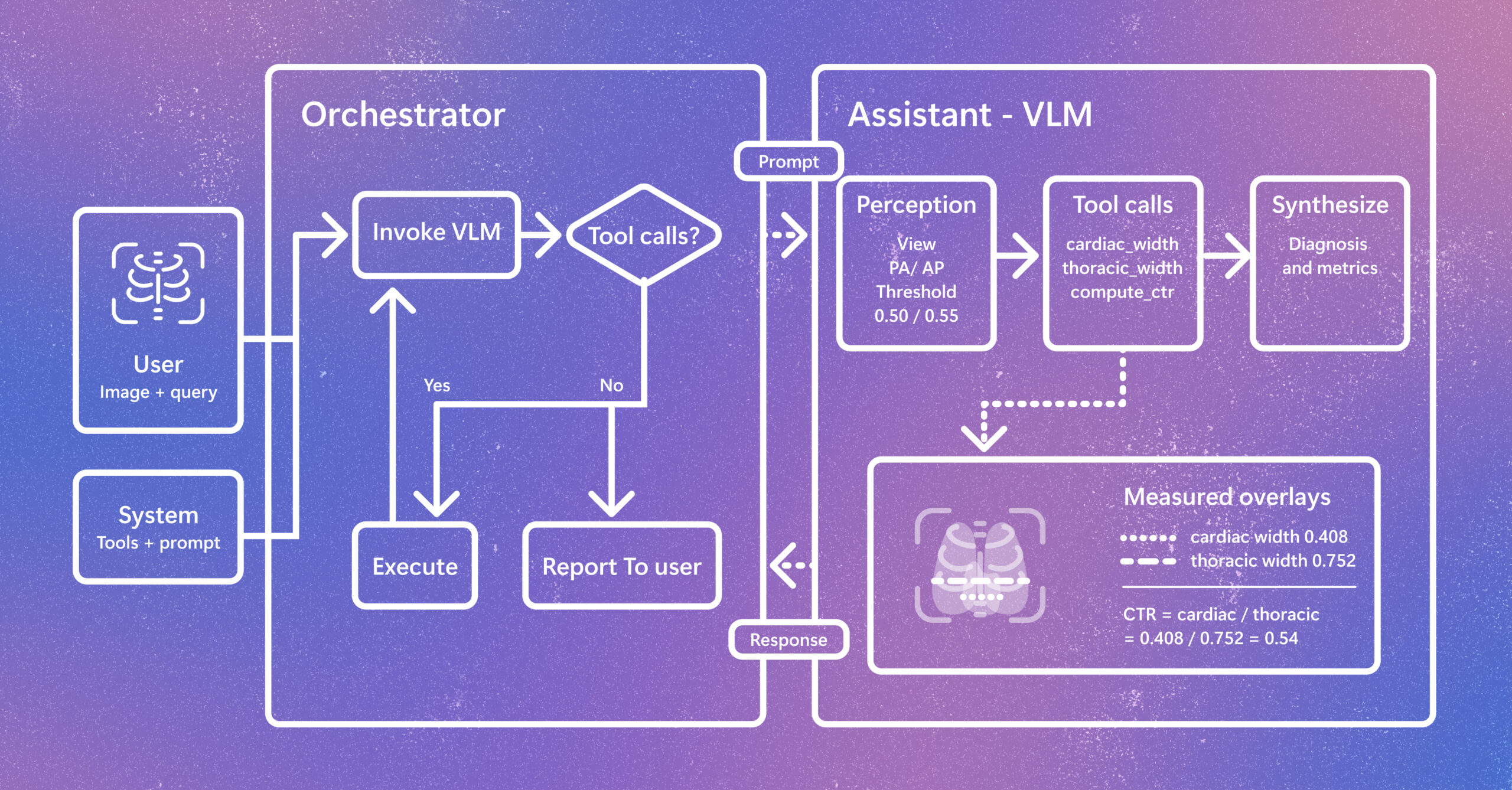
Radiology AI is evolving beyond report generation. CARE-X explores a unified approach that combines flexible reasoning, calibrated predictions, and measurement-based tools for chest X-ray interpretation. The post Introducing CARE-X: Towards Clinically Useful Radiology VLMs with Auxiliary Supervision, Reward-Aligned Learning, and Tool-Augmented Measurement appeared first on Microsoft Research.
Assistant Professor Benjamin Lindquist studies how engineers deliberately injected randomness into early AI, giving rise to deep-learning models that sometimes hallucinate.
We use cookies to run the site and, with your consent, for analytics and to show ads.
See our Cookie Policy.