Skip to content

JevAgentHarness: Benchmarking, Deploying and Training Decision Models That Share Control with LLMs

Oct 2026 · 0 citations · 136 references
Computer Science

Abstract

Large language model (LLM) agents now fix software, operate computers and serve customers, but their harnesses, the programs that run them, call a large LLM at every step, which makes long tasks slow and costly. Most of these calls end in a multiple-choice decision, such as which tool to call next. Decision models such as Jev answer these questions directly, at a fraction of an LLM call's time and price. We ask how a harness can delegate these decisions to a decision model with little loss of success. To evaluate decision models in agentic tasks, we build AgentDecisionBench, which tests them from isolated questions up to control of a running agent, on public benchmarks and our DecisionGym environment. The decision model most accurate on isolated questions solved only 69.5% of agent tasks, and without a fitted confidence threshold, delegating tool choices lowered success by 19.0 points. Building on these findings, we then design JevAgentHarness, which fits this threshold for each choice on the agent's own trajectories and lets the LLM decide below it. Because existing decision models never see the states an agent reaches after its own mistakes, we train AgentDecision-4B, an open 4B model, on such states with Jev's answers as labels. On tasks unlike its training data, the agent solved 91.5% of them with AgentDecision-4B and 82.0% with Jev. On tasks like their training data, 4B models trained this way made agents 81.1-89.0% cheaper and up to 2.5 times faster, without losing 3 or more points of task success. The models, data, and harness will be released at https://github.com/JevAgentHarness/JevAgentHarness.


View source

Similar papers

#artificial intelligence Conference Open access Jun 2018

Gibson Env: Real-World Perception for Embodied Agents

This paper investigates developing real-world perception for active agents, proposes Gibson Environment for this purpose, and showcases a set of perceptual tasks learned therein.

F. Xia, Amir Zamir, Zhi-Yang He et al. · 1,069 citations · ⚡112
#computer vision Review Sep 2017

Agile Software Development Methods: Review and Analysis

This publication proposes a definition and a classification of agile software development approaches and analyses ten software development methods that can be characterized as being "agile" against the defined criterion.

P. Abrahamsson, O. Salo, Jussi Ronkainen et al. · 727 citations · ⚡54
#computer vision Jun 2008

The impact of agile practices on communication in software development

The study shows that agile practices improve both informal and formal communication, but indicates that, in larger development situations involving multiple external stakeholders, a mismatch of adequate communication mechanisms can sometimes even hinder the communication.

M. Pikkarainen, Jukka Haikara, O. Salo et al. · 401 citations · ⚡48
#machine learning Review Open access Oct 2014

Software development in startup companies: A systematic mapping study

The results indicate that software engineering work practices are chosen opportunistically, adapted and configured to provide value under the constrains imposed by the startup context.

Nicolò Paternoster, Carmine Giardino, M. Unterkalmsteiner et al. · 394 citations · ⚡54
#computer vision Review Mar 2008

Agile methods in European embedded software development organisations: a survey on the actual use and usefulness of Extreme Programming and Scrum

The results show that the embedded industry has been able to apply agile methods in its development processes and that the appreciation of the agile methods and their individual practices appears to increase once adopted and applied in practice.

O. Salo, P. Abrahamsson · 238 citations · ⚡9
#computer vision Open access Jul 2017

What happens when software developers are (un)happy

Consequences of happiness and unhappiness that are beneficial and detrimental for developers' mental well-being, the software development process, and the produced artifacts are found.

D. Graziotin, Fabian Fagerholm, Xiaofeng Wang et al. · 236 citations · ⚡13

Related blog posts

Microsoft Research Blog Nov 5, 2026

Formally verifying agent-written full-stack web apps with PDD Kit

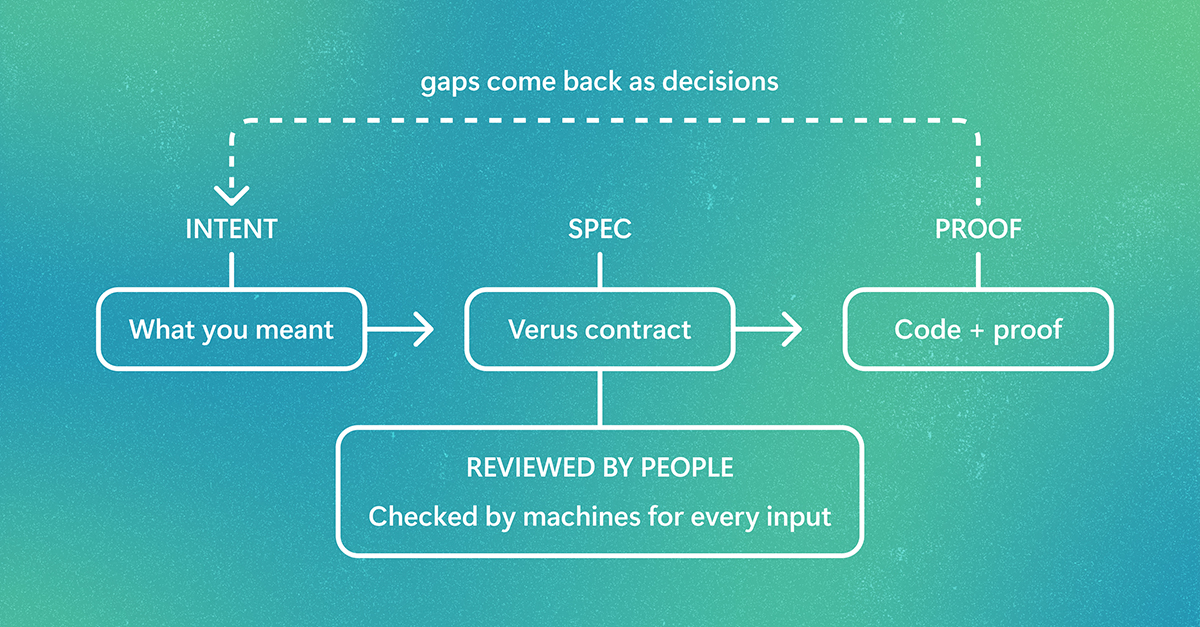
AI agents can generate code at a scale that’s hard for humans to review line-by-line. PDD Kit helps ensure the code is doing what the developer intended by creating formal specifications and testing against them. It converts developer intent into a Verus specification, proves AI-generated code meets it for every input, and uses tests where proofs aren't practical. Developers review intent, not every line. The post Formally verifying agent-written full-stack web apps with PDD Kit appeared first o…

We use cookies to run the site and, with your consent, for analytics and to show ads. See our Cookie Policy.