While foundation models and vision transformers (ViTs) have redefined visual representations, current active learning (AL) strategies for these backbones largely operate at the patch or region level, where annotation requirements remain high due to extensive pixel labeling. Extending ViT-based AL to the pixel-level, low-budget regime is uniquely challenging: with as little as one pixel query per image, a method must simultaneously identify the most informative locations and train a reliable decoder head from an extremely sparse signal. We introduce TEAL (Token-space Efficient Active Learning), the first pixel-level AL framework built around ViT representations. TEAL uses a frozen ViT backbone and performs diversity-based selection directly on its native token lattice, avoiding the artifacts introduced by interpolating token embeddings to dense pixel resolutions. Our framework applies a two-level MaxHerding strategy over multi-layer token descriptors to select representative candidates, followed by margin-based uncertainty refinement on a finer decoder grid. Across CamVid, Cityscapes, ADE20K, and Pascal Context, TEAL consistently outperforms previous baselines under extreme label scarcity, improving over the strongest baseline by up to +24.36 mIoU with a single labeled pixel (px) per image, and reaching up to 97% of fully supervised performance with just 10 px. To rigorously establish the source of the gains, we further show that the improvements persist when all baselines are equipped with the same DINOv3 backbone, demonstrating that coupling token-space selection with uncertainty refinement on the decoder grid makes ViT token geometry an effective foundation for extremely low-budget active segmentation.

This publication proposes a definition and a classification of agile software development approaches and analyses ten software development methods that can be characterized as being "agile" against the defined criterion.
P. Abrahamsson, O. Salo, Jussi Ronkainen et al.· arXiv.org· 727 citations· ⚡54
The study shows that agile practices improve both informal and formal communication, but indicates that, in larger development situations involving multiple external stakeholders, a mismatch of adequate communication mechanisms can sometimes even hinder the communication.
M. Pikkarainen, Jukka Haikara, O. Salo et al.· Empirical Software Engineeri...· 401 citations· ⚡48
The results indicate that software engineering work practices are chosen opportunistically, adapted and configured to provide value under the constrains imposed by the startup context.
Nicolò Paternoster, Carmine Giardino, M. Unterkalmsteiner et al.· Information and Software Tec...· 394 citations· ⚡54
The possibility of inferring high-dimensional data inference in a model that consists of a prior and an auxiliary differentiable constraint given some additional information is considered, thereby allowing a range of potential applications in adapting models to new domains and tasks.
Alexandros Graikos, Esmeralda S. Whitammer, N. Jojic et al.· Neural Information Processin...· 316 citations· ⚡15
It is proved that any global minimizer of the trajectory balance objective can define a policy that samples exactly from the target distribution, and empirically demonstrate the benefits of the trajectories balance objective for GFlowNet convergence, diversity of generated samples, and robustness to long action sequenc...
Esmeralda S. Whitammer, Moksh Jain, Emmanuel Bengio et al.· Neural Information Processin...· 302 citations· ⚡60
Exploring how generative AI could make machine vision more accessible to businesses. The post GenEye in a Box: Making Machine Vision Something You Can Just Ask For appeared first on GPT-Lab.
Microsoft Research Blog· microsoft.comAug 11, 2026
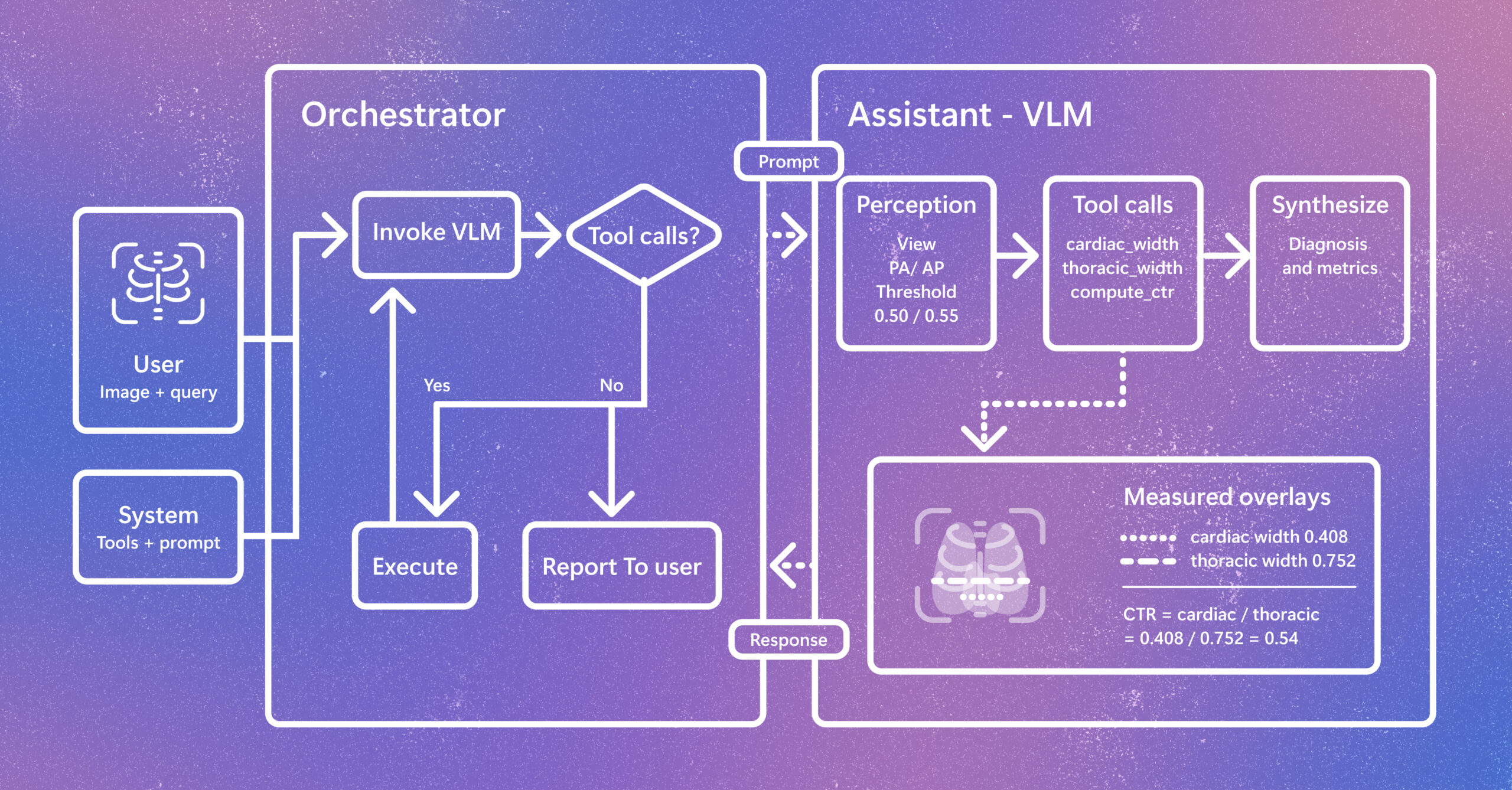
Radiology AI is evolving beyond report generation. CARE-X explores a unified approach that combines flexible reasoning, calibrated predictions, and measurement-based tools for chest X-ray interpretation. The post Introducing CARE-X: Towards Clinically Useful Radiology VLMs with Auxiliary Supervision, Reward-Aligned Learning, and Tool-Augmented Measurement appeared first on Microsoft Research.