The modality gap is intrinsic to multimodal alignment, where embeddings from different modalities remain partially separated in a shared representation space. In continual learning, CLIP-based vision-language models (VLMs) not only suffer catastrophic forgetting but also experience modality gap drift that disrupts the shared embedding geometry. Such drift degrades cross-modal alignment and generalization. We propose FPCD, an efficient framework combining Fast Null-space Projection (FNP) and Contrastive Distillation (CD). FNP accumulates compact Gram matrices of previous tasks' activations and projects gradients onto layer-adaptive approximate null spaces to reduce interference with learned representations. By replacing singular value decomposition with symmetric eigendecomposition, FNP accelerates projection-basis construction by a factor of 5-9. CD uses a small reference set to align the bidirectional image-to-text and text-to-image similarity distributions of the fine-tuned model with CLIP, thereby preserving pretrained cross-modal relations. On the 11-task MTIL benchmark, FPCD achieves 87.6% Last, 76.4% Average, and 65.2% Transfer. It also maintains more stable modality gaps and stronger zero-shot retrieval performance on COCO Captions and Flickr30k than competing methods. These results highlight the importance of controlling modality gap drift during continual adaptation of VLMs.

This publication proposes a definition and a classification of agile software development approaches and analyses ten software development methods that can be characterized as being "agile" against the defined criterion.
P. Abrahamsson, O. Salo, Jussi Ronkainen et al.· arXiv.org· 727 citations· ⚡54
The study shows that agile practices improve both informal and formal communication, but indicates that, in larger development situations involving multiple external stakeholders, a mismatch of adequate communication mechanisms can sometimes even hinder the communication.
M. Pikkarainen, Jukka Haikara, O. Salo et al.· Empirical Software Engineeri...· 401 citations· ⚡48
The results indicate that software engineering work practices are chosen opportunistically, adapted and configured to provide value under the constrains imposed by the startup context.
Nicolò Paternoster, Carmine Giardino, M. Unterkalmsteiner et al.· Information and Software Tec...· 394 citations· ⚡54
The possibility of inferring high-dimensional data inference in a model that consists of a prior and an auxiliary differentiable constraint given some additional information is considered, thereby allowing a range of potential applications in adapting models to new domains and tasks.
Alexandros Graikos, Esmeralda S. Whitammer, N. Jojic et al.· Neural Information Processin...· 316 citations· ⚡15
Exploring how generative AI could make machine vision more accessible to businesses. The post GenEye in a Box: Making Machine Vision Something You Can Just Ask For appeared first on GPT-Lab.
Microsoft Research Blog· microsoft.comAug 11, 2026
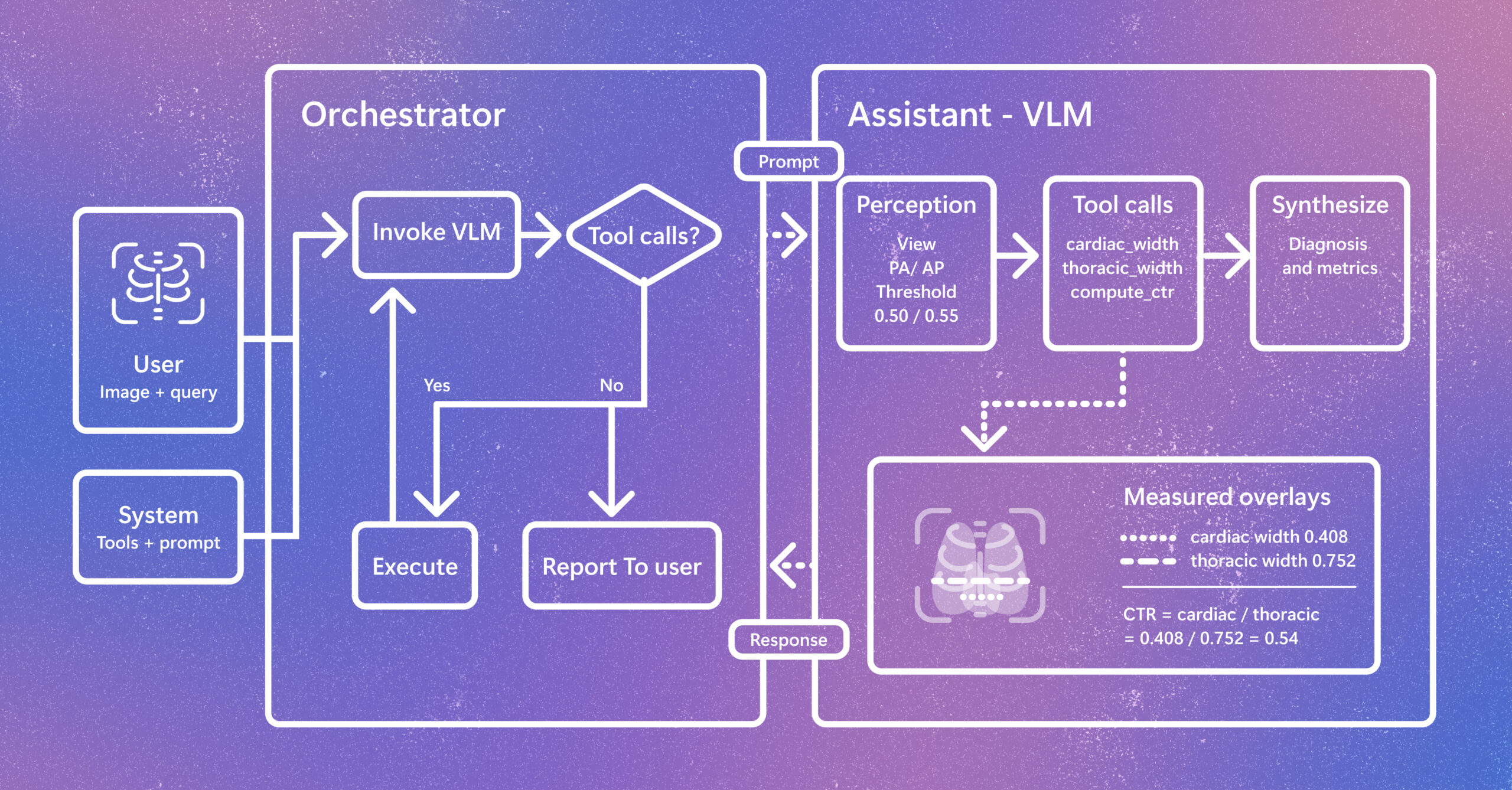
Radiology AI is evolving beyond report generation. CARE-X explores a unified approach that combines flexible reasoning, calibrated predictions, and measurement-based tools for chest X-ray interpretation. The post Introducing CARE-X: Towards Clinically Useful Radiology VLMs with Auxiliary Supervision, Reward-Aligned Learning, and Tool-Augmented Measurement appeared first on Microsoft Research.