Per-object ML-KEM against classical key exchange on an S3-compatible object store, with two client implementations, two processor types and up to 500 concurrent workers, using pre-registered experiments and statistical equivalence tests, shows that the size of the loss depends on the implementation.
Abstract
Data encrypted today with classical public-key algorithms could be decrypted once large quantum computers exist. Cloud object stores keep data for years, so the client-side encryption that protects it must move to post-quantum algorithms such as ML-KEM, which adds a key-encapsulation step and a larger ciphertext to every stored object. So far, the cost of ML-KEM has been measured for the algorithm on its own and for securing network connections, but not for encrypting each object in a storage system that serves many clients at once. It has therefore been unclear whether ML-KEM slows such a system, under which conditions, and why. We address this problem by measuring per-object ML-KEM against classical key exchange on an S3-compatible object store, with two client implementations, two processor types and up to 500 concurrent workers, using pre-registered experiments and statistical equivalence tests. ML-KEM reduced throughput only when the client's processor was at or near full load, with one unexplained exception, and then by 4.0 to 4.9% in our main client. Controlled experiments on one processor type traced most of that loss to the way the software library was called, and a second, native client showed that the size of the loss depends on the implementation. The lasting cost is storage: 1,056 more bytes per object than with classical key exchange. The results cover two clients, one single-node store and one cloud provider.

Quantum computing poses a serious long-term risk to modern cryptographic systems, including the widely used Signal messaging protocol. This research work addresses that risk by integrating ML-KEM-768, a NIST-standardized post-quantum algorithm specified in FIPS 203, as an additional security layer within Signal Desktop...
Athanasios Pavlides, H. Gjermundrød, Ioanna Dionysiou· Electronics· 0 citations
A classical-communication protocol and simulation technique that allows adapting purification-based security arguments for BB84-style states which are prepared through classical interaction to be made available in a hybrid experiment despite the classical transcript uniquely determining the prepared state in a real exe...
Classical public-key cryptography (RSA-2048, ECDH) is vulnerable to Shor's algorithm on quantum computers, with harvest-now-decrypt-later threats already targeting archived cloud traffic for future decryption. While NIST's 2024 ML-KEM (FIPS 203) and ML-DSA (FIPS 204) standards provide quantumresistant primitives, unifo...
Dvvit Patel, K. Patel, Aaryan Lunis et al.· International Conference on...· 0 citations
The migration from classically secure key agreement to post-quantum cryptography (PQC) is now a practical engineering problem rather than a distant theoretical one and anonymity networks face a particularly acute version of it. Traffic captured today on the Tor network can be archived and decrypted years later once a c...
Subhash Kumar, K. Kolhe· International Conference on...· 0 citations
An adaptive hybrid key exchange is proposed that combines the Module-Lattice-Based Key-Encapsulation Mechanism (ML-KEM, FIPS 203) with elliptic-curve Diffie–Hellman (ECDH) P-256 and selects the ML-KEM parameter set per handshake from a capability advertisement, subject to a policy-defined minimum security category.
Anurag Bhattacharjee, Anjan Bandyopadhyay, J. Singh et al.· IEEE Access· 0 citations
MuckleTEE is proposed, a hardware-software co-design that hardens hybrid key exchange against a fully compromised host by confining only its security-critical state to a Trusted Execution Environment (TEE), while delegating heavy cryptographic operations and networking to the untrusted domain.
Wassim Yahyaoui, Matteo Steinbach, J. Naccache et al.· Proceedings of the 2026 ACM...· 0 citations
Related blog posts
Microsoft Research Blog· microsoft.comNov 12, 2026
What's new in research at Microsoft? Host Anson Ho explores the latest, including AI-powered universal translation, a breakthrough in a 31-year-old mathematics challenge, and advances making AI coding agents faster and more efficient. The post Microsoft Research Focus – Edition #98 appeared first on Microsoft Research.
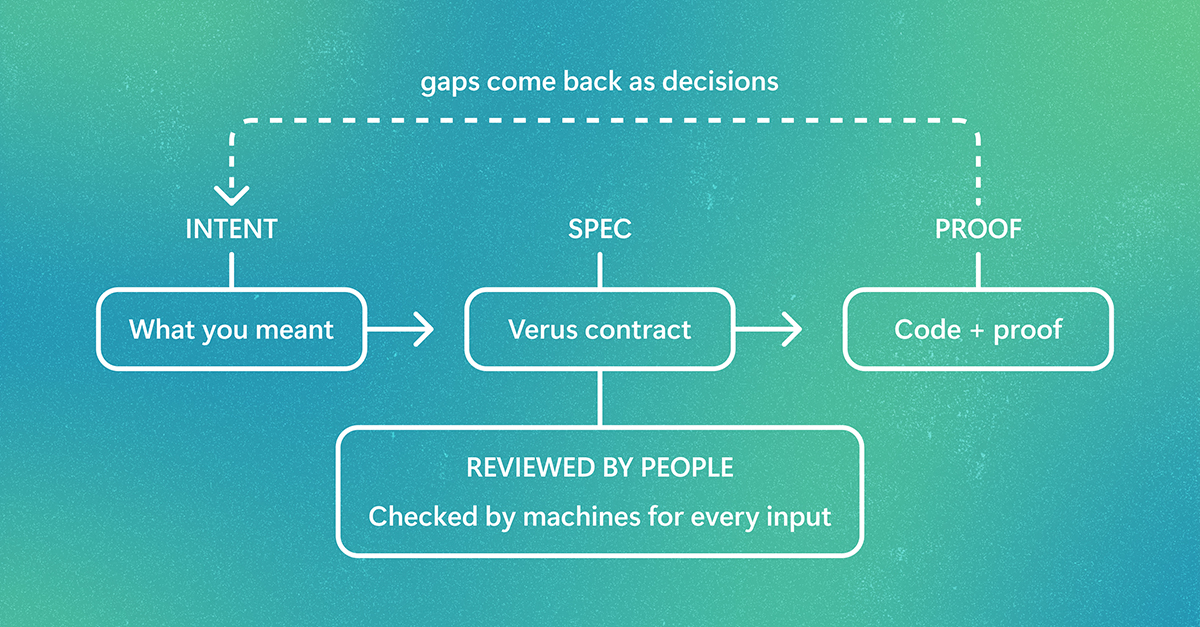
AI agents can generate code at a scale that’s hard for humans to review line-by-line. PDD Kit helps ensure the code is doing what the developer intended by creating formal specifications and testing against them. It converts developer intent into a Verus specification, proves AI-generated code meets it for every input, and uses tests where proofs aren't practical. Developers review intent, not every line. The post Formally verifying agent-written full-stack web apps with PDD Kit appeared first o…