These results make the relationship between expressivity and data structure explicit for IQP kernels: expressive power translates into a practical benefit only when the accessible frequencies match with the structure of the data, which provides a criterion for selecting the bandwidth when the periodic or multimodal structure of data is known.

Abstract
Quantum kernels are among the most promising methods in quantum machine learning, providing a natural way to embed data into high-dimensional Hilbert spaces via quantum circuits and capturing non-linear relationships in data. Their learning behaviour is governed by the function class they represent, which is formally characterized by the structure of the associated Reproducing Kernel Hilbert Space (RKHS). However, a theoretical characterization of this function class, and of how it depends on the choice of feature map and its hyperparameters, is still lacking. In this work, we focus on the Instantaneous Quantum Polynomial (IQP) feature map and derive a Fourier representation of the associated RKHS generators as finite sums of trigonometric functions evaluated on polynomially transformed input variables, with a finite set of accessible frequencies determined by the circuit construction and scaled by the bandwidth hyperparameter. This representation identifies three bandwidth regimes with qualitatively distinct expressive properties from localised, through multimodal, to periodic. Numerical experiments on synthetic datasets with controlled periodic and multimodal structure, across data dimensions and feature-map configurations, reproduce the three regimes in both supervised classification and unsupervised anomaly detection, benchmarked against a classical Gaussian kernel. These results make the relationship between expressivity and data structure explicit for IQP kernels: expressive power translates into a practical benefit only when the accessible frequencies match with the structure of the data, which provides a criterion for selecting the bandwidth when the periodic or multimodal structure of data is known.

This paper investigates developing real-world perception for active agents, proposes Gibson Environment for this purpose, and showcases a set of perceptual tasks learned therein.
F. Xia, Amir Zamir, Zhi-Yang He et al.· 2018 IEEE/CVF Conference on...· 1,069 citations· ⚡112
This publication proposes a definition and a classification of agile software development approaches and analyses ten software development methods that can be characterized as being "agile" against the defined criterion.
P. Abrahamsson, O. Salo, Jussi Ronkainen et al.· arXiv.org· 727 citations· ⚡54
The study shows that agile practices improve both informal and formal communication, but indicates that, in larger development situations involving multiple external stakeholders, a mismatch of adequate communication mechanisms can sometimes even hinder the communication.
M. Pikkarainen, Jukka Haikara, O. Salo et al.· Empirical Software Engineeri...· 401 citations· ⚡48
The results indicate that software engineering work practices are chosen opportunistically, adapted and configured to provide value under the constrains imposed by the startup context.
Nicolò Paternoster, Carmine Giardino, M. Unterkalmsteiner et al.· Information and Software Tec...· 394 citations· ⚡54
The possibility of inferring high-dimensional data inference in a model that consists of a prior and an auxiliary differentiable constraint given some additional information is considered, thereby allowing a range of potential applications in adapting models to new domains and tasks.
Alexandros Graikos, Esmeralda S. Whitammer, N. Jojic et al.· Neural Information Processin...· 316 citations· ⚡15
Related blog posts
MIT News · Artificial Intelligence· news.mit.eduOct 28, 2026
Professor Paris Smaragdis develops computers with superhuman hearing for applications like speech recognition, music understanding, and environmental monitoring.
MIT News · Artificial Intelligence· news.mit.eduOct 2, 2026
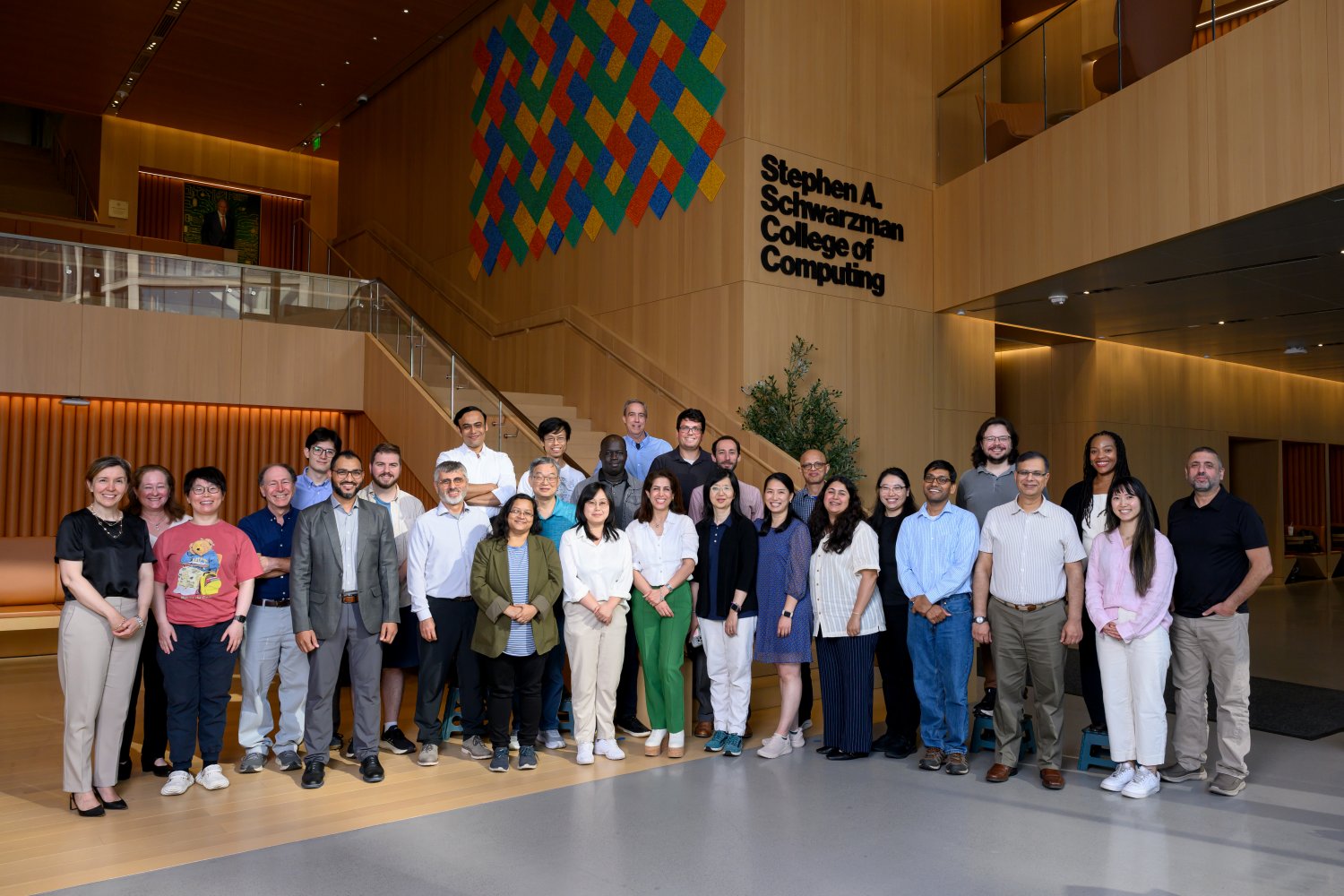
A weeklong summer workshop brought higher education faculty to campus to explore how AI and machine learning materials can be adapted for their classrooms.
MIT News · Artificial Intelligence· news.mit.eduAug 27, 2026
A new machine-learning framework aims to improve the success rate of computational protein design while moving away from results that reproduce sequences found in nature.
We use cookies to run the site and, with your consent, for analytics and to show ads.
See our Cookie Policy.