Oct 2026· Italian National Conference on Sensors· 0 citations
Machine Fault Diagnosis Techniques
Abstract
Fault diagnosis of rotating machinery frequently encounters the compounded challenges of non-stationary operating conditions and small-sample data constraints. Traditional deep learning models often exhibit suboptimal performance when addressing these issues. Deep Generative Models (DGMs) offer innovative solutions by synthesizing high-fidelity data samples, reconstructing latent system states, and modeling complex multimodal data streams. This paper presents a review of rotating machinery fault diagnosis technologies based on DGMs. The state-of-the-art applications of DGMs and their variants, including Deep Autoregressive Models (DARs), Variational Autoencoders (VAEs), Generative Adversarial Networks (GANs), Diffusion Models, and Large Language Models (LLMs), are systematically summarized. Specific applications discussed include data generation, domain adaptation and generalization, multimodal data fusion, as well as downstream fault diagnosis and anomaly detection. Furthermore, this review contrasts DGMs with traditional signal processing methods and standard deep learning models. Current limitations are also critically analyzed, focusing on parameter-efficient fine-tuning strategies, interpretability (reliability), and computational efficiency for edge deployment. Finally, future research directions are proposed, emphasizing few-shot or zero-shot learning, robust multimodal data generation, physics-informed hybrid DGM architectures, and the integration of reinforcement learning with DGMs to further enhance diagnostic accuracy in practical scenarios.
The results indicate that software engineering work practices are chosen opportunistically, adapted and configured to provide value under the constrains imposed by the startup context.
Nicolò Paternoster, Carmine Giardino, M. Unterkalmsteiner et al.· Information and Software Tec...· 394 citations· ⚡54
The results are packaged in the Greenfield Startup Model (GSM), which explains the priority of startups to release the product as quickly as possible, and the need to shorten time-to-market, by speeding up the development through low-precision engineering activities.
Carmine Giardino, Nicolò Paternoster, M. Unterkalmsteiner et al.· IEEE Transactions on Softwar...· 178 citations· ⚡14
This state-of-practice investigation was performed using a literature review followed by a multiple-case study approach and presents how inconsistency between managerial strategies and execution can lead to failure by means of a behavioral framework.
Carmine Giardino, Xiaofeng Wang, P. Abrahamsson· International Conference on...· 175 citations· ⚡19
Software startup companies develop innovative, software-intensive products within limited timeframes and with few resources, searching for sustainable and scalable business models.
M. Unterkalmsteiner, P. Abrahamsson, Xiaofeng Wang et al.· e-Informatica Software Engin...· 157 citations· ⚡17
This study conducts a case survey study based on the secondary data of the major pivots happened in 49 software startups, and demonstrates that customer need pivot is the most common among all pivot types.
Sohaib Shahid Bajwa, Xiaofeng Wang, Anh Nguyen-Duc et al.· Empirical Software Engineeri...· 127 citations· ⚡15
The comparison of adopter and non-adopter sample reveals three potential adoption inhibitor, security, data privacy, and portability, which underlines the importance of the technical and security perspectives for research investigating the adoption of technology.
Nattakarn Phaphoom, Xiaofeng Wang, S. Samuel et al.· Journal of Systems and Softw...· 111 citations· ⚡8
Related blog posts
Microsoft Research Blog· microsoft.comNov 16, 2026
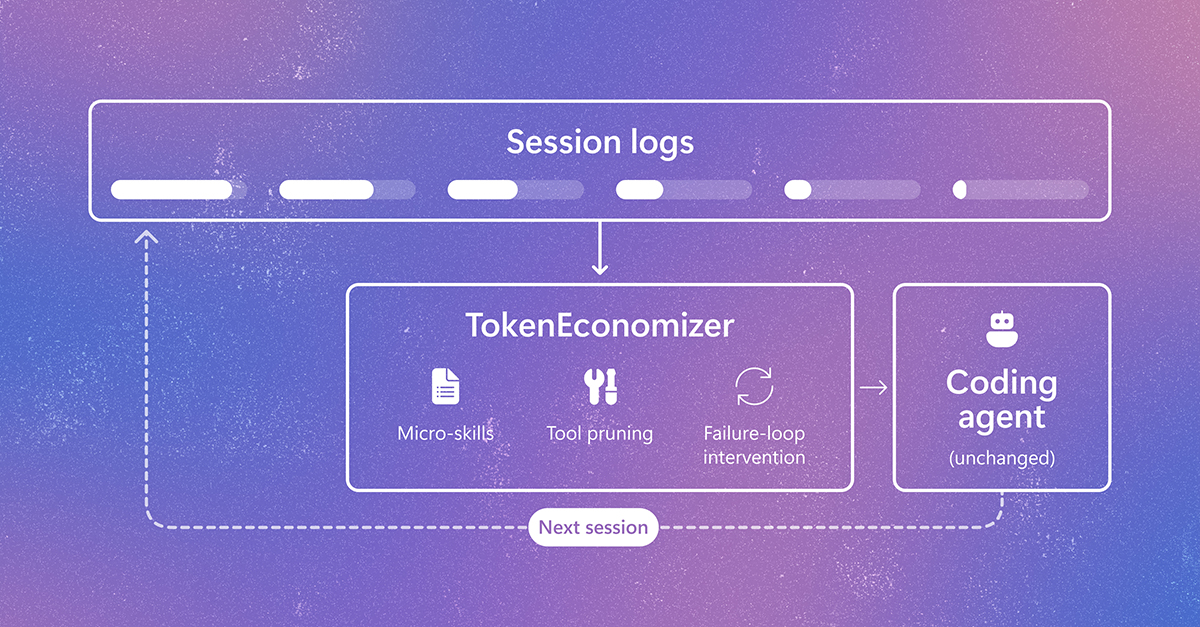
AI coding agents are increasingly help developers fix bugs and build features largely on their own, but every interaction with their models consumes tokens. In each session, an agent sends instructions, tool descriptions, and session history to its model. Most efforts to reduce this cost focus on individual tasks. Yet developers return to the same […] The post TokenEconomizer: Learning from Experience to Make AI Coding Agents More Efficient appeared first on Microsoft Research.
MIT News · Artificial Intelligence· news.mit.eduNov 9, 2026
Assistant Professor Benjamin Lindquist studies how engineers deliberately injected randomness into early AI, giving rise to deep-learning models that sometimes hallucinate.


