Skip to content

Where Did the Update Go? Certifying Declared Change Envelopes for Model Updates

Nov 2026 · 0 citations · 79 references
Computer Science

Abstract

Deployed language models are updated continually, and regulators increasingly accept changes that were declared in advance. Showing that an update changed behavior only where it was declared to is a different statistical problem from bounding how much it changed: a useful update is meant to change some decisions, so global disagreement and regression bounds cannot certify it. We formalize the problem with declared change envelopes. Before training, the developer commits to a region of inputs, and every decision that changes outside it counts as leakage. Leakage compares two models, so it can be certified from unlabeled traffic with anytime-valid tests whose sample cost we bound from above and below, and per-update certificates compose into a bound on lifetime drift outside all declared scopes. We measure leakage for LoRA and full fine-tuning, preference optimization, reinforcement learning, and knowledge editing on models from 1.5B to 72B parameters. Narrow updates leak widely: domain and policy LoRA updates keep only about 7-36% of the decisions they change inside the declared scope. Across 256 trained variants, leakage tracks the update's KL divergence to the incumbent on out-of-scope inputs (Spearman 0.94). None of the customary remedies we tested makes a rule-like update certifiable without giving up much of its intended change. Distilling the incumbent's decisions on unlabeled prompts in the deployment format does: anchored LoRA, GRPO, and (at a small learning rate) full fine-tuning updates certify 5% leakage from a few hundred to a few thousand unlabeled samples, and the certificates replicate on held-out traffic and on written answers. The certificates cover decision-like outputs only; on open-ended chat, re-batching alone changes 11-21% of responses and no update certifies. Code: https://github.com/Usama1002/declared-change-envelopes
View source

Similar papers

#artificial intelligence Conference Open access Jun 2018

Gibson Env: Real-World Perception for Embodied Agents

This paper investigates developing real-world perception for active agents, proposes Gibson Environment for this purpose, and showcases a set of perceptual tasks learned therein.

F. Xia, Amir Zamir, Zhi-Yang He et al. · 1,069 citations · ⚡112
#small language model Dataset Open access Oct 2026

Socratic guiding questions in synthetic arithmetic data: matched LoRA runs (revision v2)

Supporting data, adapters, predictions and code for the article *Low-Cost LoRA Fine-Tuning of Small Language Models for Multi-Step Arithmetic Reasoning* by Jake O'Grady, Asena Isik Gürhan, Chee Fong Ting and Effirul Ramlan (University of Galway). We generated 20,000 GSM8K-derived arithmetic problems with step-by-step s...

O'Grady, Jake, Gürhan, Asena Isik, Chee, Fong Ting et al. · 465 citations
#machine learning Review Open access Oct 2014

Software development in startup companies: A systematic mapping study

The results indicate that software engineering work practices are chosen opportunistically, adapted and configured to provide value under the constrains imposed by the startup context.

Nicolò Paternoster, Carmine Giardino, M. Unterkalmsteiner et al. · 394 citations · ⚡54

Diffusion models as plug-and-play priors

The possibility of inferring high-dimensional data inference in a model that consists of a prior and an auxiliary differentiable constraint given some additional information is considered, thereby allowing a range of potential applications in adapting models to new domains and tasks.

Alexandros Graikos, Esmeralda S. Whitammer, N. Jojic et al. · 316 citations · ⚡15

Trajectory Balance: Improved Credit Assignment in GFlowNets

It is proved that any global minimizer of the trajectory balance objective can define a policy that samples exactly from the target distribution, and empirically demonstrate the benefits of the trajectories balance objective for GFlowNet convergence, diversity of generated samples, and robustness to long action sequenc...

Esmeralda S. Whitammer, Moksh Jain, Emmanuel Bengio et al. · 302 citations · ⚡60

Related blog posts

MIT News · Artificial Intelligence Oct 23, 2026

Q&A: How AI came to model the “messy” human mind

Assistant Professor Benjamin Lindquist studies how engineers deliberately injected randomness into early AI, giving rise to deep-learning models that sometimes hallucinate.

Microsoft Research Blog Oct 12, 2026

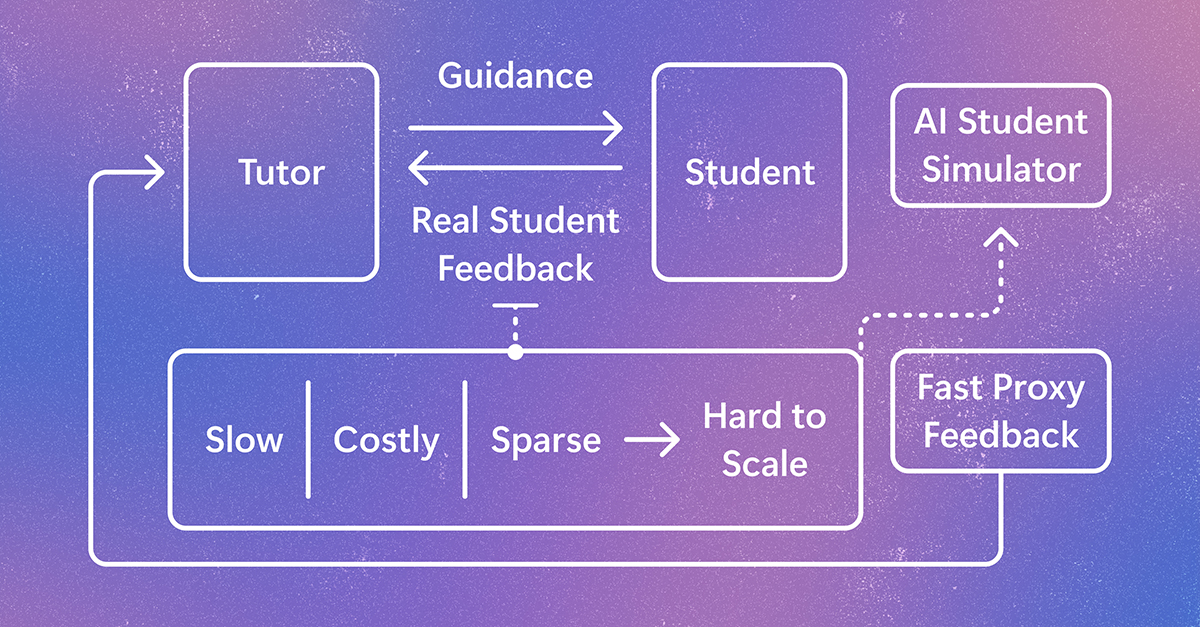
Simulating student learning for better AI tutoring

StudentSim is a research system for evaluating and improving AI tutoring tools before they are tested with learners. It models how individuals may engage with tutors, giving feedback to improve tutor performance across subjects like chess, writing, and mathematics. The post Simulating student learning for better AI tutoring appeared first on Microsoft Research.

We use cookies to run the site and, with your consent, for analytics and to show ads. See our Cookie Policy.