Federated Transfer Learning for Medical Image Classification under Mixed Skew
Alexandre G. LeclercqS\'ebastien BougleuxAur\'elien Corroyer-DulmontRomain H\'erault
Nov 2026
Machine LearningComputer Vision
Abstract
Deep learning in medical imaging is constrained by data scarcity and by privacy regulations that make centralizing patient data across institutions impractical. Federated Learning (FL) addresses these constraints by keeping data local, but its distributed nature exposes training to strong statistical heterogeneity. Multicentric medical data is particularly affected, exhibiting a mixed skew that combines feature, label, concept, and quantity shifts across centers. Personalized FL mitigates heterogeneity by tailoring a model to each client, yet most methods assume training from scratch, which is unrealistic given the high dimensionality of medical features relative to the limited data available. We propose the Personalized Aligner Federated Pretrained (PAFP) framework, a personalized FL approach built on a pre-trained backbone. PAFP inserts client-specific Feature Alignment modules before the fine-tuned blocks to realign hidden feature distributions toward a server-aggregated target. On the FedISIC benchmark, PAFP attains the highest unweighted balanced accuracy while reducing inter-client performance variance roughly six-fold relative to the strongest baseline, yielding accuracy and cross-client equity jointly. Our code is publicly available at https://github.com/Alexandre-Leclercq/PAFP.

This paper investigates developing real-world perception for active agents, proposes Gibson Environment for this purpose, and showcases a set of perceptual tasks learned therein.
F. Xia, Amir Zamir, Zhi-Yang He et al.· 2018 IEEE/CVF Conference on...· 1,069 citations· ⚡112
This publication proposes a definition and a classification of agile software development approaches and analyses ten software development methods that can be characterized as being "agile" against the defined criterion.
P. Abrahamsson, O. Salo, Jussi Ronkainen et al.· arXiv.org· 727 citations· ⚡54
The study shows that agile practices improve both informal and formal communication, but indicates that, in larger development situations involving multiple external stakeholders, a mismatch of adequate communication mechanisms can sometimes even hinder the communication.
M. Pikkarainen, Jukka Haikara, O. Salo et al.· Empirical Software Engineeri...· 401 citations· ⚡48
The results indicate that software engineering work practices are chosen opportunistically, adapted and configured to provide value under the constrains imposed by the startup context.
Nicolò Paternoster, Carmine Giardino, M. Unterkalmsteiner et al.· Information and Software Tec...· 394 citations· ⚡54
The possibility of inferring high-dimensional data inference in a model that consists of a prior and an auxiliary differentiable constraint given some additional information is considered, thereby allowing a range of potential applications in adapting models to new domains and tasks.
Alexandros Graikos, Esmeralda S. Whitammer, N. Jojic et al.· Neural Information Processin...· 316 citations· ⚡15
Related blog posts
MIT News · Artificial Intelligence· news.mit.eduOct 28, 2026
Professor Paris Smaragdis develops computers with superhuman hearing for applications like speech recognition, music understanding, and environmental monitoring.
Exploring how generative AI could make machine vision more accessible to businesses. The post GenEye in a Box: Making Machine Vision Something You Can Just Ask For appeared first on GPT-Lab.
Microsoft Research Blog· microsoft.comAug 11, 2026
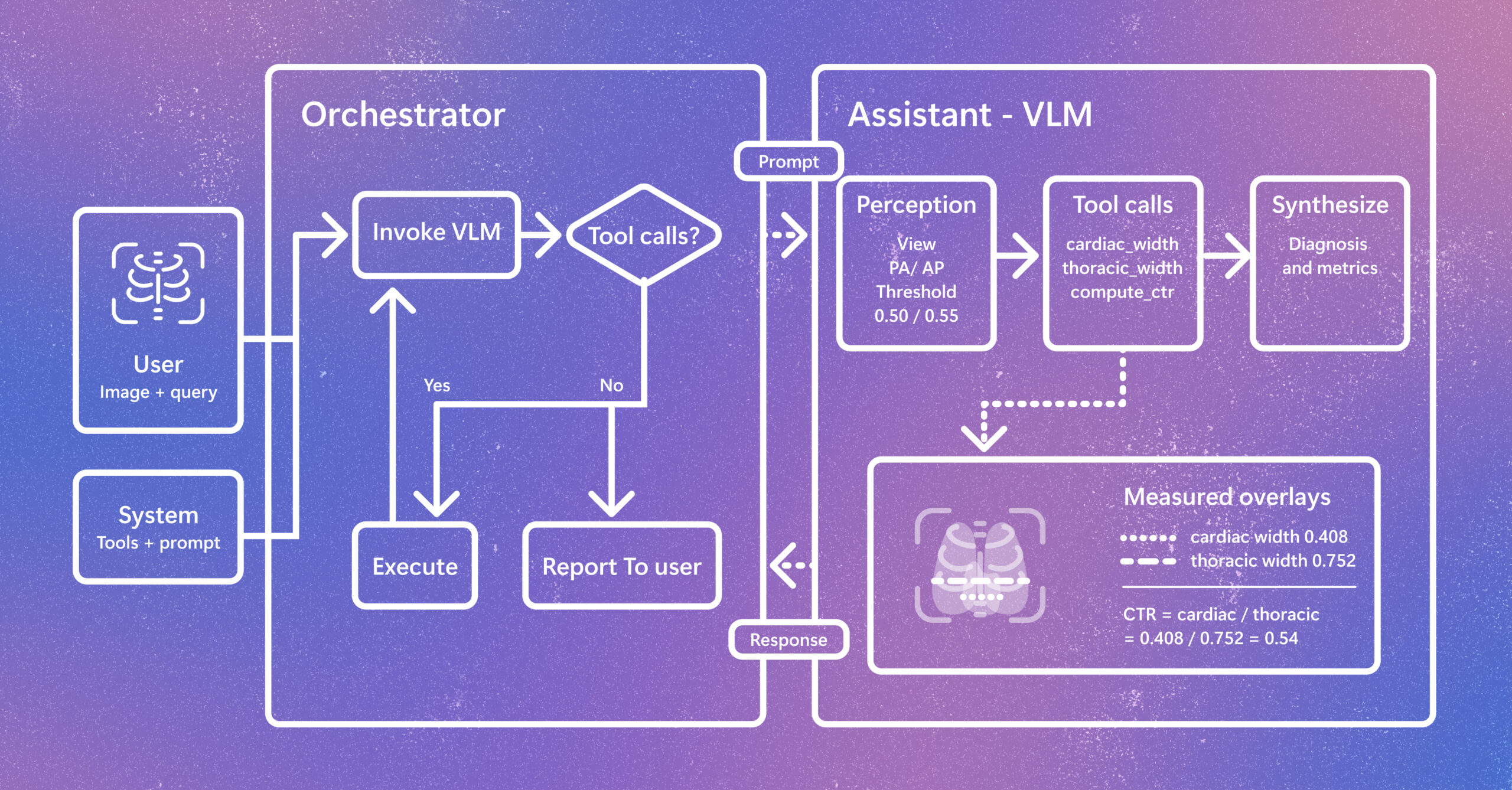
Radiology AI is evolving beyond report generation. CARE-X explores a unified approach that combines flexible reasoning, calibrated predictions, and measurement-based tools for chest X-ray interpretation. The post Introducing CARE-X: Towards Clinically Useful Radiology VLMs with Auxiliary Supervision, Reward-Aligned Learning, and Tool-Augmented Measurement appeared first on Microsoft Research.