This paper proposes CastReasoner, an evidence-grounded reasoning model for context-aware time series forecasting that uses a structured chain of thought (CoT) to extract predictive evidence from contextual features, infer the future dynamics suggested by this evidence, and assess these dynamics against the forecast prior to guide adaptive forecasting decisions.
Abstract
LLM-driven time series forecasting has become increasingly promising by leveraging contextual features to generate future values directly or refine forecast priors. However, incorporating contextual features alone does not ensure that models can identify which features matter for forecasting and understand what they suggest about future dynamics. We argue that the fundamental challenge is how to extract predictive evidence from contextual features and when and how to leverage it to guide forecasting decisions. In this paper, we propose CastReasoner, an evidence-grounded reasoning model for context-aware time series forecasting. Specifically, CastReasoner uses a structured chain of thought (CoT) to extract predictive evidence from contextual features, infer the future dynamics suggested by this evidence, and assess these dynamics against the forecast prior to guide adaptive forecasting decisions. To enable this capability, we design a reasoning-centric two-stage post-training framework including supervised fine-tuning (SFT) and reinforcement learning (RL). First, we synthesize reasoning trajectories through controllable multi-teacher guidance and select high-quality ones using a novel student-aware difficulty metric. Second, we design fine-grained multi-objective rewards to further improve reasoning and forecasting. To address heterogeneous learning needs across domains in both stages, we introduce a convergence-guided data balancing strategy. Through this two-stage training, CastReasoner improves both reasoning quality and predictive accuracy. Extensive experiments across multi-domain forecasting benchmarks demonstrate that CastReasoner achieves superior forecasting performance.

Agentic time series forecasting extends conventional approaches beyond one-shot numerical prediction toward autonomous, context-aware interaction. However, existing benchmarks offer limited integrated support for diverse contextual information, forecasting-specific adaptive interactions, and systematic evaluation of fo...
Bo-Kai Pan, Rui-Jie Yang, Ming-Yue Cheng et al.· 0 citations
Time series forecasting supports decision-making in web applications such as online retail and network management, where planned actions can reshape future dynamics. World models provide a natural paradigm for predicting such action-dependent changes beyond extrapolating historical patterns. However, existing time seri...
Contextual forecasting seeks to improve time series forecasting by incorporating forward-looking information, such as planned events, external conditions, and expert expectations. However, reliable evaluation remains difficult: existing benchmarks often have limited domain coverage, lack standardized history-future spl...
Xu Liu, Han-Shu Yan, Taha İbrahim Aksu et al.· 0 citations
LLM-based agents are increasingly used for time-series forecasting because they can organise contextual information, perform multi-step analysis, and guide the sequence of actions required to complete forecasting tasks. Most existing agents focus only on the current forecasting instance. However, in real-world deployme...
This work proposes WorldTS, a world-modeling based forecasting framework that integrates multimodal covariates directly into the forecasting to further improve forecasting performance and employs a two-stage training strategy.
Forecasting an unresolved event requires finding relevant evidence and deciding how strongly it supports each outcome. Yet outcome-based training of Large Language Model (LLM) forecasters often begins with preassembled evidence at a single prediction date, leaving evidence acquisition outside the learning loop. We intr...
Li-Qin Ye, Rong-Zhi Zhang, Xin Liu et al.· 1 citation
Related blog posts
MIT News · Artificial Intelligence· news.mit.eduNov 17, 2026
By studying the computational foundations of language learning, Associate Professor Jacob Andreas builds intelligent systems that can communicate effectively with humans.
Microsoft Research Blog· microsoft.comNov 16, 2026
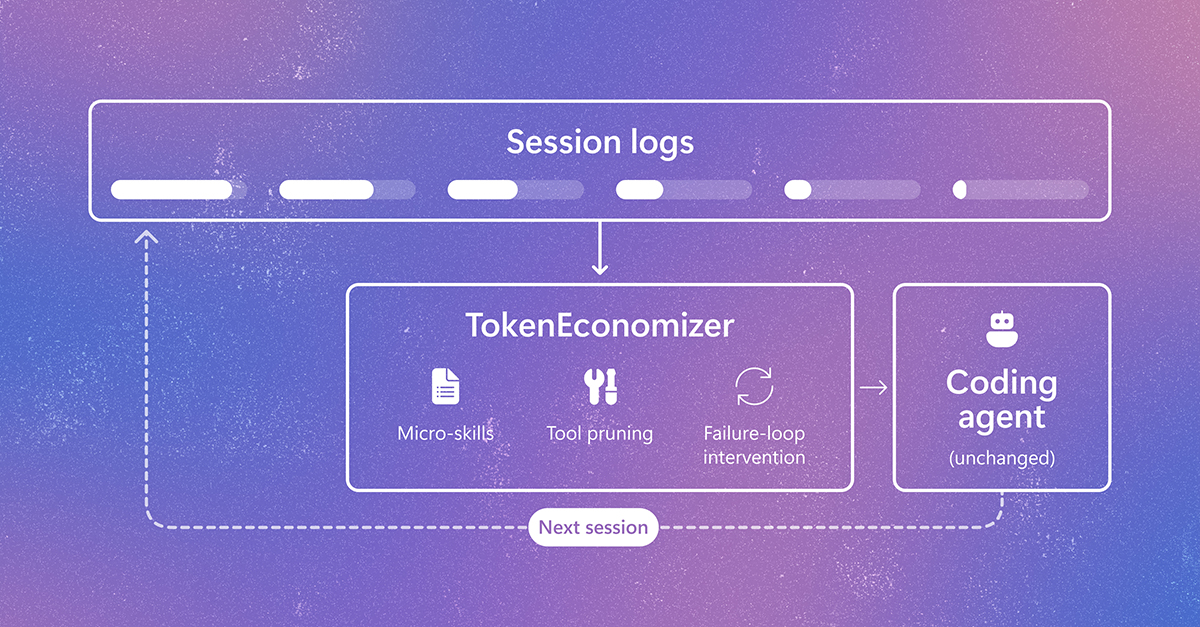
AI coding agents are increasingly help developers fix bugs and build features largely on their own, but every interaction with their models consumes tokens. In each session, an agent sends instructions, tool descriptions, and session history to its model. Most efforts to reduce this cost focus on individual tasks. Yet developers return to the same […] The post TokenEconomizer: Learning from Experience to Make AI Coding Agents More Efficient appeared first on Microsoft Research.
MIT News · Artificial Intelligence· news.mit.eduNov 13, 2026